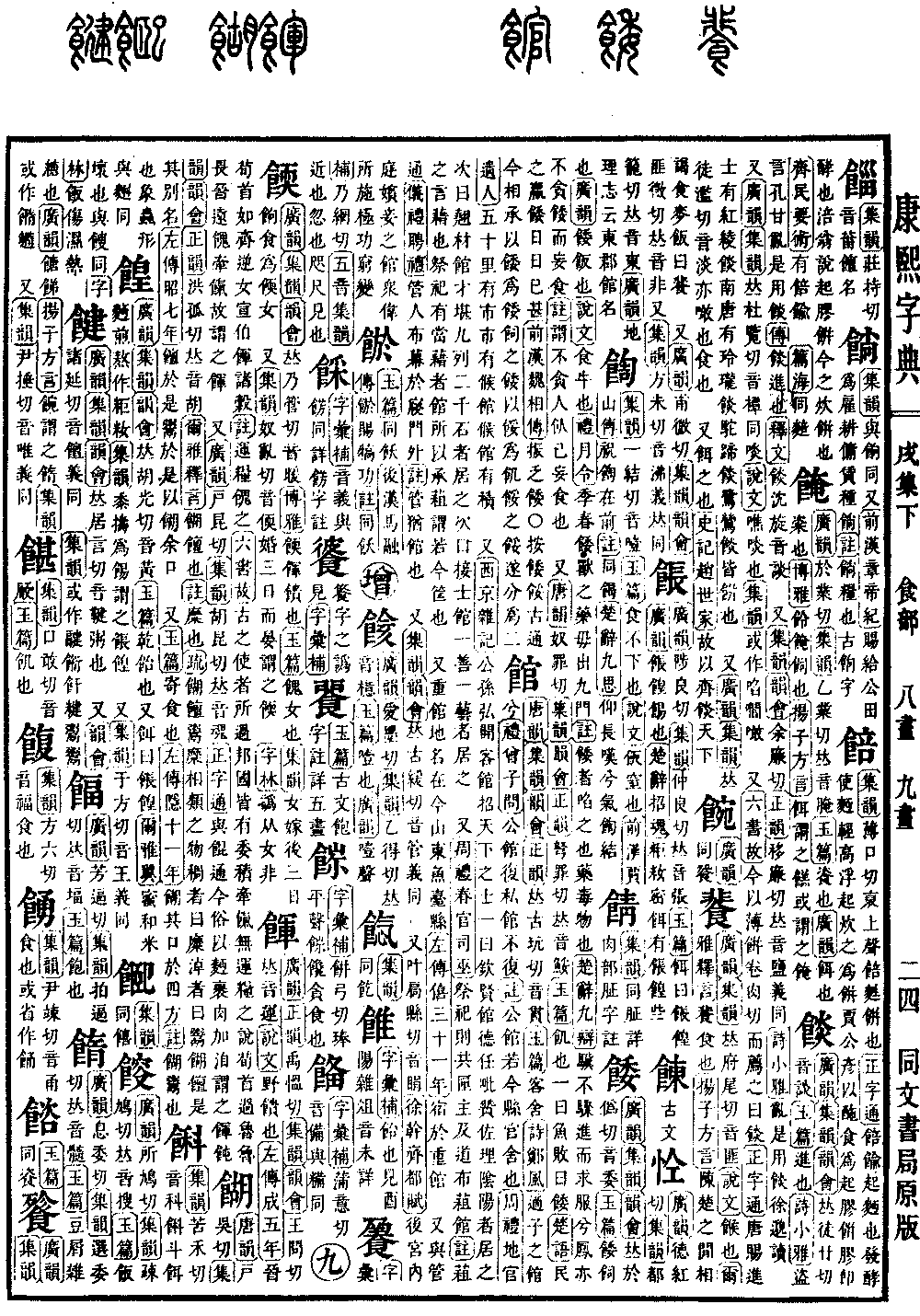
Xu Collection, Lower Volume
Radical: Food (shí)
Kangxi Strokes: 17
Page 1422, Entry 05
Broad Rhymes (Guangyun), Collected Rhymes (Jiyun), and Collection of Rhymes (Yunhui) state the pronunciation is tan.
Jade Chapters (Yupian): To advance or offer.
Book of Odes (Shijing), Lesser Odes: Thief-like words are very sweet, and through them, disorder is advanced (dan). Commentary: Dan means to advance. Explanatory Text (Shiwen): Shen Xuan reads this as tan.
Collected Rhymes (Jiyun) and Collection of Rhymes (Yunhui) also list the pronunciation as yan, and Corrected Rhymes (Zhengyun) also lists the pronunciation as yan. The meaning is the same. In the Book of Odes (Shijing), Lesser Odes, regarding the phrase about disorder being advanced, Xu Miao uses this pronunciation.
Broad Rhymes (Guangyun) and Collected Rhymes (Jiyun) state the pronunciation is dan. It is the same as the character for eat or devour (dan). Explaining Characters (Shuowen): To chew and devour. Collected Rhymes (Jiyun) notes it is also written in variant forms (dan), (tan), and (dan).
Six Scripts Principles (Liushu gu): Modern usage refers to thin pancakes rolled with meat, sliced and served, as dan.
Correction of Characters (Zhengzitong): During the Tang dynasty, those who passed the imperial examinations were gifted with red silk dan; in the Southern Tang, there were delicacies such as exquisite dan, camel hoof dan, and egret dan, all of which are types of cakes.
Broad Rhymes (Guangyun) and Collected Rhymes (Jiyun) state the pronunciation is dan. It also means to devour or to eat. It further refers to the act of baiting or luring.
Records of the Grand Historian (Shiji), House of Zhao: Therefore, they used Qi to lure (dan) the world.