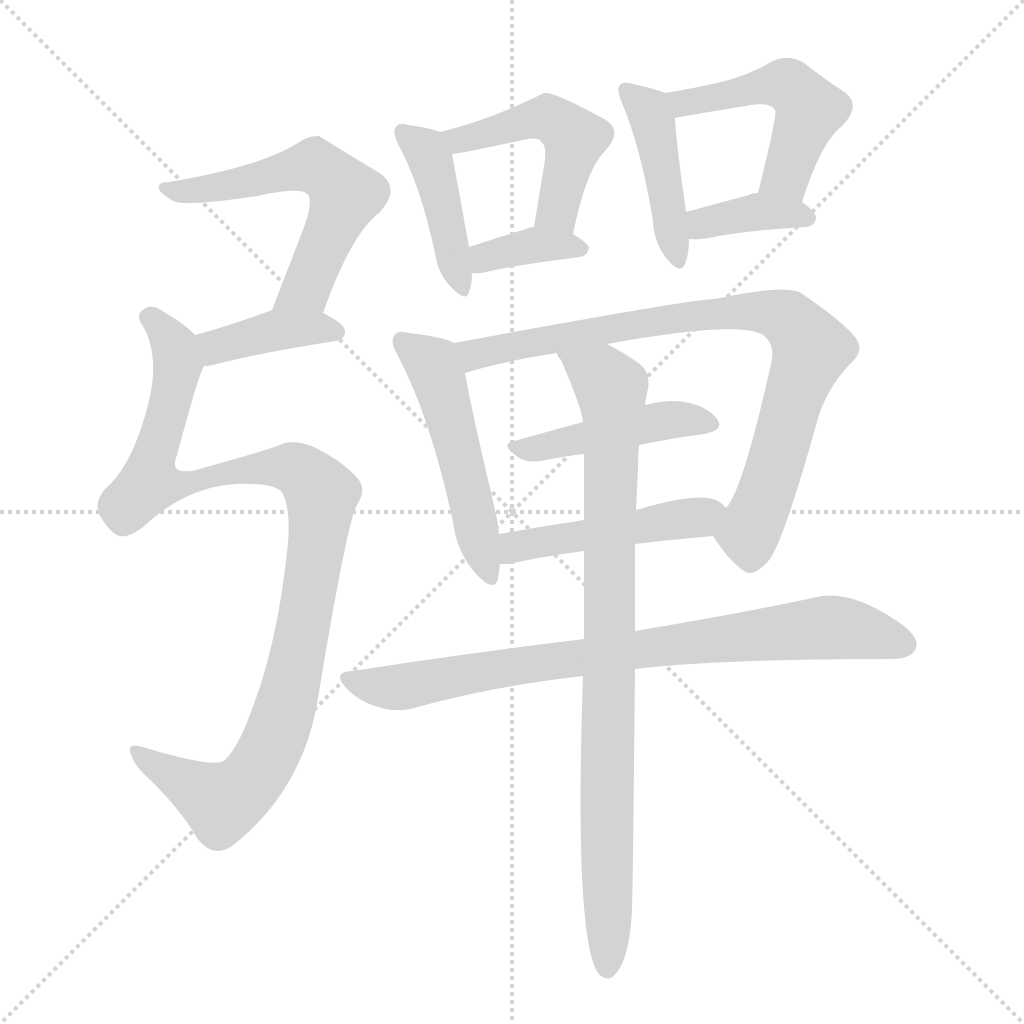
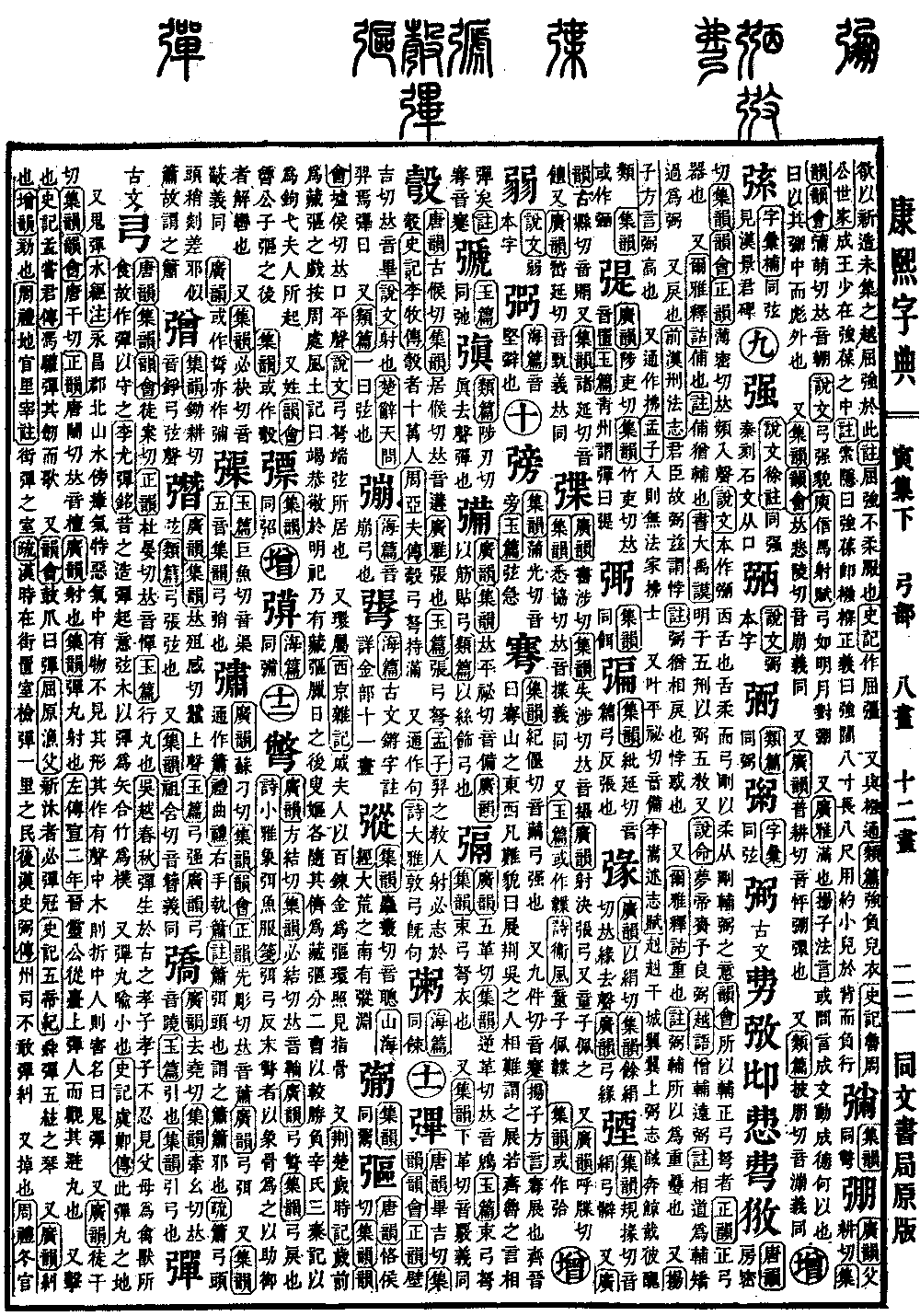
Yin Collection, Lower Volume
Radical: Bow (gōng)
Kangxi Strokes: 15
Page 360, Entry 45
Ancient script. Pronounced dan (falling tone).
In the Jade Chapters (Yupian), it is defined as launching a pellet.
In the Annals of Wu and Yue (Wuyue Chunqiu), the pellet bow originated with the filial sons of antiquity. Unable to bear seeing their parents eaten by wild beasts, they made pellet bows to guard them.
In the Inscription on the Pellet Bow by Li You, it is written that the pellet bow was created by bending wood, using the pellet as an arrow and bamboo as the stock.
Also, pellet, used metaphorically to mean something small. In the Records of the Grand Historian (Shiji), Biography of Yu Qing, it mentions a territory the size of a pellet.
Also, ghost pellet. In the Commentary on the Water Classic (Shuijing Zhu), it is noted that near the mountain waters north of Yongchang Commandery, there is a malignant miasma containing a presence that cannot be seen but emits sound. If it hits a tree, the tree breaks; if it hits a person, it causes harm; this is called the ghost pellet.
Also, pronounced tan (rising tone).
In the Broad Rhymes (Guangyun), it means to shoot. In the Collected Rhymes (Jiyun), it refers to shooting with a pellet.
In the Zuo Commentary (Zuo Zhuan), second year of Duke Xuan, it records Duke Ling of Jin shooting pellets at people from a tower to watch them dodge.
Also, to strike. In the Records of the Grand Historian (Shiji), Biography of Lord Mengchang, it says Feng Huan struck his sword and sang.
Also, in the Rhyme Collection (Yunhui), plucking with the fingernails is called tan.
In the Fisherman (Yufu) by Qu Yuan, it mentions that one who has just washed their hair must pluck their cap.
In the Records of the Grand Historian (Shiji), Annals of the Five Emperors, it says Shun played the five-stringed zither.
Also, in the Broad Rhymes (Guangyun), it means to investigate or impeach.
In the Rites of Zhou (Zhouli), Earth Offices, commentary on the Neighborhood Overseer, it mentions the office of neighborhood surveillance. The sub-commentary explains that during the Han dynasty, offices were placed in the streets to inspect and impeach the people of the neighborhood.
In the History of the Later Han (Houhan Shu), Biography of Shi Bi, it mentions that the provincial officials dared not impeach or correct him.
Also, to sway. In the Rites of Zhou (Zhouli), Winter Offices, Artificer's Record, it says hooked weapons should not sway. The commentary notes that hooked weapons refer to daggers and halberds, and swaying describes the motion.
Also, pellet chess. In the Miscellaneous Records of the Western Capital (Xijing Zaji), it is written that Emperor Cheng loved football, but his ministers thought it too strenuous. The Emperor asked for something similar but less demanding. My father created pellet chess and presented it to him.
Also, rhyming with tian (rising tone).
In the Rhyme-Prose on Literature (Wenfu) by Lu Ji, it says those possessing light must knock, and those harboring sound must pluck. Some shake the leaves by following the branches, others trace the waves to seek the source.
Also, a variant form of the character represented as radical 62 with a phonetic component.