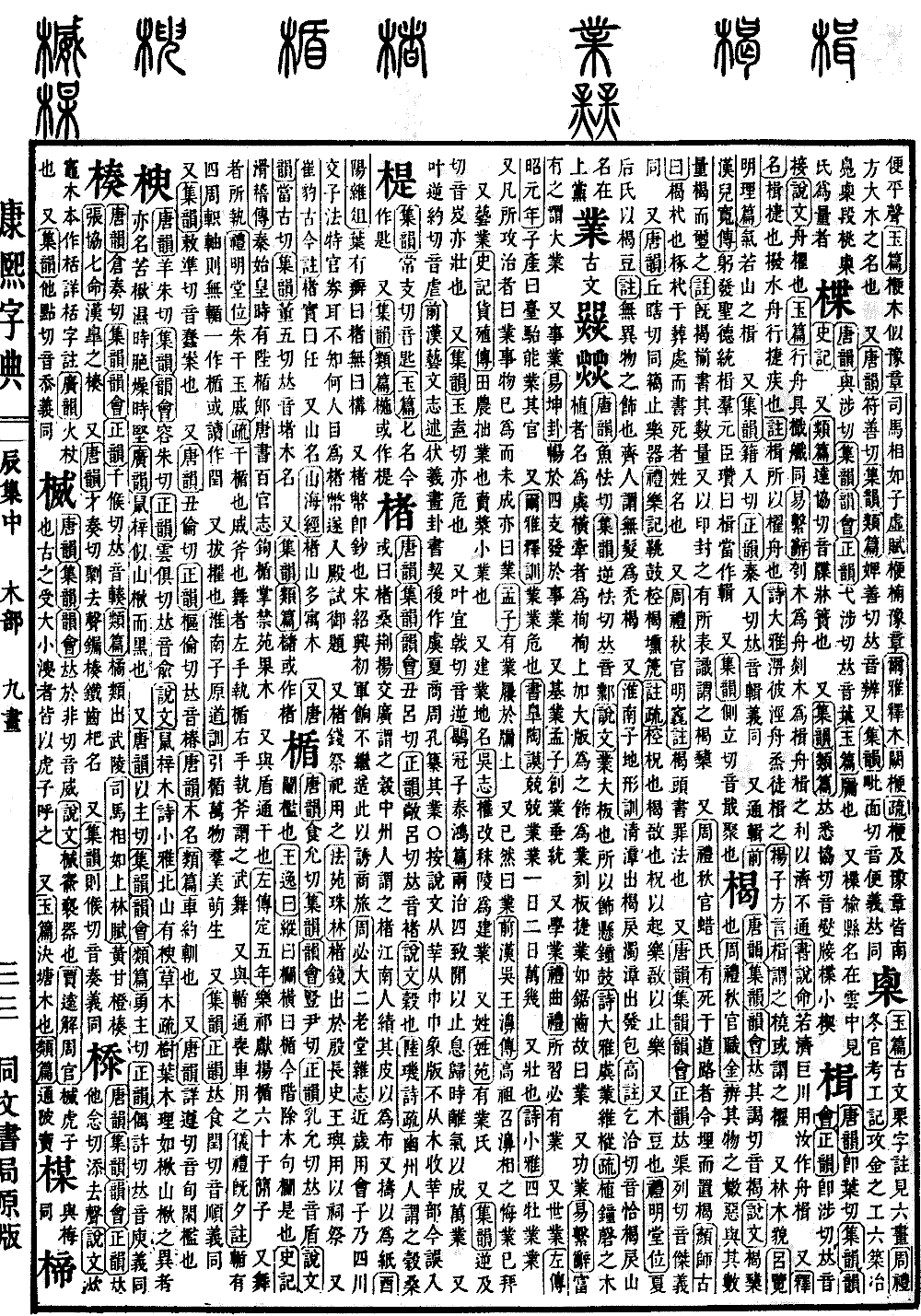
Chen Collection, Middle Volume
Radical: Tree (mù)
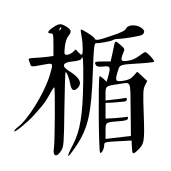
楯
Kangxi strokes: 13
Page 541, Entry 10
Pronounced shun (rising tone).
In the Shuo Wen Jie Zi (Explaining Graphs and Analyzing Characters), it refers to a balustrade or railing.
Wang Yi stated that vertical elements are called lan, while horizontal elements are called shun; this refers to the wooden railings found on stairs.
In the Records of the Grand Historian (Shiji), Biography of the Jesters, it mentions that during the time of the First Emperor of Qin, there were guards known as the Palace Balustrade Attendants.
In the Book of Tang (Tangshu), Treatise on Officialdom, it mentions the Gou Shun office, which managed the fruits and trees of the imperial gardens.
Also interchangeable with the character for shield, meaning a defensive implement.
In the Zuo Commentary (Zuozhuan), Sixth Year of Duke Ding, it records that Yue Qi presented sixty raised shields to the viscount.
Also refers to an implement held by dancers.
In the Book of Rites (Liji), Bright Hall Positions, it mentions vermilion shields and jade battle-axes. The commentary explains that a shield is a shun, and a battle-axe is a qi; dancers hold the shield in the left hand and the axe in the right, which is known as a martial dance.
Also interchangeable with the character for a funeral carriage (chun), used for such vehicles.
In the Book of Etiquette and Ceremonial (Yili), Notes on the Completion of Rites, it discusses the axles of a funeral carriage; sometimes written as shun. Sometimes read as run (falling-rising tone).
Also means to pull or promote.
In the Huainanzi, Treatise on the Origin of the Dao, it says to pull up all things, allowing various beauties to sprout and grow.
Pronounced shun (falling-rising tone). The meaning is the same.
Pronounced chun (rising tone). Refers to a wooden table or support.
Pronounced chun.
A type of tree.
According to the Lei Pian (Categorized Compendium), it refers to a binding on a carriage.
Pronounced xun.
Refers to a railing or balustrade.
Textual research: In the Zuo Commentary, Fifth Year of Duke Ding, it should be corrected to the Sixth Year based on the original text.