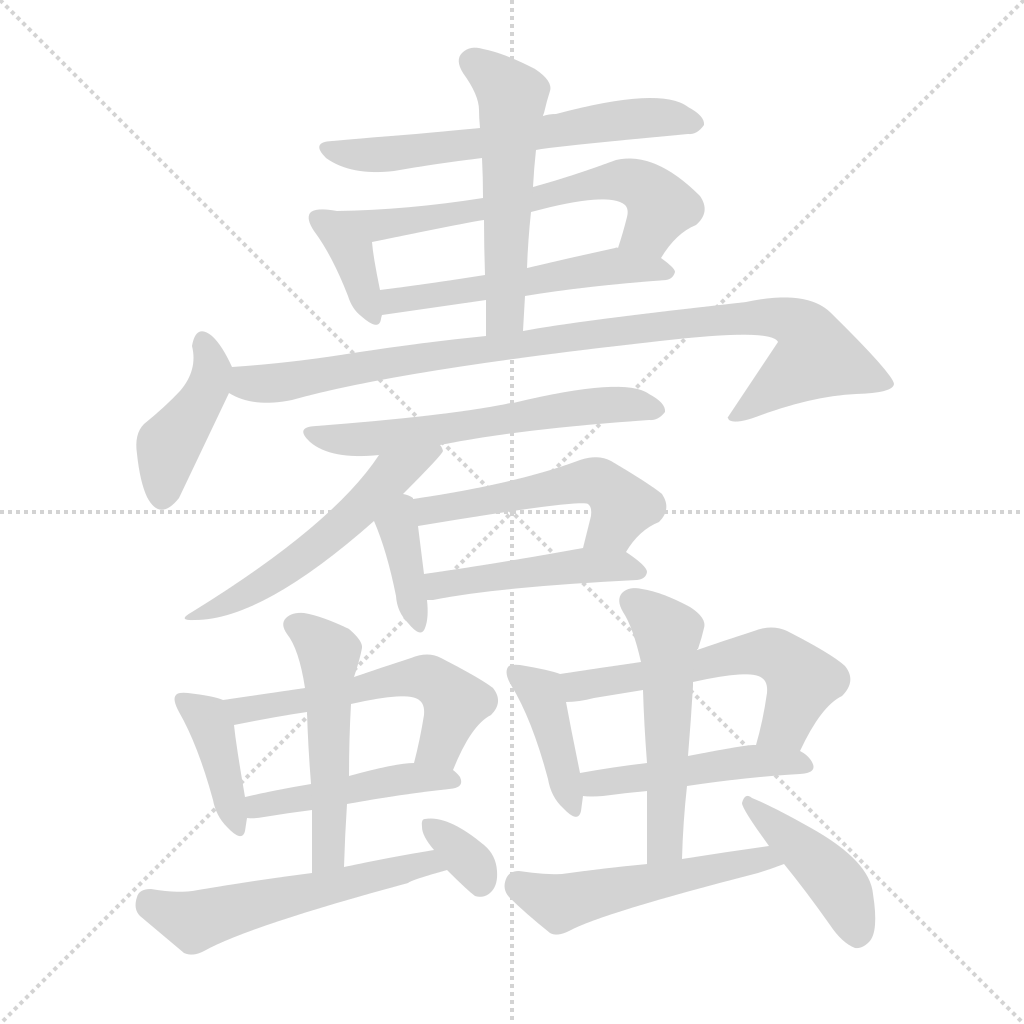
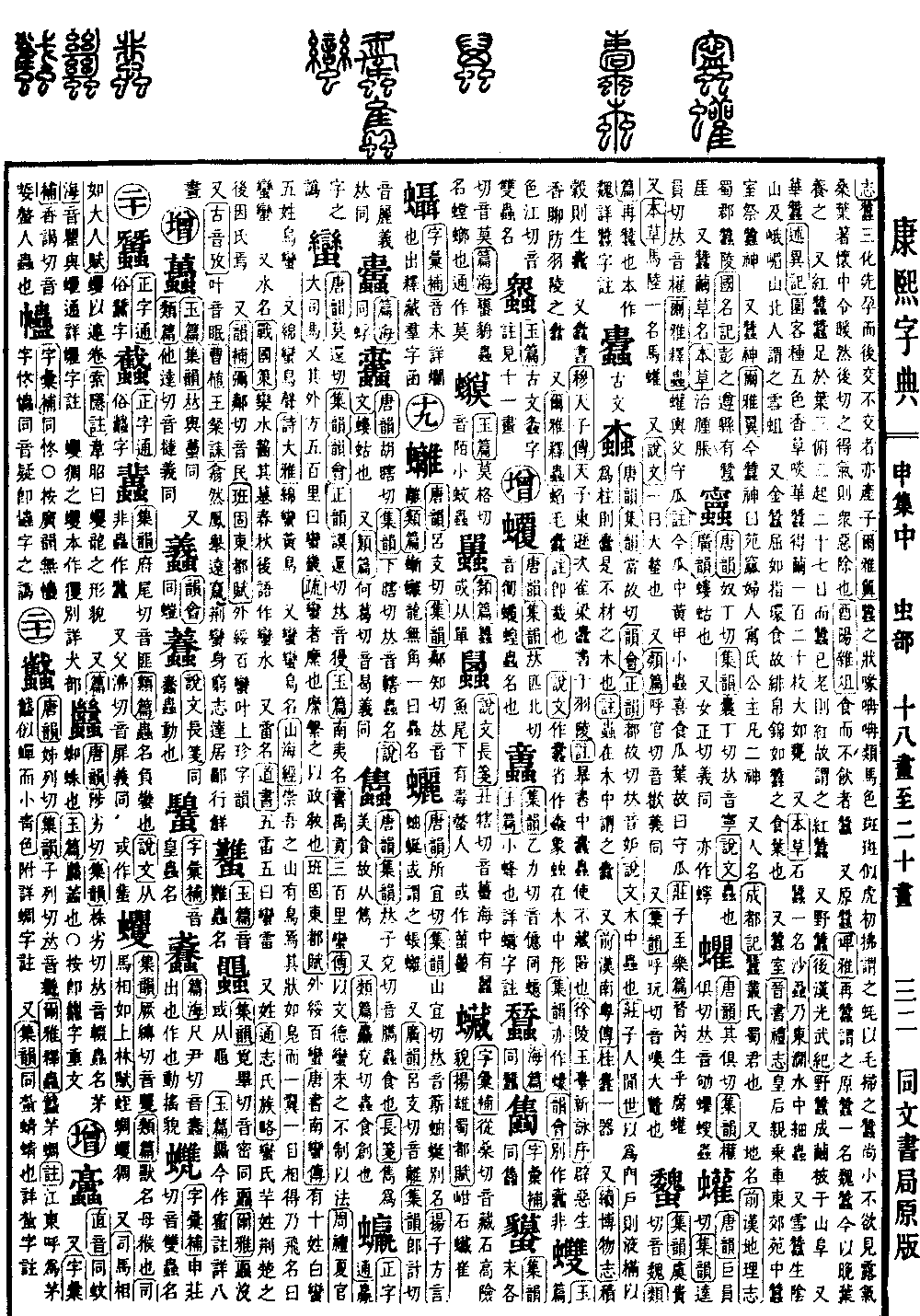
Shen Collection, Middle Volume
Radical: Insect (chóng)
Total strokes: 24
Page 1104, Entry 05
Ancient form: du
Pronounced du (falling tone).
According to the Explaining Graphs and Analyzing Characters (Shuowen Jiezi), it refers to an insect that lives inside wood.
As stated in the Zhuangzi (Zhuangzi), if one uses it for doors or windows, it oozes sap, and if used for pillars, it becomes riddled with wood-boring insects; thus, it is a tree of no utility. The commentary notes that an insect living within wood is called a du.
In the Records of the Han (Qianhan Shu), Southern Yue Biography, it mentions a vessel of cassia-eating insects.
The Continuation of the Record of Broad Knowledge (Xu Bowuzhi) states that stored grain produces these insects.
It also refers to the act of book-eating insects.
The Biography of King Mu (Mu Tianzi Zhuan) records that when the Emperor traveled east and stopped at Que-liang, he aired his books at Yuling. The commentary explains this means exposing the books to remove the wood-boring insects so that they do not remain hidden.
In the Preface to New Songs from the Jade Terrace (Yutai Xinyong) by Xu Ling, it mentions fragrant herbs used to ward off evil, serving to prevent the insects of Yuling.
According to the Erya (Erya), the term xian refers to a hairy wood-boring insect. The commentary explains that this is the same as the caterpillar.
The Explaining Graphs and Analyzing Characters (Shuowen Jiezi) uses the character du, with a simplified form du, resembling the shape of an insect inside wood.
The Compilation of Rhymes (Jiyun) also records the variant form du.
The Dictionary of Rhymes (Yunhui) notes the variant form tu is incorrect.
Textual research: In the Biography of King Mu (Mu Tianzi Zhuan), the text originally stated that the Emperor traveled east and submitted. Per the original text, submitted has been corrected to traveled.