You Collection, Lower Volume
Radical: Foot (zú)
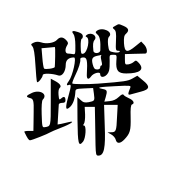
蹛
Kangxi strokes: 18
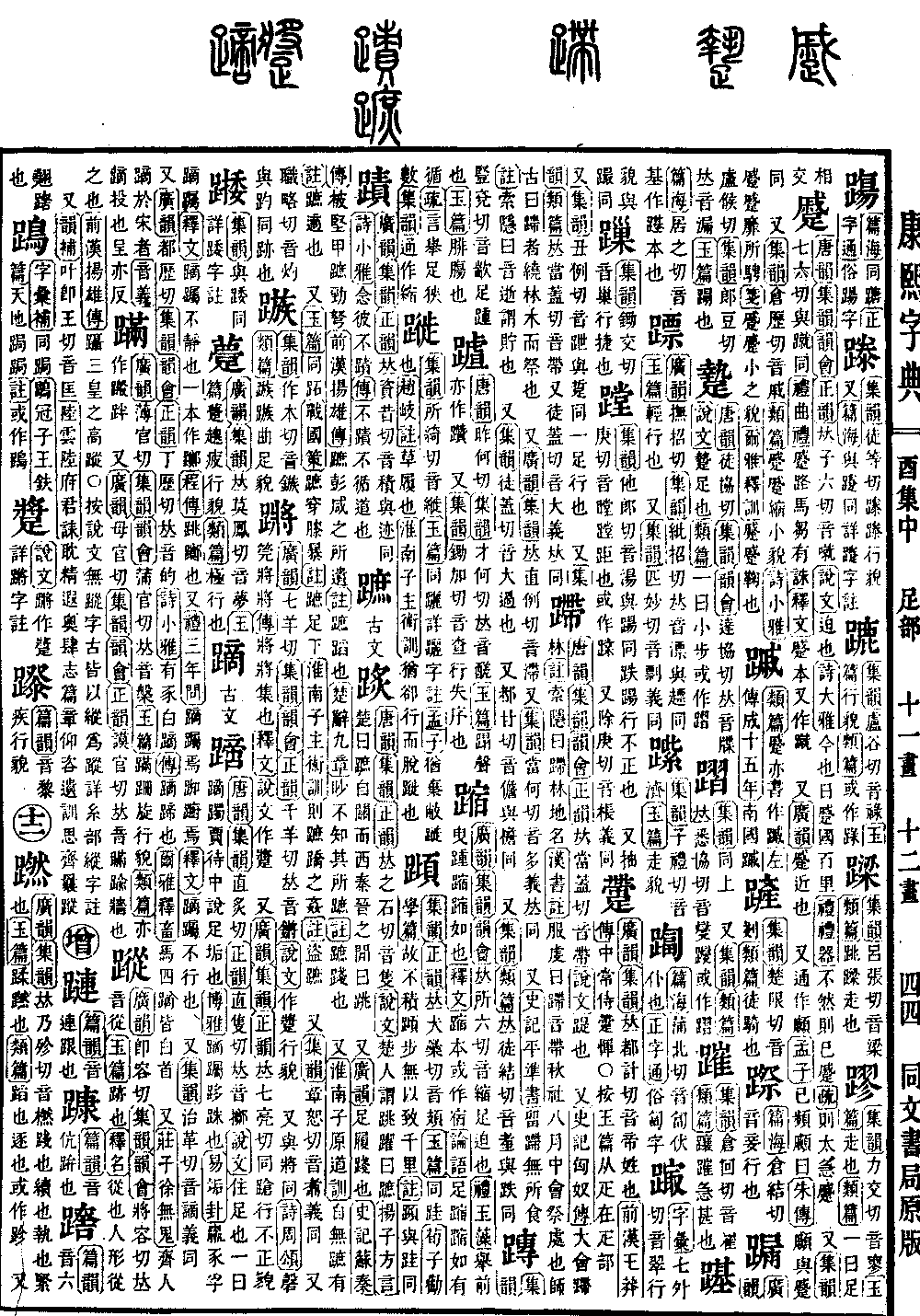
Page 1232, Entry 22
Tang Rhyme (Tangyun), Collection Rhymes (Jiyun), Rhyme Compendium (Yunhui), and Correct Rhymes (Zhengyun): Pronounced dai.
Explaining Graphs and Analyzing Characters (Shuowen Jiezi): To trample.
Also, Records of the Grand Historian (Shiji), Biography of the Xiongnu: A great gathering at Dailin. Commentary: The Seeker of Hidden Meanings (Suoyin) states that Dailin is a place name.
Commentary on the Book of Han (Hanshu): Fu Qian states that dai is pronounced dai, and refers to a place where a gathering and sacrifice are held in the middle of the eighth month during the autumn festival. Yan Shigu states that dai means to gather and offer sacrifices while circling trees in a forest.
Also, Extensive Rhymes (Guangyun) and Collection Rhymes (Jiyun): Pronounced zhi.
Also, Collection Rhymes (Jiyun): Pronounced duo. The meaning is the same.
Also, Records of the Grand Historian (Shiji), Treatise on the Balance of Standards (Pingzhun Shu): To store up and have nothing to eat. Commentary: The Seeker of Hidden Meanings (Suoyin) states that it is pronounced shi, meaning to store.
Also, Collection Rhymes (Jiyun): Pronounced da. Meaning to pass by.
Also: Pronounced dan. Equivalent to the variant form chan.
Also, Collection Rhymes (Jiyun) and Classified Chapters (Leipian): Pronounced die. Equivalent to the variant form die (to stumble).