Wu Collection, Middle Volume
Radical: Eye (mù)
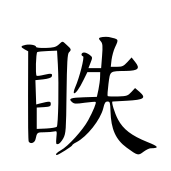
眣
Kangxi stroke count: 10
Page 805, Entry 10
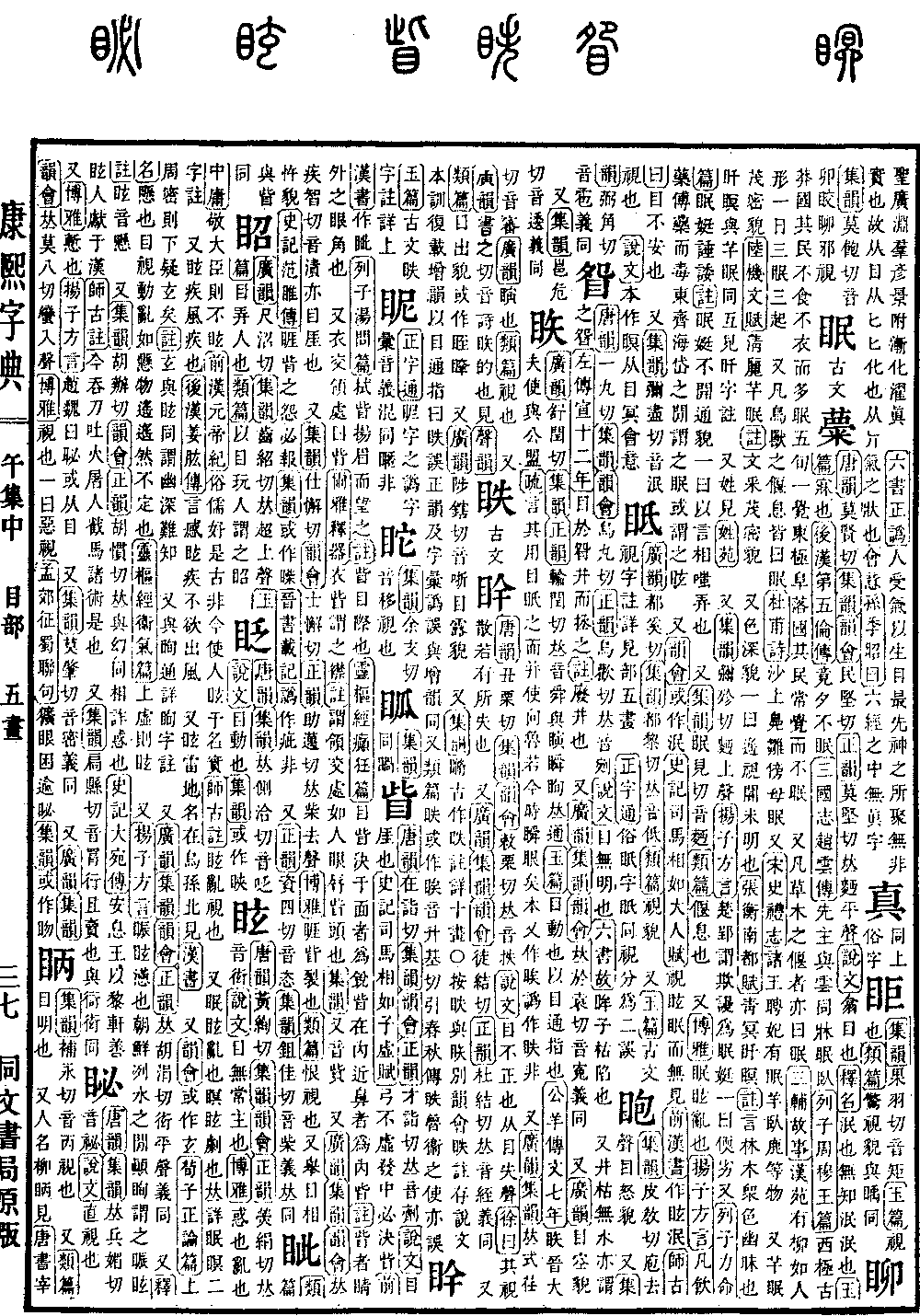
Ancient text. According to the Tang Rhyme (Tangyun), pronounced chi (falling-rising tone). According to the Collected Rhymes (Jiyun) and the Rhyme Gathering (Yunhui), pronounced chi (falling-rising tone). According to the Explanation of Graphs and Analysis of Characters (Shuowen), it means the eyes are not aligned properly. Formed from the radical for eye with a phonetic component representing loss. Xu states that the gaze is scattered, as if something has been lost.
Also, according to the Extended Rhymes (Guangyun), the Collected Rhymes (Jiyun), and the Rhyme Gathering (Yunhui), pronounced die (falling-rising tone). According to the Correct Rhymes (Zhengyun), pronounced die (falling-rising tone). The meaning is the same.
Also, according to the Classified Chapters (Leipian), it refers to the appearance of eyes protruding. Sometimes written in a variant form.
Also, according to the Extended Rhymes (Guangyun), pronounced zha (level tone). The appearance of eyes exposed.
Also, according to the Collected Rhymes (Jiyun), anciently written as a variant. Note detailed under ten strokes. Note that this character is distinct from others. The Rhyme Gathering (Yunhui) note on this character preserves the original definition from the Explanation of Graphs and Analysis of Characters (Shuowen), but repeats an entry from the Expanded Rhymes (Zengyun) suggesting that eyes generally are referred to as this, which is an error. The Correct Rhymes (Zhengyun) and the Collection of Characters (Zihui) repeat this error along with the Expanded Rhymes (Zengyun).
Also, according to the Classified Chapters (Leipian), this character is sometimes written in a variant form, pronounced shengji (tone unspecified). Citing the Spring and Autumn Annals Traditions (Chunqiu Zhuan), it mentions this character in the context of the envoys of Lu and Wei, which is also an error.