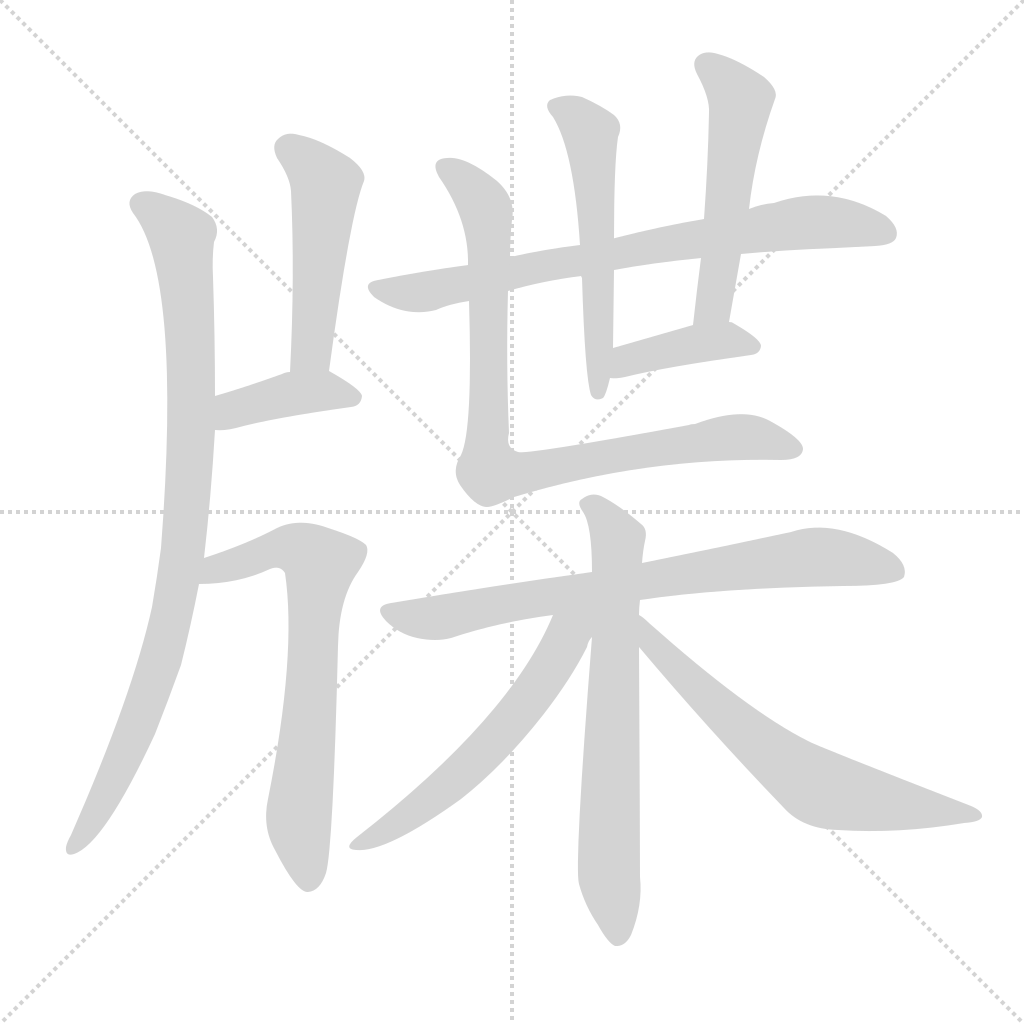
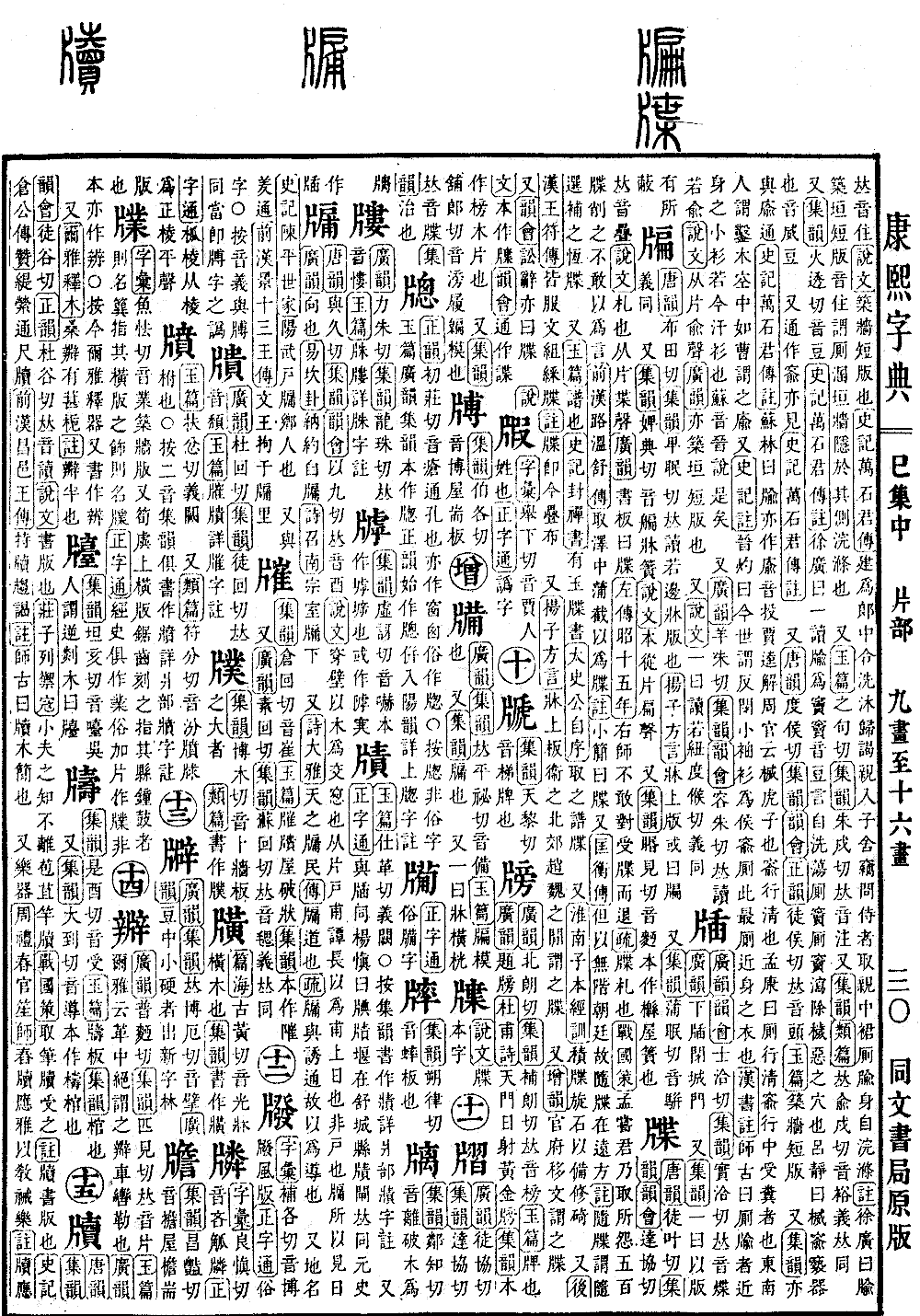
Si Collection, Middle Volume. Radical: Strip (piàn). Kangxi strokes: 13. Page 694, Entry 03.
Pronounced dié.
According to the Explaining Graphs and Analyzing Characters (Shuowen Jiezi), it is a wooden tablet. Formed by the radical for strip and the phonetic component yè.
According to the Extensive Dictionary of Sounds (Guangyun), a writing tablet is called a dié.
In the Commentary on the Zuo Tradition (Zuozhuan), year 15 of Duke Zhao, it is written: The commander of the right wing did not dare to reply, but received the tablet and withdrew. The sub-commentary states: A dié is a tablet.
In the Strategies of the Warring States (Zhanguoce), it is written: Lord Mengchang then took the five hundred tablets of those who held grievances against him and scraped them clean, not daring to speak of them.
In the History of the Former Han (Qianhan Shu), Biography of Lu Wenshu, it is written: He gathered reeds from the marsh and cut them into tablets. The annotation states: Small slips are called dié.
In the Biography of Kuang Heng, it is written: Merely because he lacked the connections for the imperial court, he followed the appointment tablets to a distant region. The annotation states: Following the tablets refers to following the routine appointment tablets for recruitment and assignment.
According to the Jade Chapters (Yupian), it is also a genealogy.
In the Records of the Grand Historian (Shiji), Book of the Feng and Shan Sacrifices, it is written: There were jade genealogy records. In the Grand Historian’s Preface, it is written: Consulted the genealogies.
In the Huainanzi, it is written: Piling up tablets and rotating stones to prepare for the repair of the embankments.
In the History of the Later Han (Houhan Shu), Biography of Wang Fu, it is written: All wore patterned ribbons and colorful tablets. The annotation states: A dié is what is now called layered cloth.
According to the Yangzi Dialect (Fangyan), it refers to the boards of a bed. In the northern suburbs of Wei and between Zhao and Wei, this is called a dié.
According to the Extended Rhyme Dictionary (Zengyun), official correspondence is called a dié.
According to the Collection of Rhymes (Yunhui), a legal petition is also called a dié.
The original form of the character according to the Explaining Graphs and Analyzing Characters (Shuowen Jiezi) was written differently. The Collection of Rhymes (Yunhui) notes it is interchangeably used with the character pronounced dié.