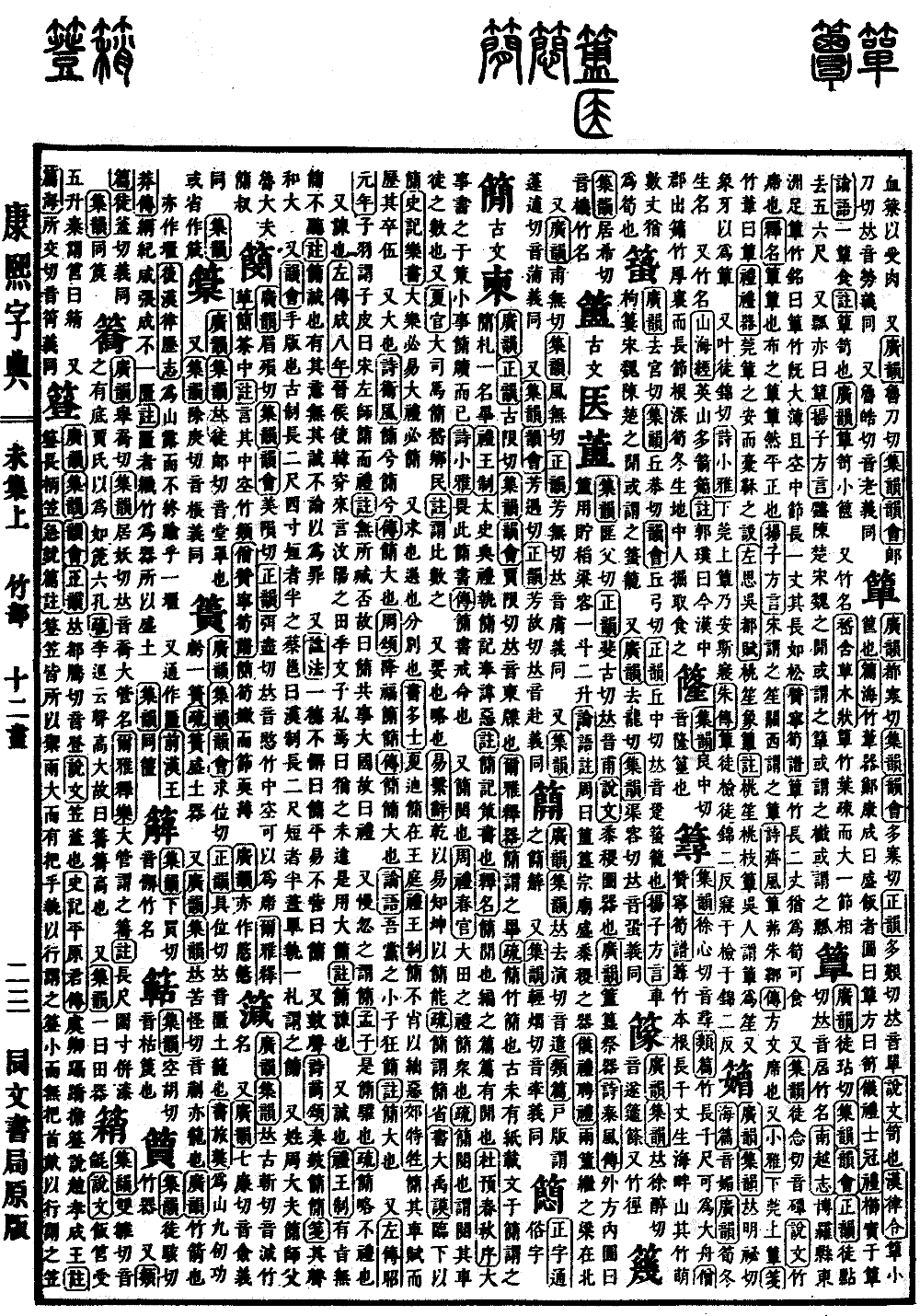
Wei Collection, Upper Volume
Radical: Bamboo (zhú)
Kangxi Strokes: 18
Page 899, Entry 02
Pronounced diàn. A type of bamboo. Southern Viet Records (Nanyuezhi) states in the inscription of the Dian bamboo in Dongzhou, Boluo County: The Dian bamboo is large, with thin walls and a hollow center; the nodes are one zhang long, and its length resembles that of a pine tree. In the Bamboo Shoot Manual (Sunpu) by Zanning, it is noted that Dian bamboo can reach a length of two zhang while still a shoot, and is edible.
Also pronounced diàn. According to the Explaining Graphs and Analyzing Characters (Shuowen): A bamboo mat. According to the Definitions of Names (Shiming): The word dian is derived from the sense of spreading something out to make it flat and even. According to the Regional Speech (Fangyan) by Yang Xiong: In the region of Song it is called sheng, while west of the pass it is called dian. According to the Book of Odes (Shijing), Qi Odes: A bamboo mat with red leather trim. The Commentary states: A mat with square patterns. Also, in the Lesser Odes (Xiaoya): A rush mat is spread below and a bamboo mat is spread above. The Annotations state: A mat woven from bamboo or reeds is called a dian. According to the Book of Rites (Liji), Ritual Vessels (Liqi): There is the comfort of rush and bamboo mats, yet grass cushions are placed upon them. In the Rhapsody on the Capital of Wu (Wudu Fu) by Zuo Si: Peach mats and ivory mats. The Annotation states: Peach mats are mats woven from peach-branch bamboo. People in the region of Wu call a dian a sheng. It also mentions mats made from ivory.
Also, rhyming as jin. In the Book of Odes (Shijing), Lesser Odes: A rush mat is spread below and a bamboo mat is spread above, and thus one sleeps peacefully. Zhu Xi’s Commentary states: For the word dian, there are the pronunciations dian and jin. For the word sleep (qin), there are the pronunciations jian and jin.