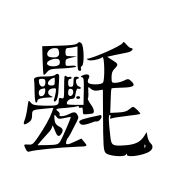
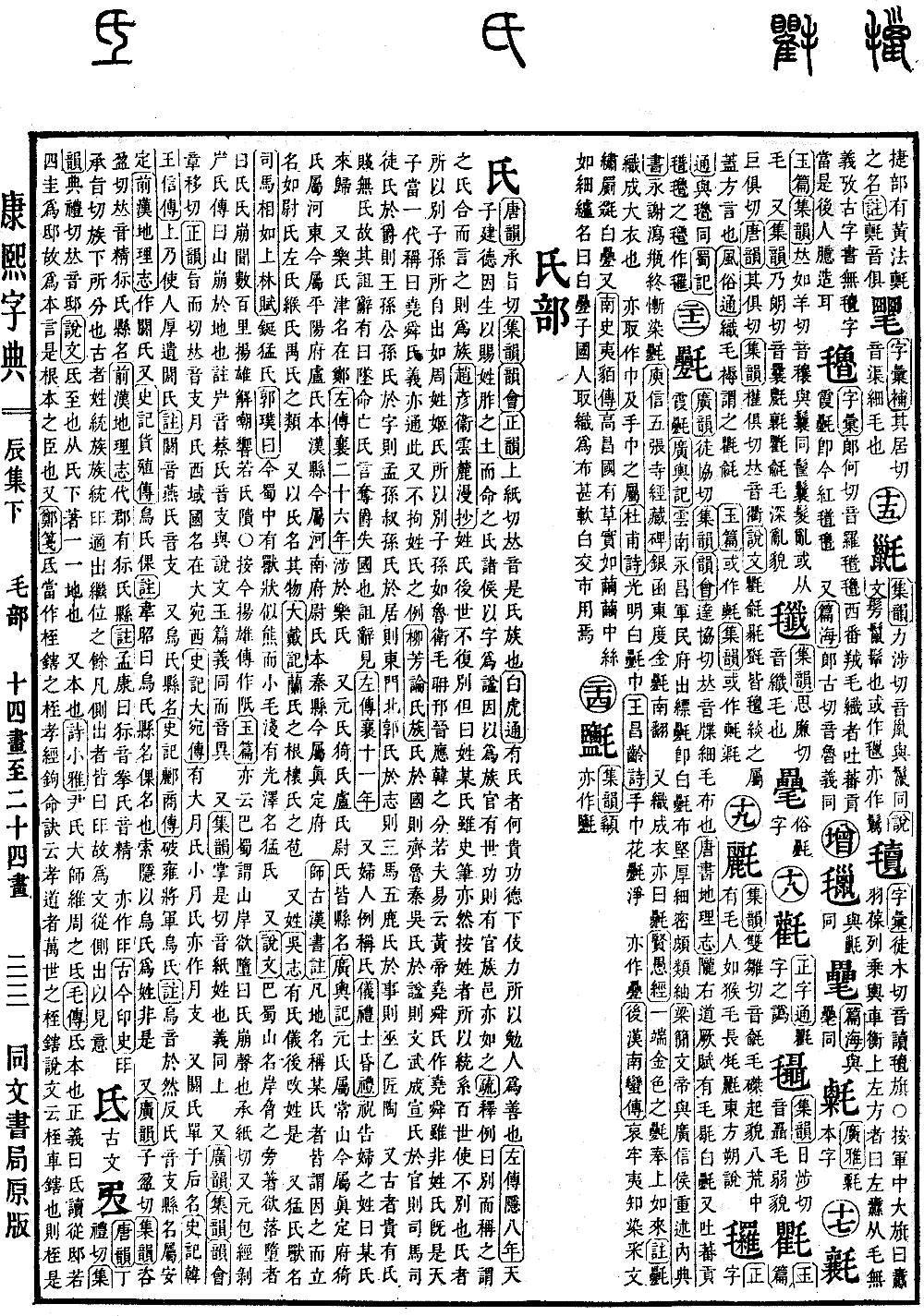
Chen Collection, Lower Volume
Radical: Hair (máo)
Kangxi Strokes: 26
Page 597, Entry 16
According to the Extensive Rhymes (Guangyun), the pronunciation is die; according to the Collected Rhymes (Jiyun) and the Rhyme Compilation (Yunhui), the pronunciation is die. It shares the same pronunciation as the character for tablet (die). It refers to cloth woven from fine hair.
The Geography Treatise (Dilizhi) of the History of Tang (Tangshu) records that the taxes of the Longyou region included hair blankets and white hair cloth (die). There is also the sunset-hued hair cloth (die) offered as tribute by the Tibetan Empire.
The Records of the Wide World (Guangyuji) records that the Yongchang military and civilian prefecture in Yunnan produces fine-woven hair cloth, which is white hair cloth (die); this fabric is thick and dense, very similar to silk.
In the Letter to the Marquis of Guangxin Discussing the Inner Canon (Yu Guangxinhou Chongshu Neidian Shu) by Emperor Wen of Liang, it is written: Forever bidding farewell to the pouring water of the vessel, ultimately ashamed to be stained by hair cloth (die).
In the Five Zhang Temple Scripture Repository (Wuzhangsi Jingcang) by Yu Xin, it is written: The silver casket traveled east, the golden hair cloth (die) was transmitted south.
Additionally, clothing made from this fabric is also called hair cloth (die).
The Sutra of the Wise and the Foolish (Xianyu Jing) records: A piece of golden hair cloth (die) was offered to the Tathagata.
Note: The term refers to a large garment woven from this material. It is also used to make headscarves and hand towels.
In the poetry of Du Fu, it is written: Bright white hair cloth (die) headscarf.
In the poetry of Wang Changling, it is written: The hand towel of patterned hair cloth (die) is clean.
Sometimes also written in a variant form (die).
The Treatise on the Southern Barbarians (Nanman Zhuan) in the History of the Later Han (Hou Hanshu) records that the Ailao people knew how to dye and embroider, creating woolen goods and white cloth (die).
Furthermore, the Treatise on the Eastern and Northern Barbarians (Yimo Zhuan) in the History of the Southern Dynasties (Nanshi) records that in the kingdom of Gaochang, there is a plant whose fruit resembles a silkworm cocoon, and the silk within the cocoon is like fine hemp thread, called white cloth (die) fiber. The local people take it and weave it into cloth, which is very soft and white, used in trade.