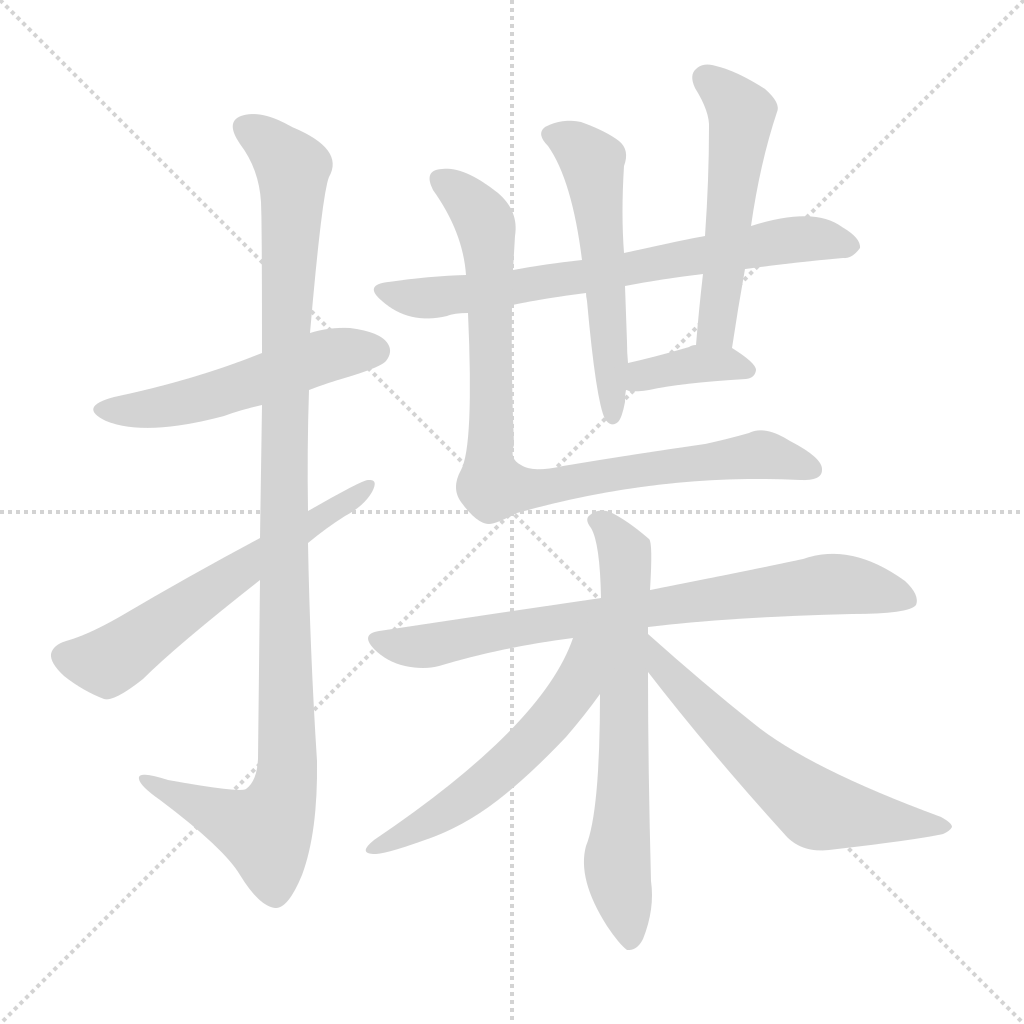
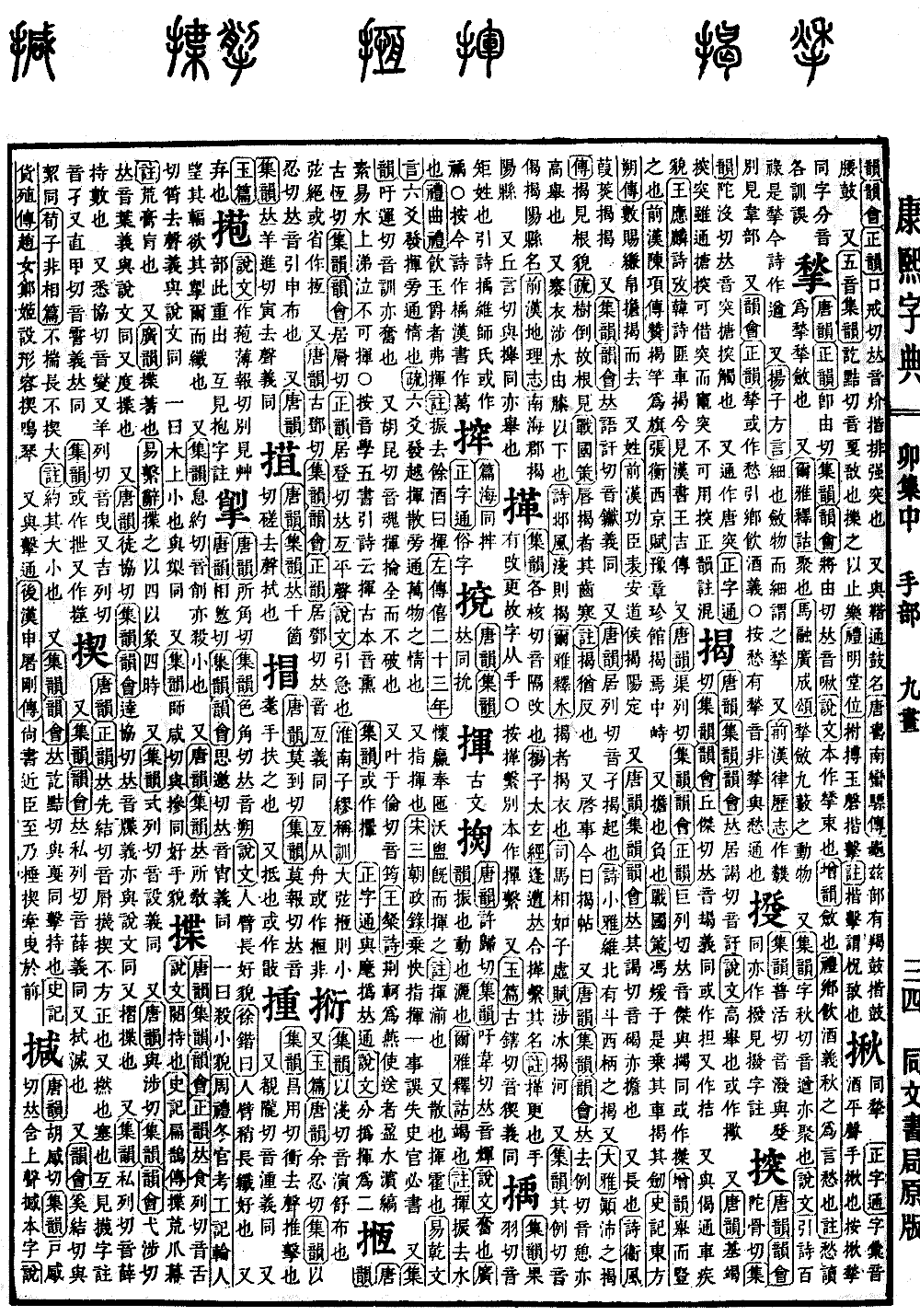
Mao Collection, Middle Volume. Radical: Hand (shǒu). Kangxi dictionary strokes: 13. Page 444, Entry 19.
Tang Rhyme (Tangyun), Collection Rhyme (Jiyun), Rhyme Compendium (Yunhui), and Orthodox Rhymes (Zhengyun) state the pronunciation is shi (rising tone), which sounds the same as she. Explanation in Explaining Graphs and Analyzing Characters (Shuowen Jiezi): to examine and grasp. Records in the Records of the Grand Historian (Shiji), Biography of Bian Que, mention grasping the vital area. Note: The word huang refers to the area between the heart and diaphragm.
Furthermore, Broad Rhymes (Guangyun) states that this term refers to divination using yarrow stalks. The Book of Changes (Yijing), Appended Remarks (Xici), states: Count them by four, to represent the four seasons, meaning to count the yarrow stalks four at a time to symbolize the four seasons.
Also, Collection Rhyme (Jiyun) states the pronunciation is she (falling tone), which sounds the same as she. The meaning is the same as mentioned above.
Also, Tang Rhyme (Tangyun) and Collection Rhyme (Jiyun) and Rhyme Compendium (Yunhui) state the pronunciation is ye (entering tone), which sounds the same as ye. The meaning is the same as in the Explaining Graphs and Analyzing Characters (Shuowen Jiezi). It also carries the meaning of measuring and grasping.
Also, Tang Rhyme (Tangyun) and Collection Rhyme (Jiyun) and Rhyme Compendium (Yunhui) state the pronunciation is die (entering tone), which sounds the same as die. The meaning is also the same as in the Explaining Graphs and Analyzing Characters (Shuowen Jiezi). It also carries the meaning of folding and grasping.
Also, Collection Rhyme (Jiyun) states the pronunciation is xue (entering tone), which sounds the same as xue. It means to hold and calculate.
Also, the pronunciation is xie (entering tone).
Also, the pronunciation is ye (entering tone).
Also, the pronunciation is jie (entering tone).
Also, the pronunciation is zha (entering tone). All meanings are the same.
Collection Rhyme (Jiyun) records that this character may also be written as a variant form (ye) or in another variant form.