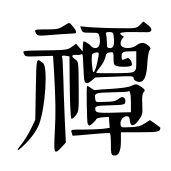
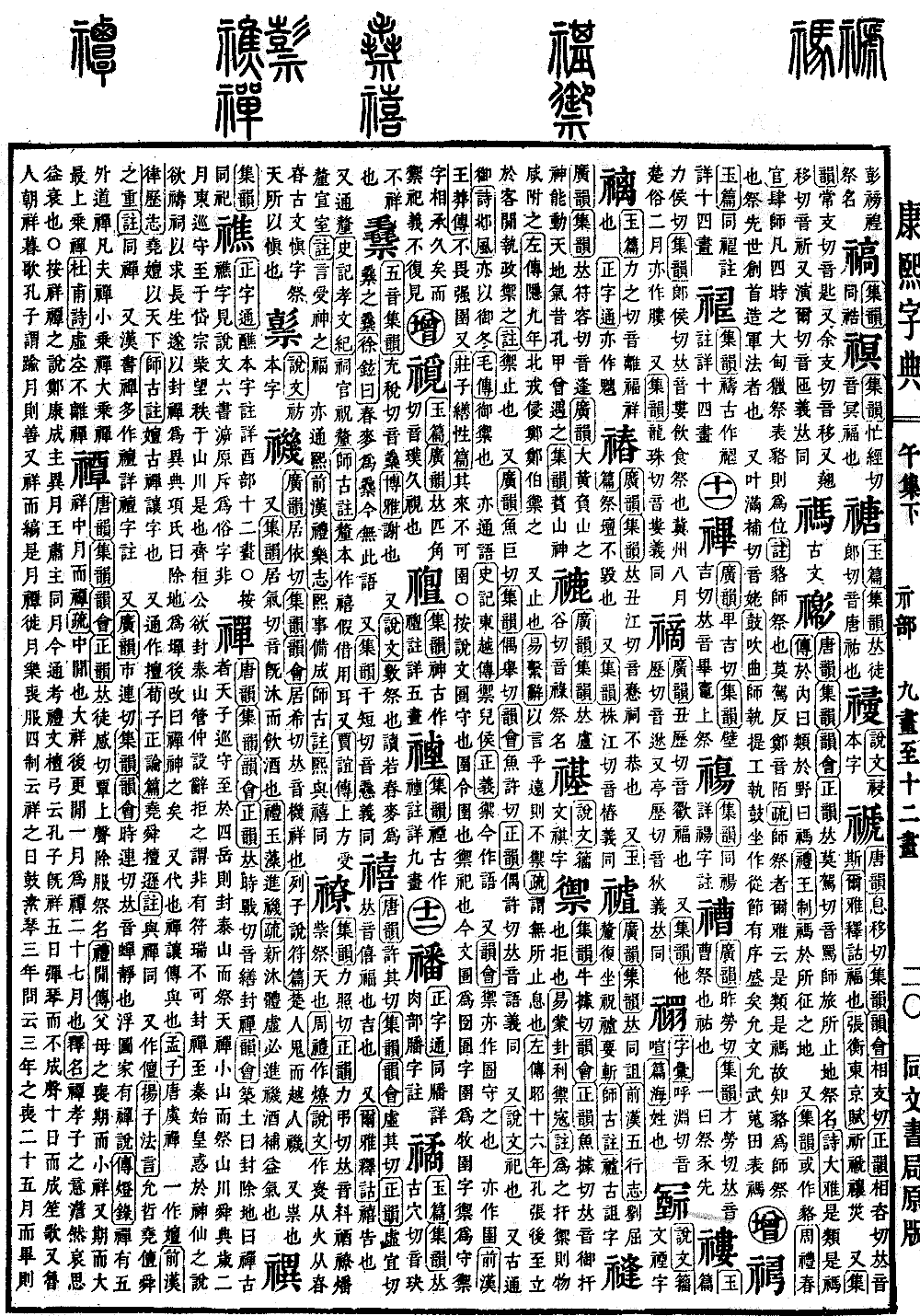
Wu Collection, Lower Volume
Radical: Spirit (shì)
dan, 17 strokes
Page 846, Entry 37
Pronounced dan (rising tone)
A name for a sacrificial rite performed after the end of the mourning period.
Book of Rites (Liji), Treatise on Leisure (Xianzhuan): For the mourning of parents, after one year there is the small xiang sacrifice, and after another year there is the great xiang sacrifice; in the intervening month occurs the dan sacrifice.
Commentary: The term intervening means that after the great xiang sacrifice, there is an interval of one month, and the dan sacrifice is performed in the twenty-seventh month.
Explanation of Names (Shiming): Dan refers to the heart of the filial child, indicating that the feelings of grief and longing have gradually faded.
Regarding the theories of the xiang and dan sacrifices, Zheng Kangcheng advocated that they be held in separate months, while Wang Su advocated that they be held within the same month. Examining the literature of the Rites (Liji) comprehensively: The Tan Gong section states that Confucius, after the xiang sacrifice, played the zither but could not strike the correct notes for five days, and after ten days he was able to play the sheng flute and sing. It also records that someone from the state of Lu performed the xiang sacrifice in the morning and sang in the evening, to which Confucius remarked that one should wait for the intervening month. It further states that after the xiang sacrifice, one wears white mourning clothes, and in that month the dan sacrifice is performed; after one month passes, one may play music.
The Four Provisions for Mourning Clothes (Sangfu Sizhi) states that on the day of the xiang sacrifice, one may play an unadorned zither. The Three Years Question (Sannian Wen) states that the three-year mourning period concludes after twenty-five months. Thus, the theory of Wang Su has a basis. The Ritual for the Scholar’s Repose (Shi Yu Li) and the Treatise on Leisure (Xianzhuan) both state that the dan sacrifice occurs in the intervening month, which means the dan sacrifice is performed within the same month as the xiang sacrifice. Even if one must avoid certain days for ritual events, and the xiang sacrifice might occur late in the month, performing the dan sacrifice immediately after the xiang sacrifice does not prevent it from being called an intervening month.
Zheng Kangcheng specifically relied on the phrases in the Record of Mourning Clothes (Sangfu Xiaoji) regarding an interval of more than one, and the Record of Learning (Xueji) regarding annual examinations, interpreting the word intervening as an interval of time, thus setting it at twenty-seven months, which in reality does not accord with the classics. However, earlier scholars like Sima Guang and Zhu Xi knew that Wang Su’s theory was correct, yet dared not publicly correct the error because, for the mourning of parents, it is better for the rituals to be more stringent, and such systems have been followed for so long that they do not permit sudden change.
Also interchangeable with dan. Xunzi, In Opposition to the Twelve Masters: Planting the dan with his words.