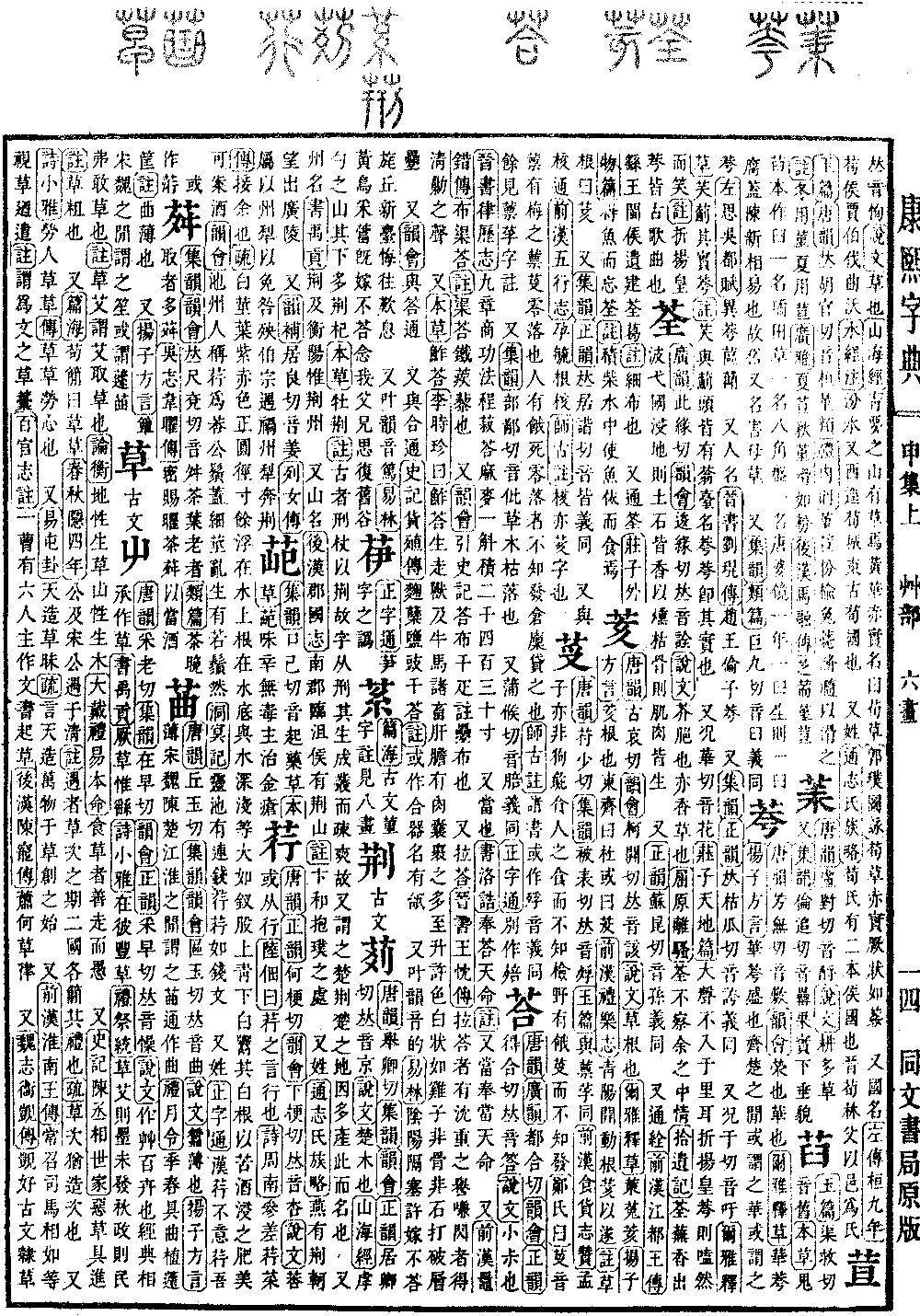
Shen Collection, Upper Volume
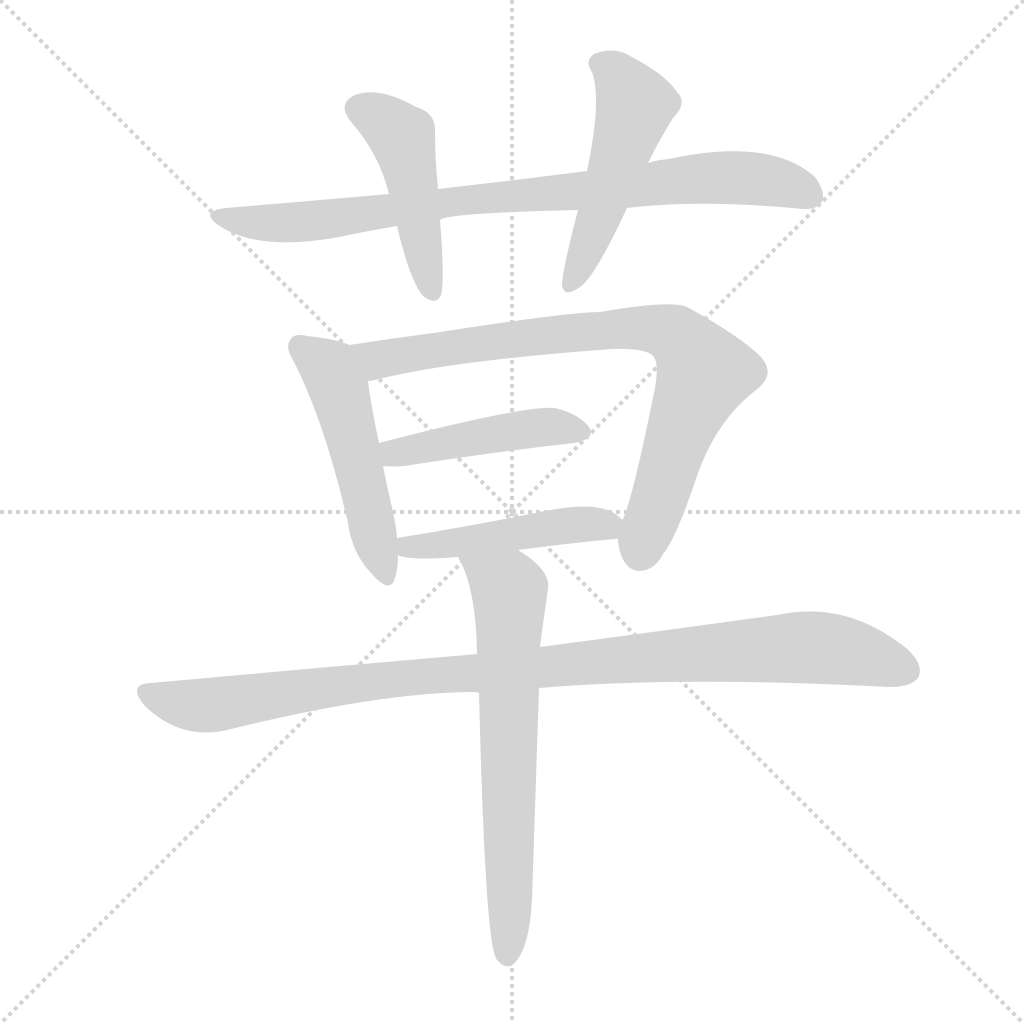
Radical: Grass (cǎo)
Kangxi Strokes: 12
Page 1030, Entry 17
Written as (chè) in ancient texts.
Pronounced cǎo. Pronounced cǎo. Pronounced cǎo. Pronounced cǎo. Pronounced cǎo. Pronounced cǎo. Pronounced cǎo. Pronounced cǎo. Pronounced cǎo. Pronounced cǎo. Pronounced cǎo. Pronounced cǎo. Pronounced cǎo. Pronounced cǎo. Pronounced cǎo. Pronounced cǎo. Pronounced cǎo. Pronounced cǎo. Pronounced cǎo. Pronounced cǎo. The pronunciation is the same as (cào).
Explaining Characters (Shuowen Jiezi): Written as (cǎo), referring to all types of herbs. In classical works, it has been traditionally written as (cǎo).
Book of Documents (Shujing), Tribute of Yu (Yugong): The grass there is very lush.
Book of Odes (Shijing), Minor Odes (Xiaoya): Among the lush grasses.
Book of Rites (Liji), Treatise on Sacrificial Rites (Jitong): When the time for cutting grass arrives (punishments are enacted), if the autumn government decrees have not yet been issued, the people dare not cut the grass. Note: Grass-cutting (cǎoài) means to harvest grass.
Critical Essays (Lunheng): The nature of the earth is to produce grass; the nature of the mountains is to produce trees.
Dai's Record of Rites (Da Dai Liji), Basic Destiny of the Yi (Yi Benming): Herbivorous animals are swift but unintelligent.
Also, Records of the Grand Historian (Shiji), Biography of Chancellor Chen: To offer coarse food. Note: Grass here refers to being rough or crude.
Also, Sea of Documents (Pianhai): Hasty and careless behavior is called (cǎo cǎo).
Spring and Autumn Annals (Chunqiu), Duke Yin, Year 4: Duke Yin of Lu met with the Duke of Song at Qing. Note: Meeting (yù) refers to a hasty appointment where both states simplified their rituals. Commentary (Shu): Hasty stay (cǎo cì) is like being hurried.
Also, Book of Odes (Shijing), Minor Odes (Xiaoya): People troubled by toil have heavy hearts. Commentary (Zhuan): (cǎo cǎo) describes the appearance of being worried.
Also, Book of Changes (Yijing), Hexagram of Difficult Beginnings (Tun): When heaven and earth were first created, all things were in a state of obscure beginnings (cǎo mèi). Commentary (Shu): This says that heaven and earth created all things at the inception of their emergence.
Also, History of the Former Han (Qian Hanshu), Biography of the Prince of Huainan: Often summoned Sima Xiangru and others to review the draft (cǎo gǎo) before dispatching them. Note: Refers to a draft of a written work.
Register of Officials (Baiguanzhi) Note: A government office has six people responsible for drafting documents.
History of the Later Han (Hou Hanshu), Biography of Chong: Xiao He drafted (cǎo chuàng) the laws.
Also, Records of the Three Kingdoms (Weizhi), Biography of Wei Ji: Wei Ji loved ancient scripts; he was skilled in clerical script (lishu) and cursive script (caoshu).
Also used as a surname. Orthodox Character Dictionary (Zhengzitong): For example, Cao Zhong.
Also, Rhyme Supplement (Yunbu): Pronounced zuǒ. Similar to the rising tone of cu. Xu Gan, Ode to the Capital of Qi: Burning the obstructive forests, and setting fire to the grass in the gardens.
Also pronounced gǒu. Similar to the rising tone of còu. Bian Rang, Ode to Zhanghua: Holding the delicate wrists of Xi Shi, pulling the white elbows of Mao Qiang. Their figures are light and beautiful, just like grass bending with the wind.
Also, Explaining Characters (Shuowen Jiezi): Pronounced zào. Cao dou refers to the fruit of the oak tree, also called an acorn. Xu Xuan says: Today, common people use this character for the grass and trees of the world, and have created the character (zào) to represent the color black. Investigation: Oak fruit can be used to dye silk black, hence it is called (cǎo), and the two characters are interchangeable. The character forms written by common people today, some with the component for white (bái) and ten (shí), others with white (bái) and seven (qī), are all meaningless.
Correction: Explaining Characters (Shuowen): Pronounced zào. It is the fruit of the oak tree, an acorn. Following the original text, the character for grass (cǎo) is added under the character zào. The phrase "Another name is" is added before "acorn." Xu Xuan says: The fruit can be used to dye silk black. Following the original text, the character for white (bái) is changed to silk (bó).