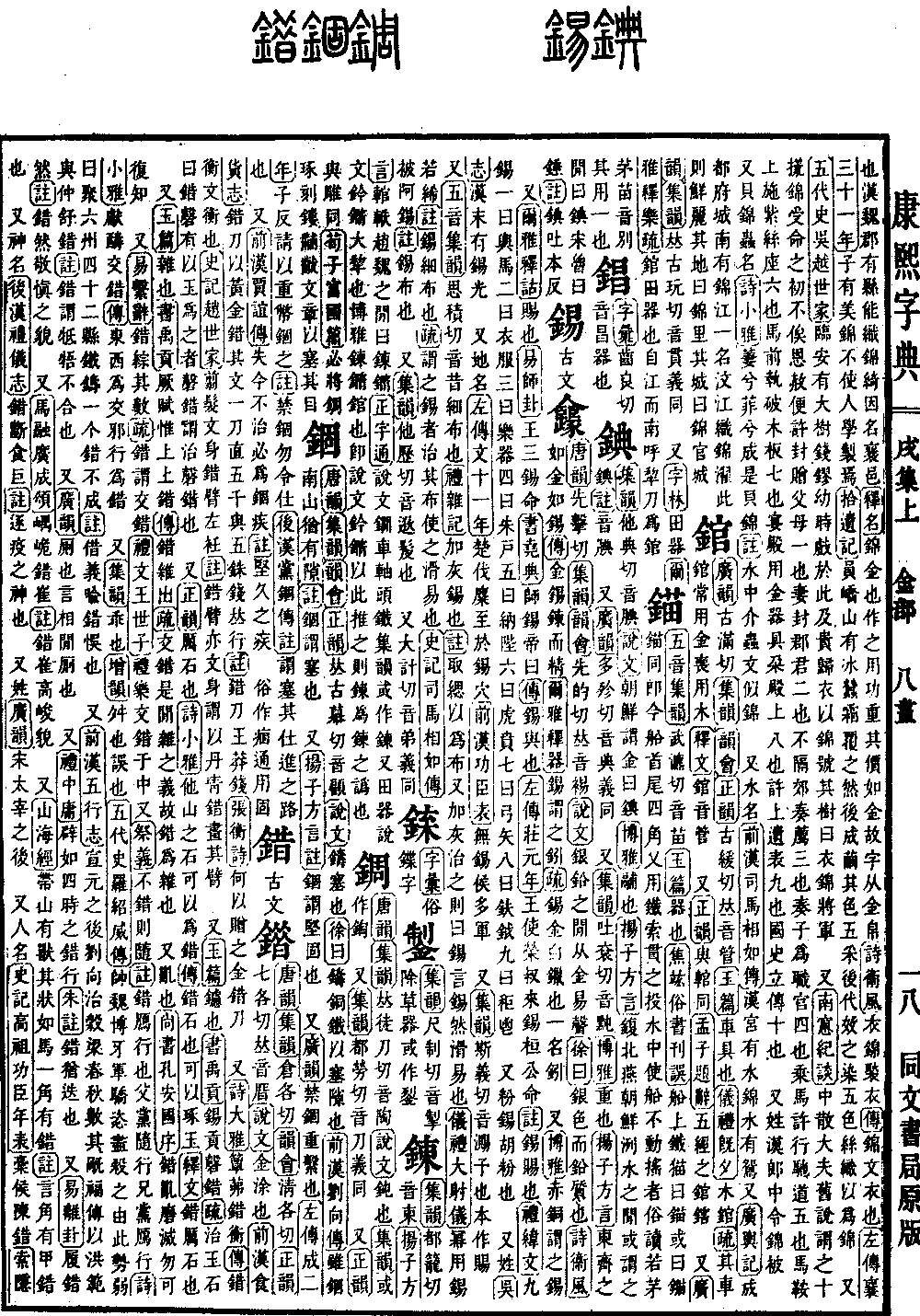
Xu Collection, Upper Volume
Radical: Metal (jīn)
Page 1312, Entry 12
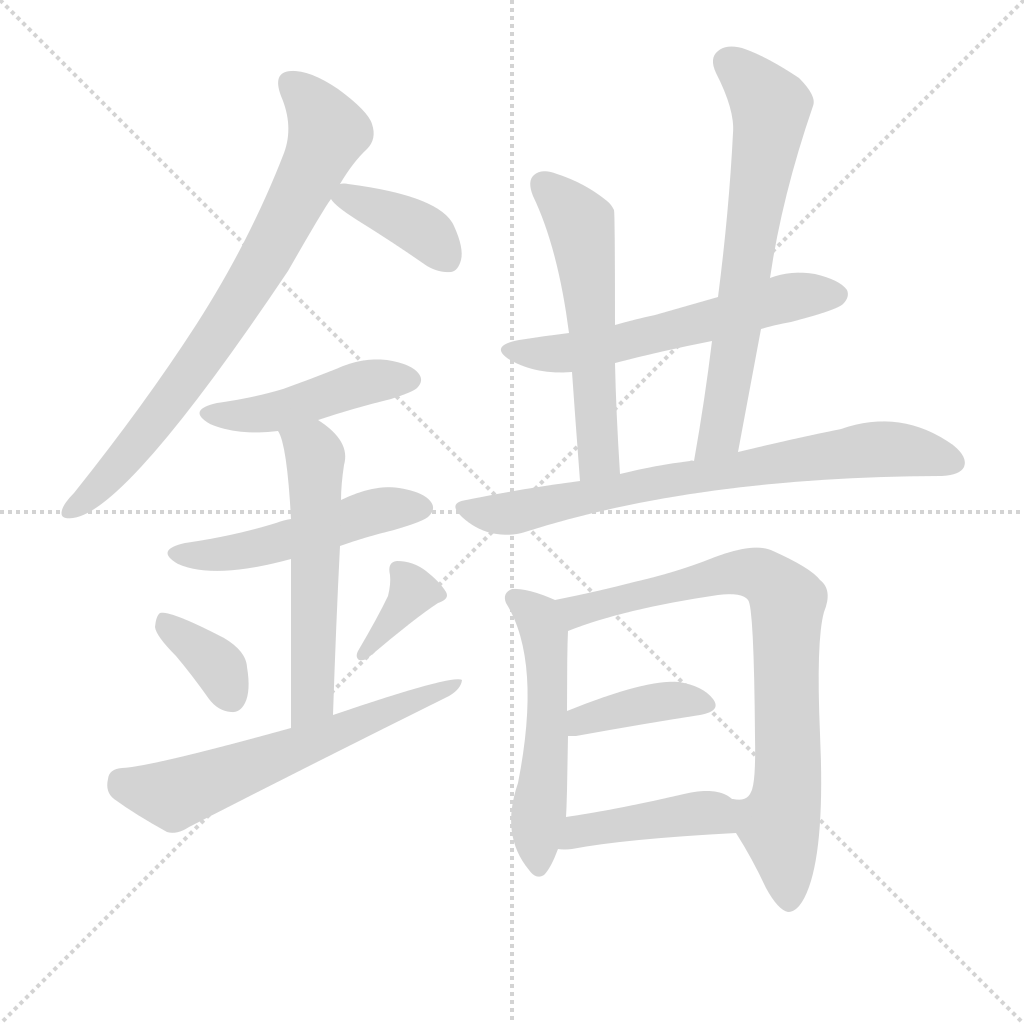
Ancient form. Pronounced cuò.
According to the Explaining Graphs and Analyzing Characters (Shuowen Jiezi), it refers to gold inlay.
According to the Book of Han (Hanshu), Treatise on Food and Money: "A knife inlaid with gold; one knife is worth five thousand, and it circulates alongside the five-zhu coins."
Note: The gold-inlaid knife was a currency issued by Wang Mang.
From the poem by Zhang Heng: "What shall I give to present this gold-inlaid knife?"
Also, in the Book of Odes (Shijing), Great Odes: "Mats with embroidered decorative crossbars."
Commentary: A decorative crossbar is an ornamental crossbar.
In the Records of the Grand Historian (Shiji), Annals of Zhao: "Cutting hair and tattooing the body, with arms adorned and left-lapelled garments."
Note: The adorned arms also refer to tattooing, meaning the arms are decoratively painted with cinnabar and blue dye.
Also, according to the Jade Chapters (Yupian), it means to grind or polish.
In the Book of Documents (Shangshu), Tribute of Yu: "They paid tribute of stone chimes and grinding stones."
Sub-commentary: To refine jade and stone is called cuò. The chimes were made of jade; "chimes and grinding stones" refers to the tools used to grind the chimes.
Also, according to the Correct Rhymes (Zhengyun), it means a whetstone.
In the Book of Odes (Shijing), Lesser Odes: "The stones of other hills, may be used as grindstones."
Commentary: Cuò refers to a stone that can be used to polish jade.
Explication of the Text: Cuò is a whetstone.
Also, according to the Jade Chapters (Yupian), it means mixed or miscellaneous.
In the Book of Documents (Shangshu), Tribute of Yu: "The taxes are of the highest grade and varied."
Commentary: Cuò means mixed or appearing in variety.
Sub-commentary: Intertwined means the sense of being intermingled; thus, cuò means miscellaneous.
Also, it means chaotic or disordered.
In the Preface to the Book of Documents by Kong Anguo: "The texts were chaotic and worn away, such that they could no longer be understood."
Also, in the Book of Changes (Yijing), Appended Remarks: "Intertwining and combining their numbers."
Sub-commentary: Cuò means intertwined.
In the Record of Rites (Liji), The Royal Sons: "Ritual and music intermingle within."
Also, in the Record of Rites (Liji), Meaning of Sacrifices: "If the order is not cuò, then follow."
Note: Cuò means in the order of wild geese flying. The party of the father follows in order; the party of the elder brother follows in the order of geese.
In the Book of Odes (Shijing), Lesser Odes: "Presenting and returning wine, crossing and interweaving."
Commentary: From east to west is called cross-interweaving; moving diagonally is called cuò.
Also, according to the Collected Rhymes (Jiyun), it means to go against or deviate.
According to the Expanded Rhymes (Zengyun), it means erroneous or a mistake.
In the History of the Five Dynasties, Biography of Luo Shaowei: "The commander of the Weibo teeth-guards was arrogant; he killed them all, and as a result, his power weakened. He said: 'Gathering iron from six prefectures and forty-two counties, even if I cast a cuò, it will not succeed.'"
Note: This uses the figurative meaning of a mistake.
Also, in the Book of Han (Hanshu), Treatise on the Five Elements: "After Emperor Xuan and Emperor Yuan, Liu Xiang studied the Guliang Commentary of the Spring and Autumn Annals, numbering its disasters and blessings, and compared it with the Great Plan, finding it cuò with Dong Zhongshu."
Note: Cuò means conflicting and not matching.
Also, according to the Guangyun Rhyme Dictionary, it means to place side by side or to intersperse.
Also, in the Record of Rites (Liji), Doctrine of the Mean: "Like the cuò movement of the four seasons."
Zhu Xi's Note: Cuò means alternating.
Also, in the Book of Changes (Yijing), Li Hexagram: "Walking in a cuò manner."
Note: Cuò here describes a respectful and cautious appearance.
Also, in the Rhapsody on Guangcheng by Ma Rong: "The mountain peaks are high and cuò."
Note: Cuò describes a high and precipitous appearance.
Also, in the Classic of Mountains and Seas (Shanhaijing): "On Dai Mountain there is a beast, shaped like a horse, with one horn, and it has a cuò."
Note: It means the horn has overlapping scales.
Also, the name of a deity.
In the Later Han (Hou Hanshu), Treatise on Rites: "Cuò cuts off the food of the giant."
Note: A deity that dispels plagues.
Also, a surname.
According to the Guangyun Rhyme Dictionary: Descendants of the Grand Tutor of the Song state.
Also, a person's name.
In the Records of the Grand Historian (Shiji), Table of Meritorious Officials of the Han Dynasty: "Marquis Gao Cuò."
Commentary: The Han table writes it as Kai (kǎi).
Also, the name of an insect.
In the Supplementary Dictionary (Zihuibu): The long-horned grasshopper; the people of Youzhou call it the pucuò.
Also, interchangeable with cuò (置).
In the Book of Han (Hanshu), Geography Treatise: "The five directions are mixedly placed (cuò), and the customs are not pure."
Note: Cuò and cuò are interchangeable in ancient texts.
Also, according to the Guangyun, Collected Rhymes, Rhyme Society, and Correct Rhymes: Pronounced cù.
According to the Collected Rhymes (Jiyun): Gold inlay is called cuò. Also a surname. Originally written as the character for metal combined with the character for measure.
Also, according to the Erya (Boya), it means to store or hide.
Also, in the Songs of Chu (Chuci), Nine Declarations: "The lives of the people, each has a place to be cuò."
Note: Cuò means to settle or be at peace.
Also, in the Records of the Grand Historian (Shiji), Biography of Sima Xiangru: "Expanding official duties and cuò affairs."
Note: Expanding their official posts and establishing (cuò) their careers. Pronounced cù.
Also, in the Book of Changes (Yijing), Appended Remarks: "If one places (cuò) them on the ground, then it is acceptable."
Sub-commentary: Cuò means to place.
Explication of the Text: Pronounced cù.
In the Records of the Grand Historian (Shiji), Annals of Zhou: "During the reigns of Cheng and Kang, the world was at peace, and for over forty years, nothing was cuò."
Note: Cuò means to store or set aside.
Also, in the Records of the Grand Historian (Shiji), Biography of Zhang Yi: "The relations between Qin and Wei can be cuò."
Note: Cuò means to stop or cease. Pronounced cù.
Also, in the Later Han (Hou Hanshu), Biography of Han Lang: "The two men were cuò-è and could not reply."
Note: Cuò here is pronounced like the combination of q and uo. Cuò-dàn means to be in a state of panic.
Also, according to Yang Xiong's Dialects (Fangyan), it means to extinguish. Zhou and Qin call it cuò.
Note: Pronounced cù.
Also, interchangeable with cù (vinegar).
In the Guanzi, Student Regulations: "Place the sauce and cuò (cù) for the food."
Also, according to the Collected Rhymes (Jiyun): Pronounced què. Refers to coarse physical properties.