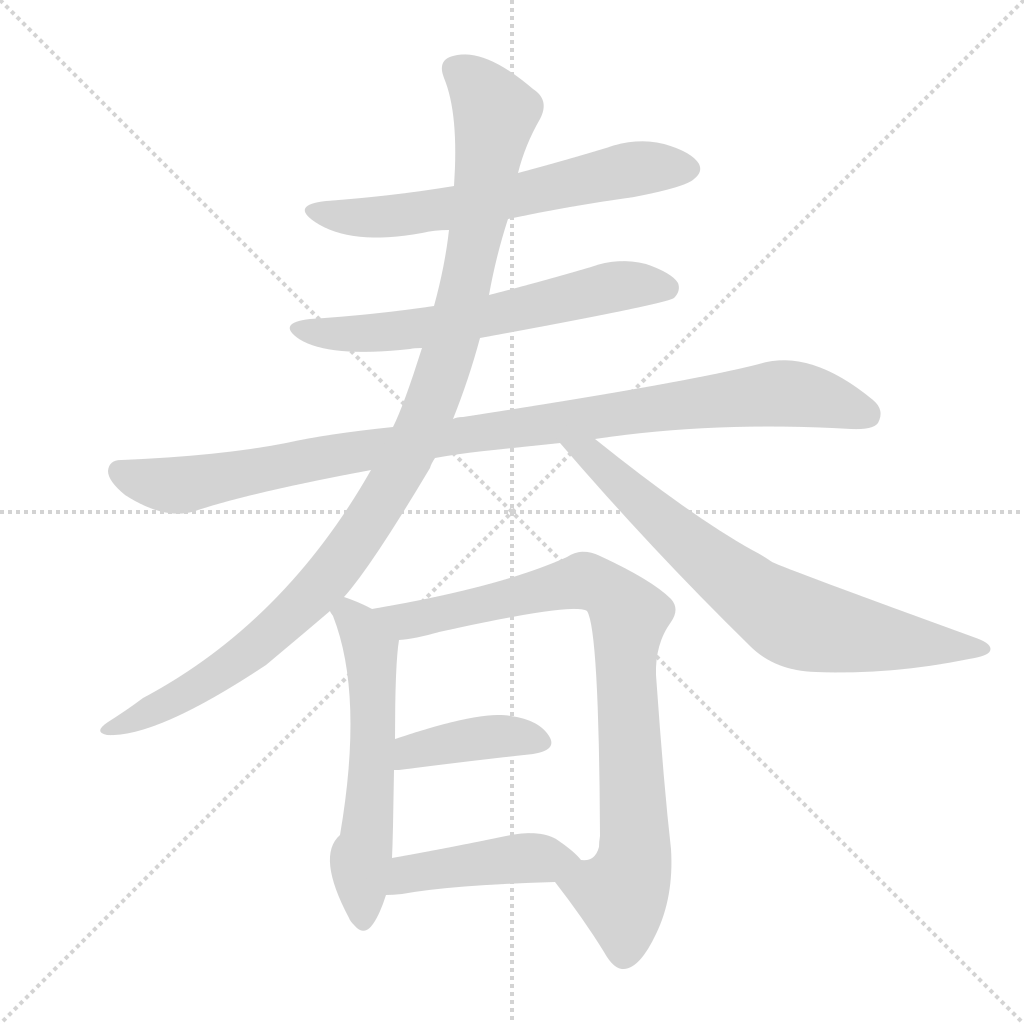
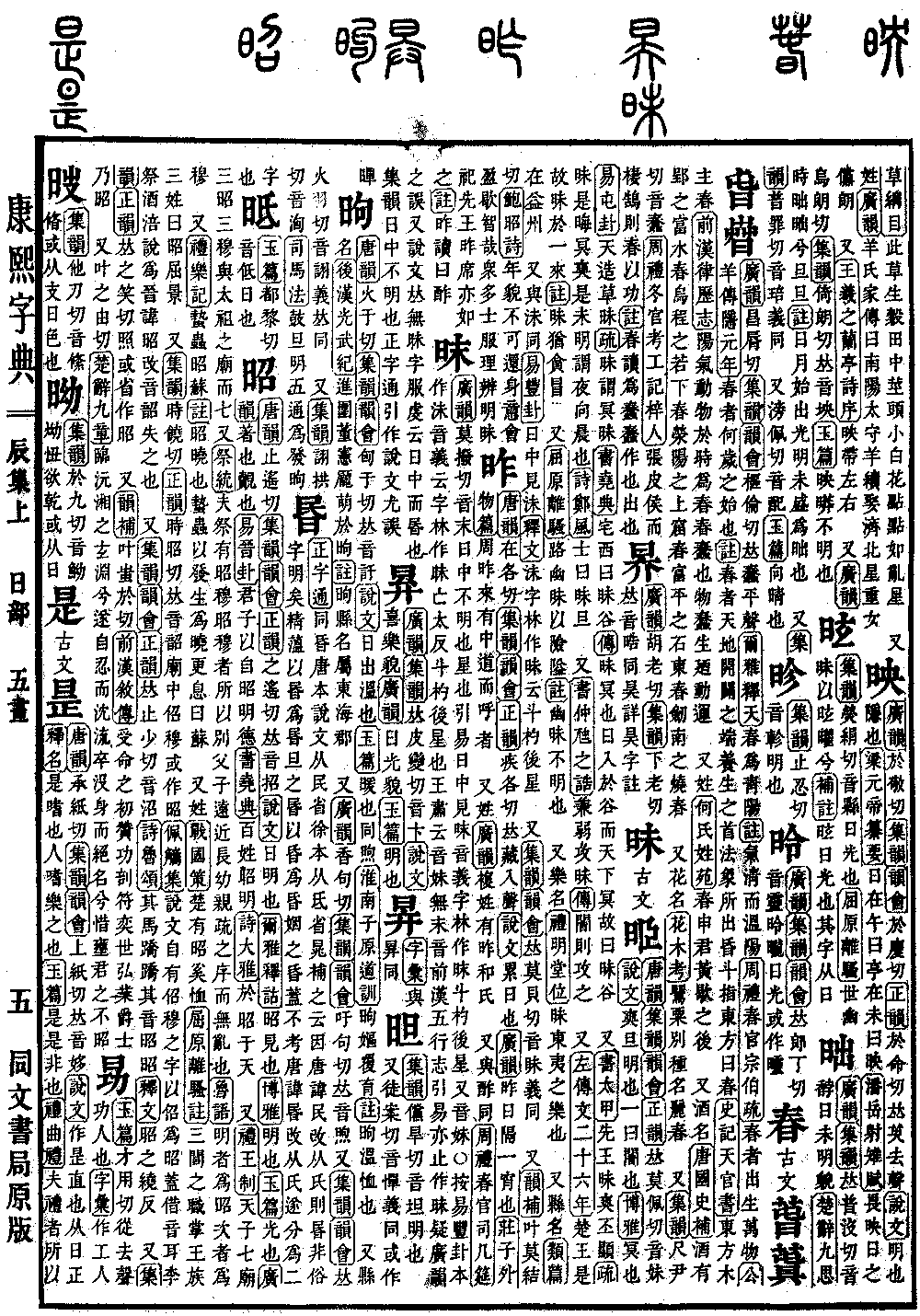
Chen Collection, Upper Volume
Radical: Sun (rì)
Page 493, Entry 06
In ancient texts, sometimes written in the variant forms chun or chun.
According to the Broad Rhymes (Guangyun), pronounced chun.
According to the Collected Rhymes (Jiyun) and the Rhyme Compilation (Yunhui), pronounced chun (level tone). The reading is similar to the level tone of the word chun (to wriggle).
Erya: Interpretation of Heaven (Erya Shitian) records: Spring is called Green Yang.
Commentary explains: The atmosphere of spring is clear, harmonious, and oriented toward the sun.
Rites of Zhou: Offices of Spring, Ministers of Religion Commentary (Zhouli Chunguan Zongboshu) states: Spring is the season when all things sprout.
Gongyang Commentary on the Spring and Autumn Annals: First Year of Duke Yin (Gongyangzhuan Yinyuanian) asks: What is spring? The answer is: The beginning of the year.
Commentary explains: Spring is the origin of the opening of heaven and earth, the primary season for nurturing life, and the manifestation of natural laws. When the handle of the Northern Dipper points toward the east at dusk, it is called spring.
Records of the Grand Historian: Treatise on the Celestial Offices (Shiji Tianguanshu) records: The east belongs to the element of wood, which governs the season of spring.
History of the Former Han: Treatise on Harmonics and Calendars (Qianhanshu Lulizhi) states: The yang energy causes all things to become active; this season is spring. Spring means to wriggle; all things wriggle and sprout, thus beginning their movement and cycle.
Also, a surname.
The Ho Family Genealogy (Heshi Xingyuan) records: Descendants of Lord Chunshen, Huang Xie.
Also, a name for a type of wine.
The Supplementary History of the Tang (Tangguoshibu) records: Famous wines include the Fu Shui Chun of Ying, the Ruo Xia Chun of Wucheng, the Shang Ku Chun of Xingyang, the Shi Dong Chun of Fuping, and the Shao Chun of Jiannan.
Also, a name for a flower.
Study of Flowers and Trees (Huamukao) records: A variant of the poppy is named Li Chun.
Also, according to the Collected Rhymes (Jiyun), pronounced chun. The reading is similar to the word chun (to wriggle).
Rites of Zhou: Winter Offices, Record of Artificers, The Woodworker (Zhouli Dongguan Kaogongji Ziren) records: Set up the leather archery target and perch the hawk on it, then spring through work.
Commentary explains: Here, the reading and meaning of the character are the same as the word chun (to wriggle). Chun means to arise or to originate.