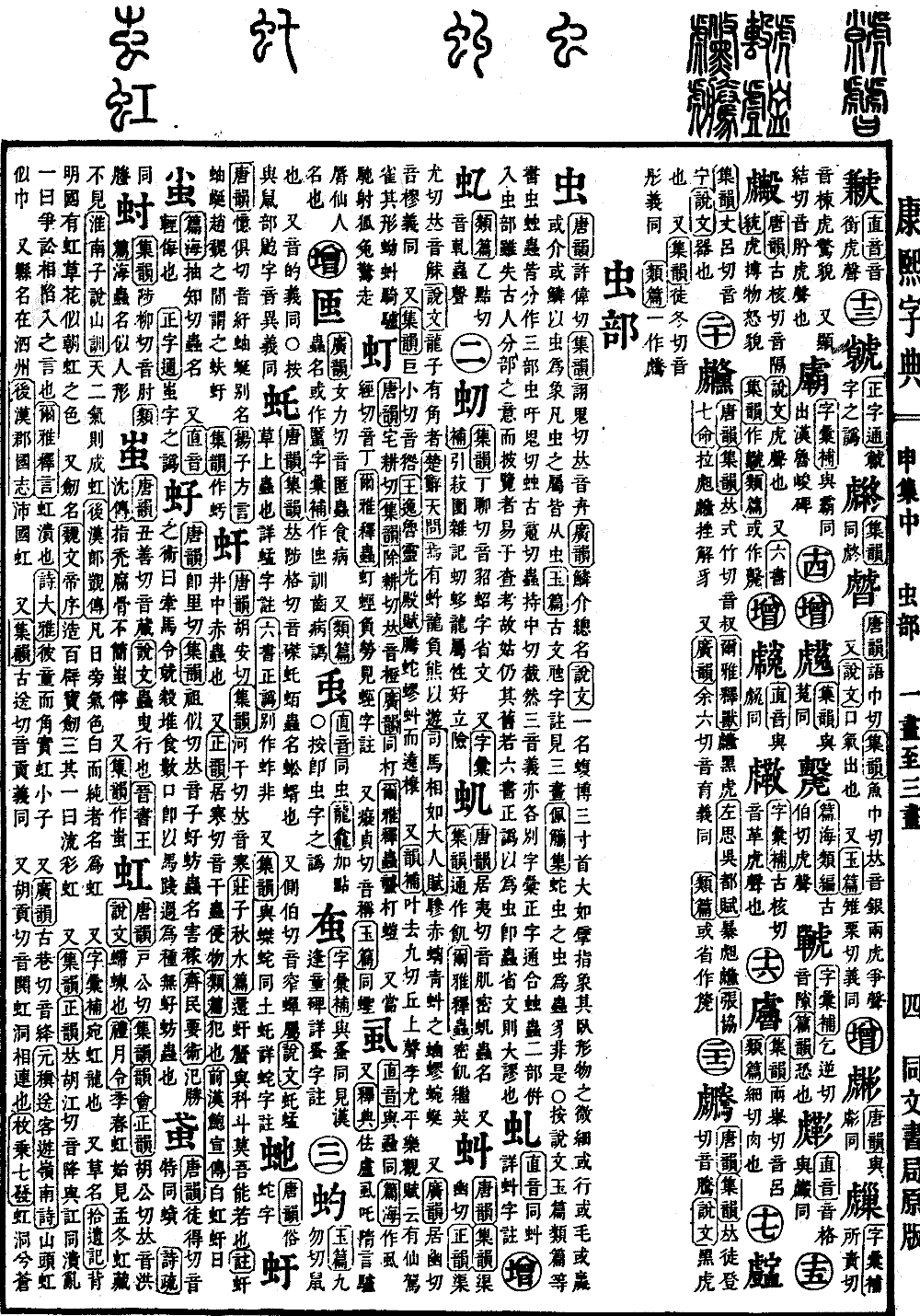
Shen Collection, Lower Volume
Radical: Insect (chóng)
Kangxi Strokes: 18
Page 1076, Entry 01
Pronounced zhong.
According to the Explaining Graphs and Analyzing Characters (Shuowen Jiezi), it is composed of three insect characters, representing the shape. All categories belonging to insects follow the insect radical.
According to the Record of Rites by Dai the Elder (Da Dai Liji), winged creatures number three hundred and sixty, with the phoenix as their leader. Fur-bearing creatures number three hundred and sixty, with the qilin as their leader. Shelled creatures number three hundred and sixty, with the sacred turtle as their leader. Scaled creatures number three hundred and sixty, with the jiaolong dragon as their leader. Naked creatures number three hundred and sixty, with the sage as their leader.
According to the Literary Expositor (Erya), entry on insects, those with feet are called chong, while those without feet are called zhi.
According to the Rites of Zhou (Zhouli), winter office, record of examinees, artisan section, creatures with external or internal skeletons, those that walk backward or sideways, those that walk continuously or in circles, those that call with their necks, mouths, sides, wings, legs, or chests, are all categorized as small insects and serve as subjects for carving.
According to the Record of Rites by Dai the Elder (Da Dai Liji), two multiplied by nine is eighteen; eight governs wind, and wind governs insects. Therefore, insects undergo change in the eighth month.
According to Xunzi, Exhortation to Learning, when flesh rots, insects are born from it.
Also, from the Book of Odes (Shijing), great elegantia section: hot and steamy, the insects swarm. The commentary states that the insect character here describes the appearance of intense heat.
Also, the peach-insect, the name of a bird. From the Book of Odes (Shijing), eulogies of Zhou: it began with that peach-insect. The commentary states that the peach-insect is the wren, a bird that starts small and grows larger.
Also, from the Book of Documents (Shujing), glorious achievement: the flower-insect was depicted on the robes. The commentary by Kong states that this refers to the pheasant.
Also, a place name. From the Zuo Commentary (Zuozhuan), nineteenth year of Duke Zhao: the Duke of Song attacked Zhu and besieged Chong for three months. The commentary notes that Chong was a city in the state of Zhu.
Also, the name of a book. In the Records of the Three Kingdoms (Weizhi), commentary by Pei Songzhi, it is noted that Handan Chun was skilled in the Cang Jie and the insect seal script.
Also, a surname. From the History of the Former Han (Qian Hanshu), table of meritorious officials: the Marquis of Qucheng, Chong Da.
Also, pronounced zhong. Identical to the character for worms eating food.
Also, pronounced tong. According to the Collected Rhymes (Jiyun), in the Literary Expositor (Erya), explanations of teaching: chong-chong refers to intense heat. It is sometimes written as the character for insect. According to the Distinctions of Sounds in the Classics (Qunjing Yinbian), for the phrase in the Book of Odes describing intense heat, the insect character is also pronounced tong. The Rhyme Collection (Yunhui) notes that the common writing of this character is incorrect.