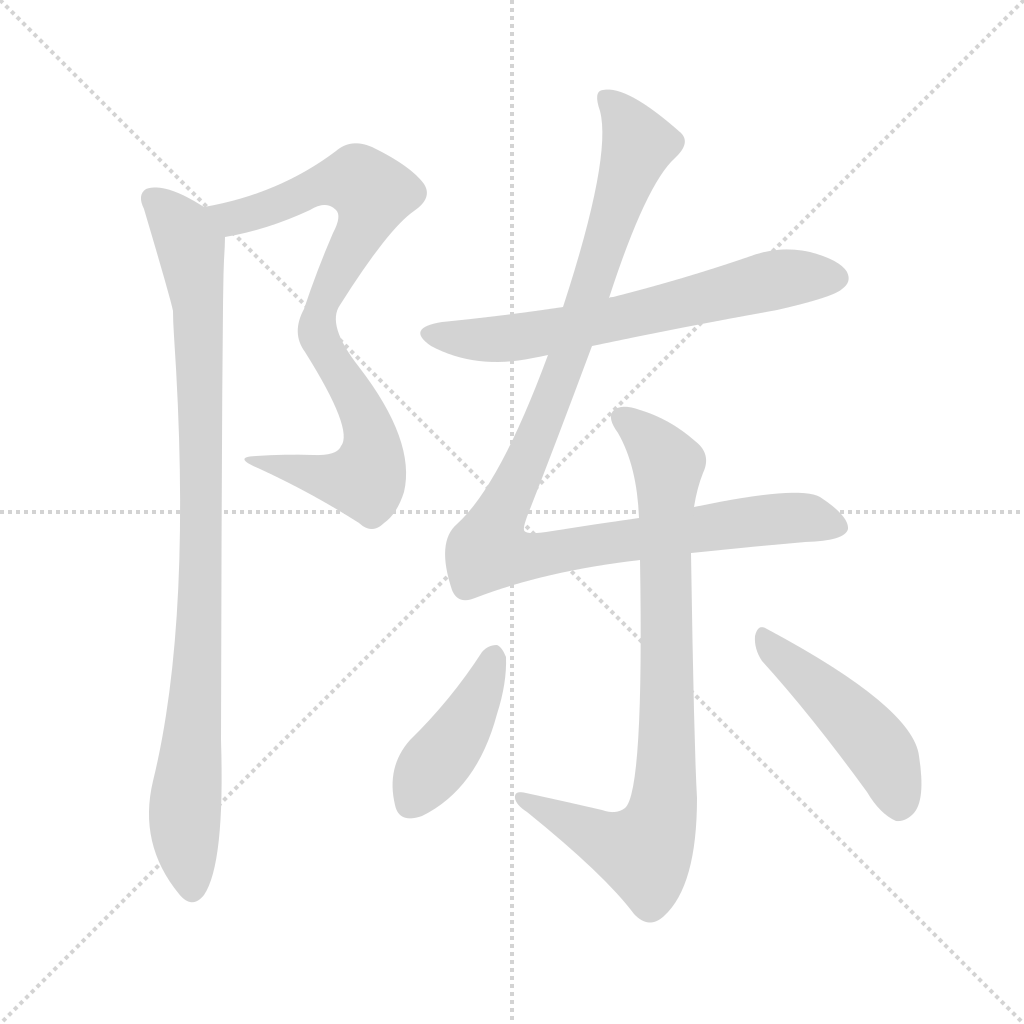
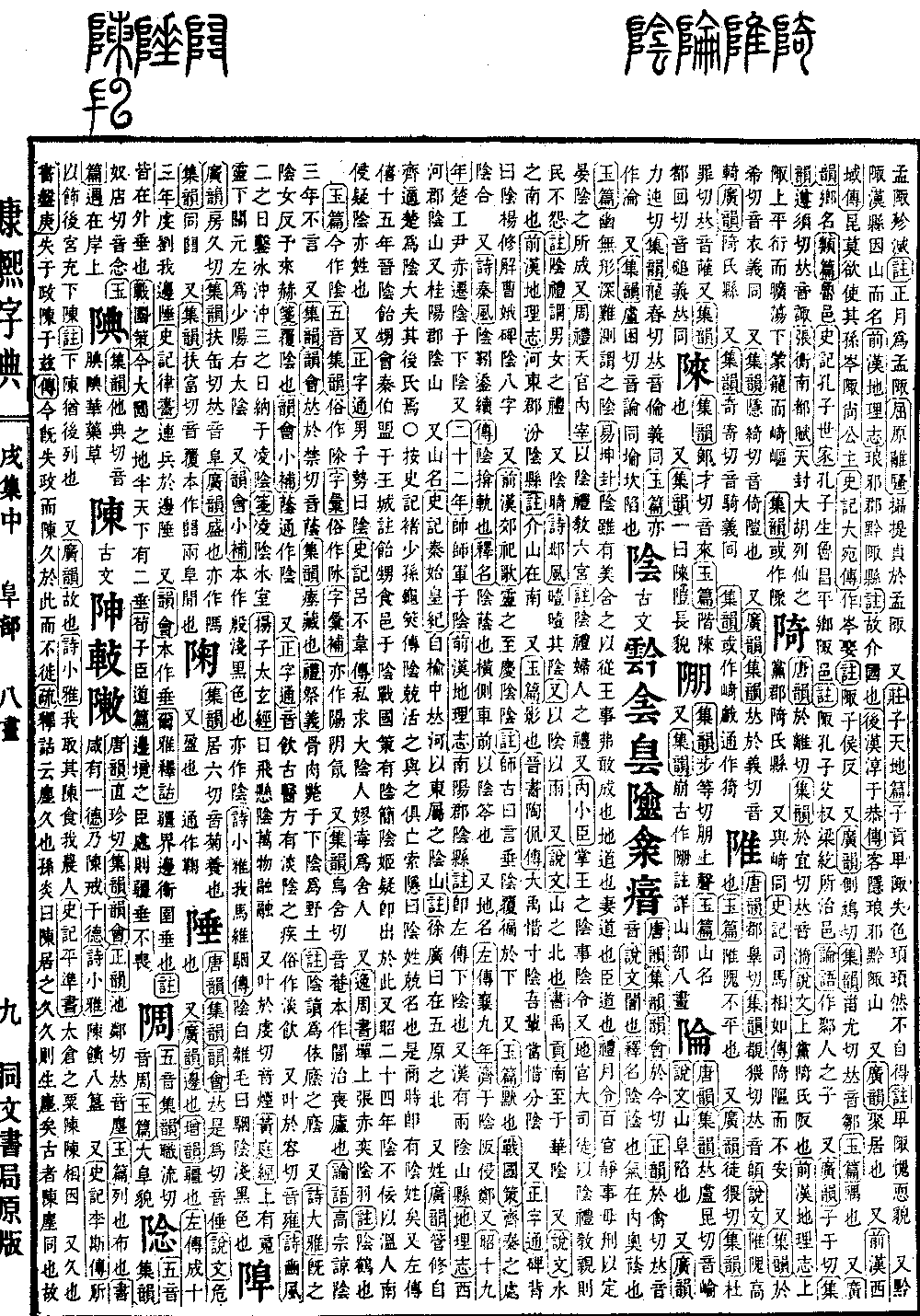
Xu Collection, Middle Volume. Radical: Mound (fù). Character: chén. Kangxi stroke count: 16. Page 1353. In ancient script, it was also written as the variant forms zhuàn or chén. According to Tang Rhymes (Tangyun), the pronunciation is determined by the fanqie zhí-zhēn. According to Collected Rhymes (Jiyun), Rhyme Assembly (Yunhui), and Correct Rhymes (Zhengyun), the pronunciation is determined by the fanqie chí-lín, pronounced the same as the word for dust (chén). According to Jade Chapters (Yupian), it is explained as to arrange or to set out. In the Book of Documents (Shangshu), it states: Thereupon he set forth and exhorted them regarding virtue. In the Book of Odes (Shijing), it states: Displaying the eight sacrificial vessels. Furthermore, in the Records of the Grand Historian (Shiji) within the Biography of Li Si, it states: Used to decorate the inner palace and fill the lower ranks. The Note explains that the term lower ranks (xiàchén) refers to the rear rows. Additionally, Broad Rhymes (Guangyun) explains the meaning as old. In the Book of Odes, it states: I take that old grain to nourish my farmers. In the Records of the Grand Historian within the Treatise on the Balanced Standard (Pingzhunshu), it states: In the Great Granary, old grain piles upon old grain. It is also explained as long-standing. In the Book of Documents within the Pan Geng section, it states: There have been errors in government, and it has remained here for a long time. The Commentary explains: Now that the administration has failed, it has stayed here for a long time without moving. The Sub-commentary notes that Explaining Words (Erya) says the word for dust (chén) means long-lasting. Sun Yan says: Living in a place for a long time results in dust (chén). In ancient times, the characters for dust and display were interchangeable, which is why it carries the meaning of long-standing. Broad Rhymes also explains the meaning as to publicize. In the Record of Rites (Liji) within the Record of the Presentation, it states: In serving a lord, one wishes to remonstrate but not to publicize his faults. The Note explains this refers to spreading his mistakes to the outside world. Broad Rhymes also defines the meaning as numerous. According to Explaining the Palace (Erya): The path from the hall to the gate is called chén. The Note explains this refers to the passage from below the hall to the inside of the gate. Explaining Names (Shiming) says it is the place where guests and hosts meet and line up. In the Book of Odes, it states: Who is that man, why does he pass through my hall-path? The Note explains it faces north toward the steps, and its southern side connects to the eaves inside the gate. It is also the name of a state. Broad Rhymes states that King Wu of Zhou enfeoffed Hu Gong Man, a descendant of Emperor Shun, in the State of Chen. After the State of Chu destroyed Chen, it was established as a county. In the Han dynasty, it was the Kingdom of Huaiyang, and in the Sui dynasty, it was established as Chen Prefecture. It is also a surname. Descendants of Hu Gong Man took the state name as their family name. Jade Chapters notes it is sometimes written as the character for dust (chén). According to Broad Rhymes and Collected Rhymes, the pronunciation is zhí-rèn, being the same as the character for battle formation (zhèn), referring to the rows of an army. For a detailed explanation, see the previous entry for the character zhèn. It is also read with the rhyming sound diān. In the Forest of Changes (Yilin), it states: The autumn harvest is not yet ripe and cannot be delivered. The water is too deep to cross, preventing me from advancing. In the Scripture of the Yellow Court (Huangting Jing), it states: Fire-soldier talismans are prepared at the spiritual gate, high in the front and low in the back. In this context, the word for gate rhymes with juān.