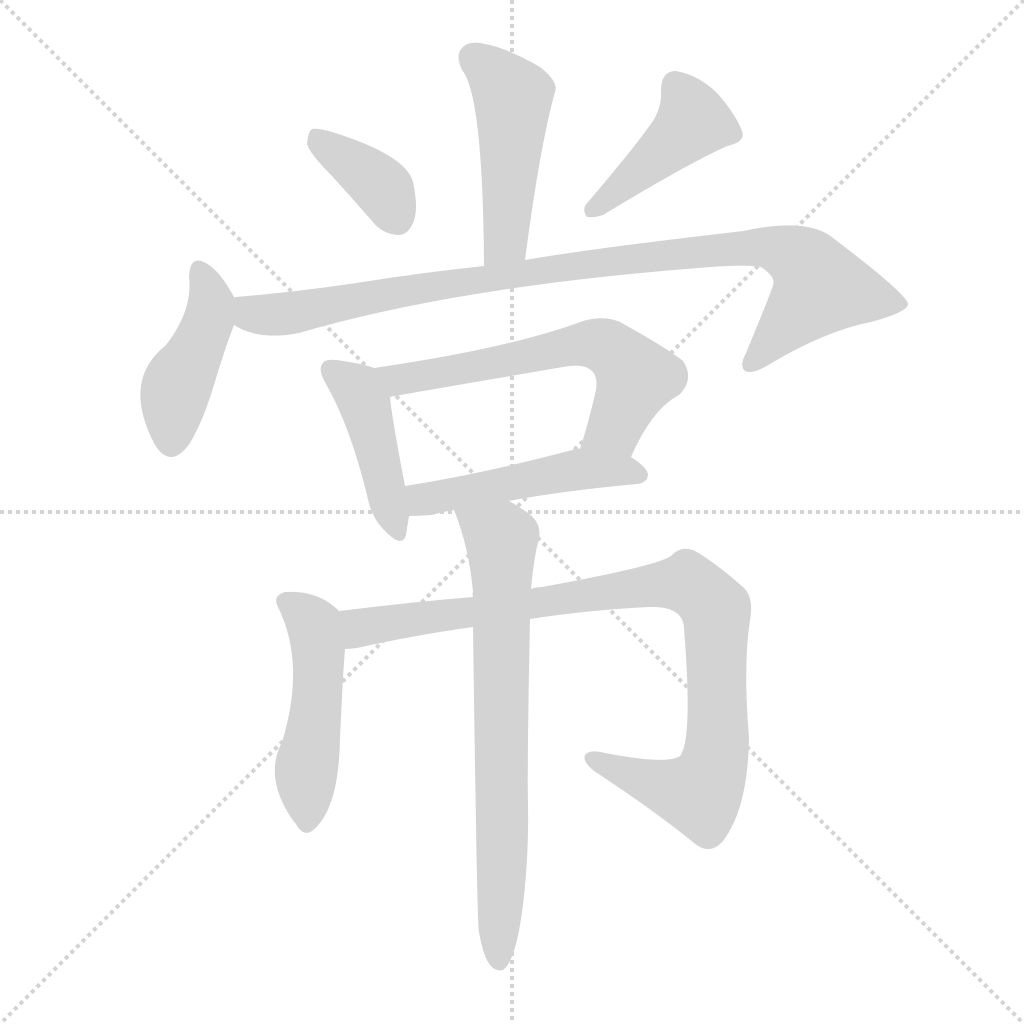
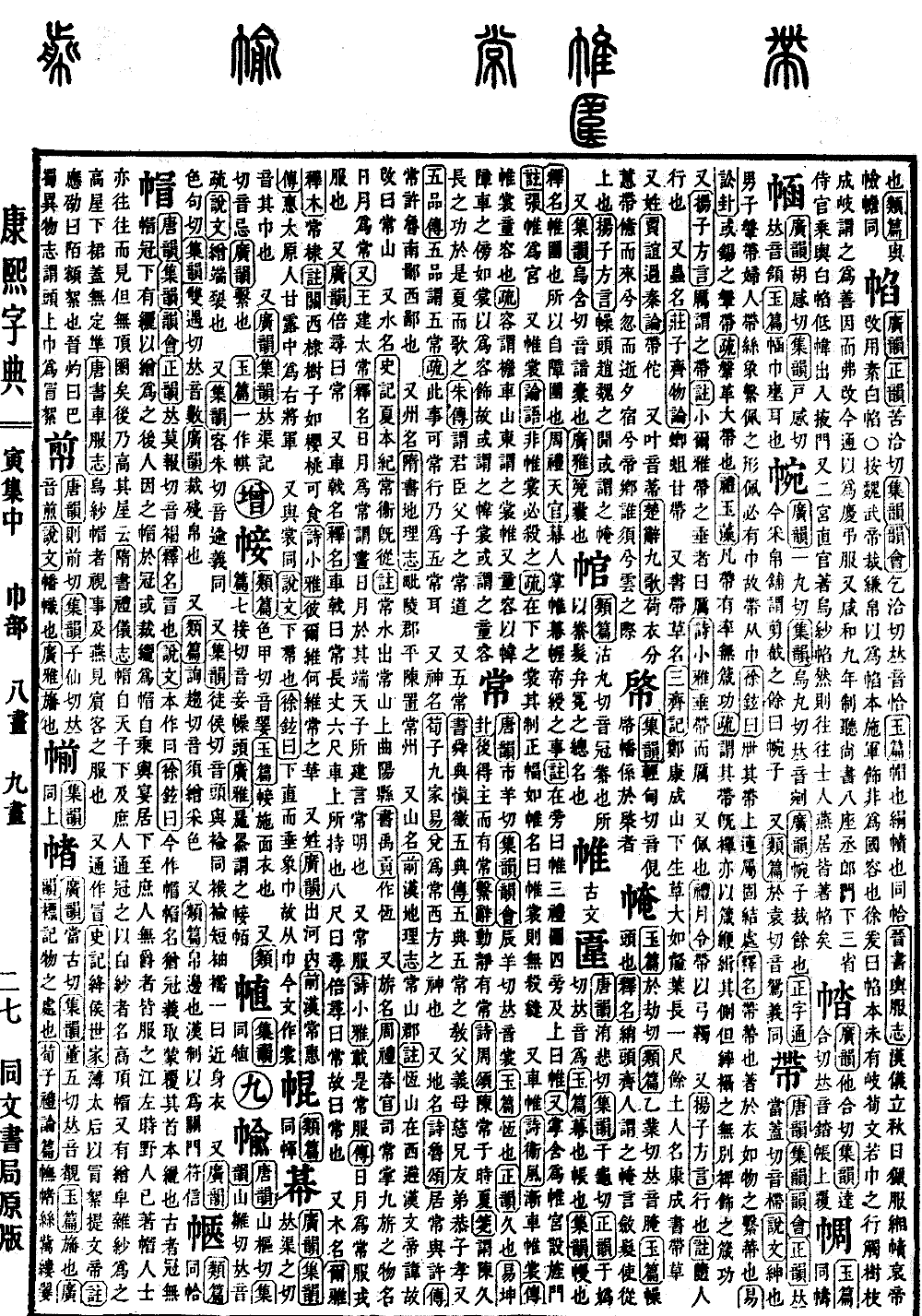
Yin Collection, Middle Volume
Radical: Turban (jīn)
Kangxi Strokes: 11
Page 333, Entry 12
Pronounced shang (rising tone).
Pronounced shang (rising tone).
Pronounced shang (rising tone).
Pronounced shang (rising tone).
Jade Chapters (Yupian): The meaning of constant or lasting.
Correct Rhymes (Zhengyun): The meaning of long-lasting.
Book of Changes (Yijing), Kun Hexagram: Later one obtains a host and thus possesses a constant path.
Appended Remarks (Xici): Movement and stillness both have regular patterns.
Book of Odes (Shijing), Odes of Zhou (Zhousong): Everlasting in this Xia dynasty.
Commentary (Jian): Refers to long-lasting achievements, thus singing praises in the Xia dynasty.
Zhu Xi’s Commentary (Zhu Zhuan): Refers to the constant path of rulers, ministers, fathers, and sons.
Also refers to the Five Constants (Wuchang).
Book of Documents (Shujing), Canon of Shun: Respect and improve the five constant virtues. Commentary: The five constant virtues are the teachings of the five constants: fathers are righteous, mothers are loving, elder brothers are friendly, younger brothers are respectful, and sons are filial.
Also, Commentary on the Five Ranks (Wupin Zhuan): The five ranks refer to the five constants.
Sub-commentary (Shu): These matters can be constantly practiced, thus they become the five constants.
Also refers to a deity name.
Xunzi, Nine Schools of Changes (Jiujia Yi): The Dui hexagram represents Chang, the deity of the west.
Also refers to a place name.
Book of Odes (Shijing), Odes of Lu (Lusong): Dwelling in Chang and Xu.
Commentary: Chang and Xu are the southern and western border towns of the State of Lu.
Also refers to a prefecture name.
History of Sui (Suishu), Treatise on Geography: Piling Commandery was designated as Chang Prefecture upon the pacification of the Chen dynasty.
Also refers to a mountain name.
History of the Former Han (Qianhan Shu), Treatise on Geography: Chang Mountain Commandery.
Note: Heng Mountain is to the west of the commandery; it was renamed Chang Mountain to avoid the naming taboo of Emperor Wen of Han.
Also refers to a river name.
Records of the Grand Historian (Shiji), Annals of Xia: The Chang River and Wei River have both been dredged.
Note: The Chang River originates in Qu Yang County on Chang Mountain.
Book of Documents (Shujing), Tribute of Yu (Yugong): Written as Heng.
Also refers to a flag name.
Rites of Zhou (Zhouli), Offices of Spring (Chunguan): The Minister of Banners manages the colors and names of the nine types of flags; those painted with the sun and moon are called chang.
Also: The Son of Heaven erects the Great Chang flag.
Explanation of Names (Shiming): Those painted with the sun and moon are called chang. This means that the sun and moon are painted on the tip of the flag, which is erected by the Son of Heaven to signify eternal brightness.
Also refers to standard ceremonial dress.
Book of Odes (Shijing), Lesser Odes (Xiaoya): Raise these standard ceremonial clothes.
Commentary: The flag painted with the sun and moon is the standard ceremonial dress, which is military attire.
Also, Wide Rhymes (Guangyun): Twice the length of one xun (an ancient measure of eight feet) is called a chang.
Also refers to a type of chariot halberd.
Explanation of Names (Shiming): A chariot halberd is called a chang, sixteen feet in length; it is a weapon held on a chariot. Eight feet are called a xun, and twice a xun is a chang, hence it is called chang.
Also refers to a tree name.
Erya, Explanation of Trees (Shimu): Changdi (a species of crabapple).
Note: The di tree of the Guanzhong region; its fruit resembles a cherry and is edible.
Book of Odes (Shijing), Lesser Odes (Xiaoya): What is that in full bloom? It is the flower of the changdi tree.
Also refers to a surname.
Wide Rhymes (Guangyun): Originates from Henei Commandery.
History of the Former Han (Qianhan Shu), Biography of Chang Hui: Chang Hui, a man from Taiyuan, reached the rank of General of the Right during the Ganlu era.
Also interchangeable with shang (garment).
Explaining Characters (Shuowen): It is a skirt for the lower body.
Xu Xuan says: Because the lower part hangs down straight and its shape resembles a cloth (jin), it uses the Turban radical. In contemporary writing, it is written as shang.