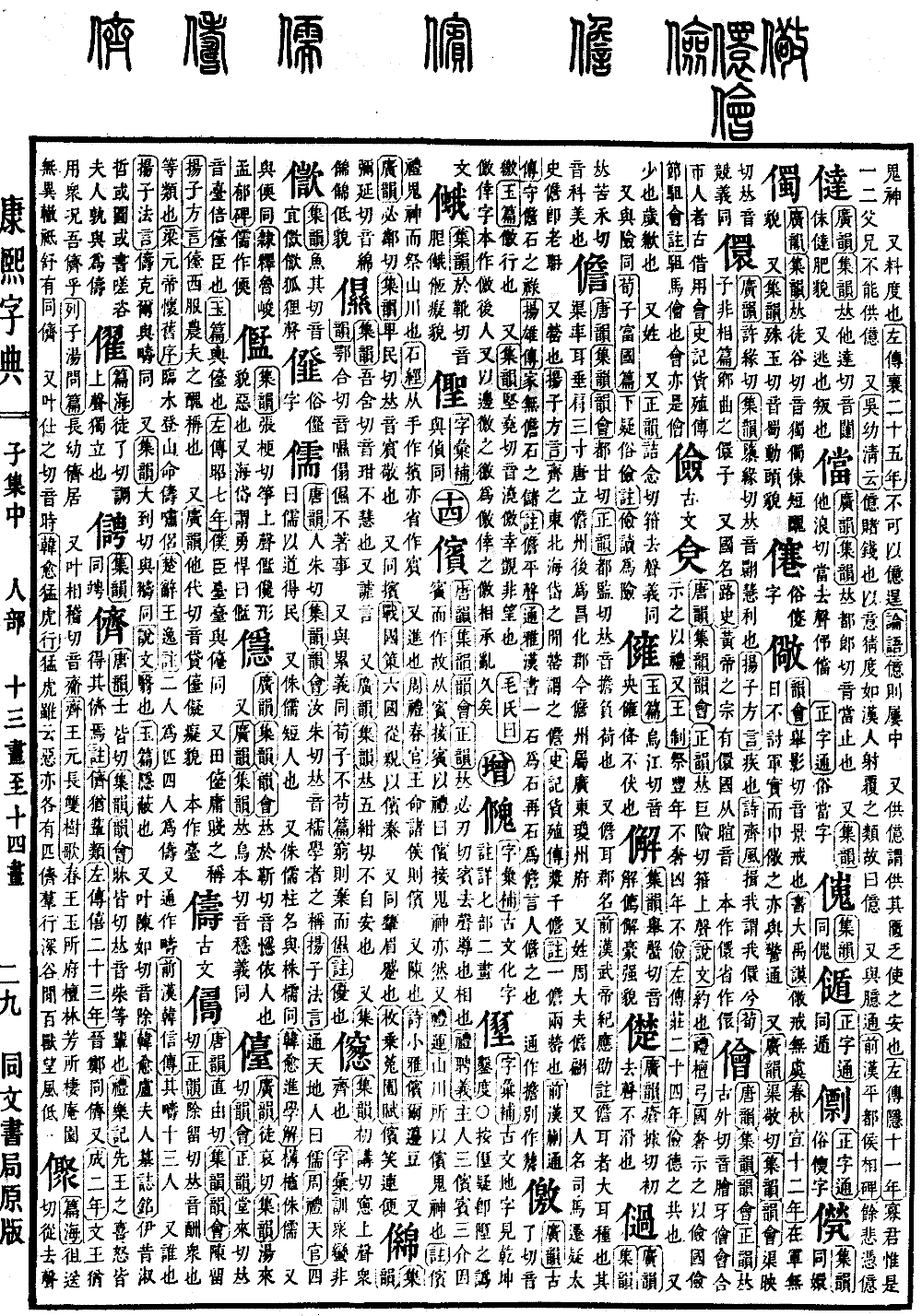
Zi Collection, Middle Volume
Radical: Person (rén)
Chái
Kangxi Stroke Count: 16
Page 119
According to the Tang Dynasty Rhymes (Tangyun), the pronunciation is the fanqie of shì and jiē. According to the Collected Rhymes (Jiyun) and the Rhyme Collection (Yunhui), the pronunciation is the fanqie of chuáng and jiē. It is pronounced like chái.
People of the same generation or class; peers.
The joy and anger of the former kings all harmonized with the feelings of their peers. — Record of Ritual (Liji), Record of Music (Yueji).
Commentary: Chái means those of the same generation or the same kind.
The states of Jin and Zheng are of the same class. — Zuo Commentary (Zuozhuan), the 23rd year of Duke Xi.
Also mentioned in the 2nd year of Duke Cheng: King Wen even employed ordinary people, how much more so for those of our class?
People of all ages live together with their peers. — Master Lie (Liezi), Questions of Tang (Tangwen).
Also used as a rhyming character with the fanqie of xiāng and jī, pronounced like qí.
Song of the Twin Trees by Prince Yuanchang of Qi: The spring king's jade storehouse, the sandalwood forest where fragrance rests. In the monastery garden there are no diverging paths, only peers gathered together.
Also used as a rhyming character with the fanqie of shì and zhī, pronounced like shí.
Ballad of the Fierce Tiger (Menghu Xing) by Han Yu: Although the fierce tiger is said to be cruel, they each have their own companions. Traveling in groups within the deep valleys, the hundred beasts flee upon seeing them.