Wei Collection, Lower Volume
Radical: Boat (zhōu)
Kangxi Strokes: 11
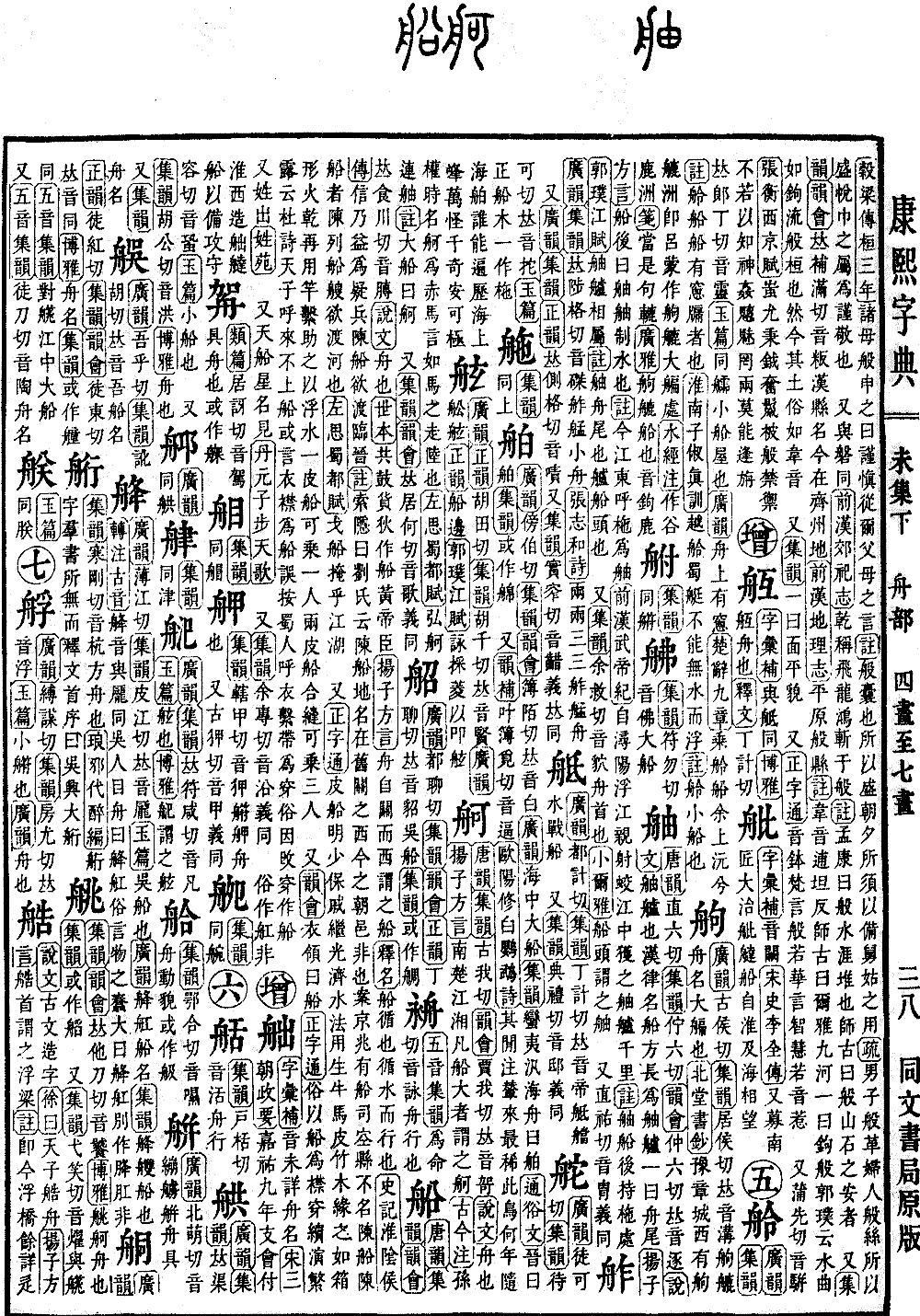
Page 1010, Entry 17
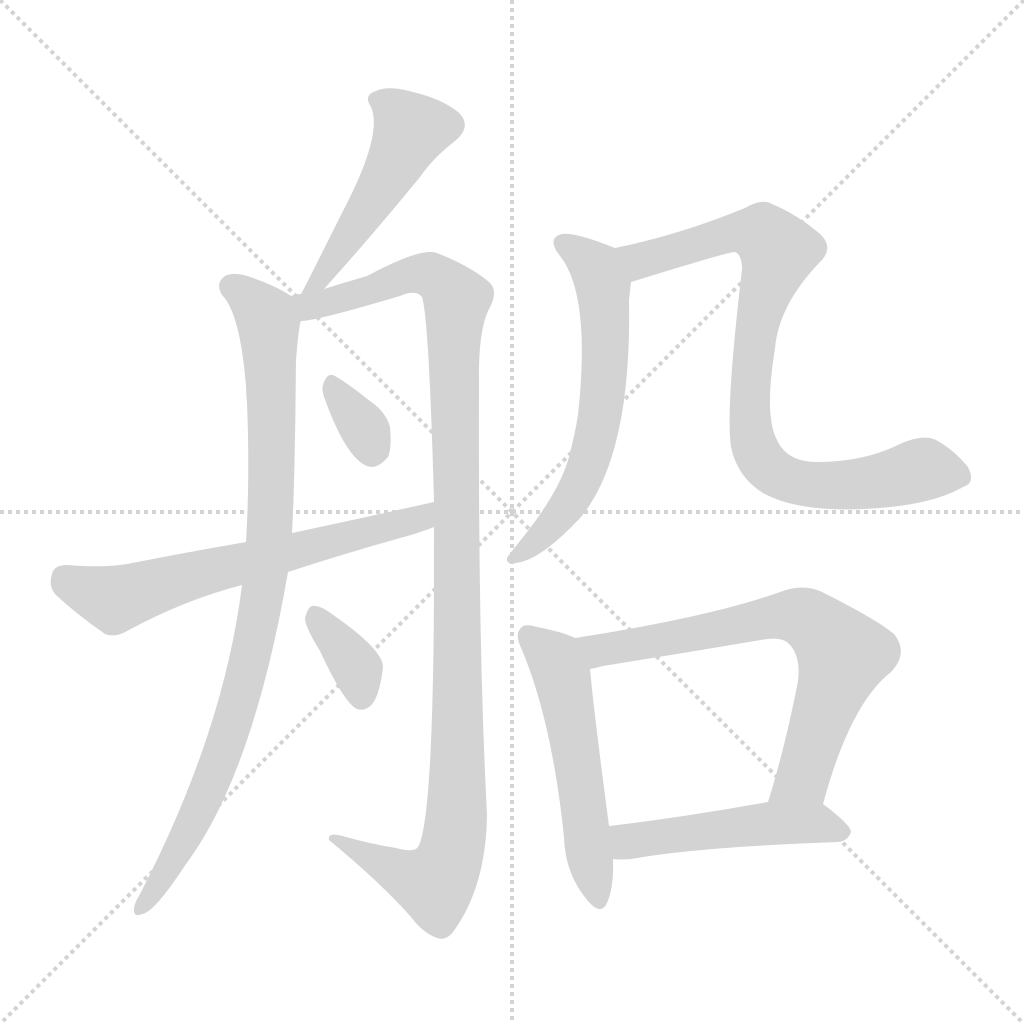
Pronounced chuan.
According to the Explanation of Simple and Compound Characters (Shuowen Jiezi), it refers to a vessel.
According to the Genealogy of Generations (Shiben), Gonggu and Huodi created the boat; they were ministers of the Yellow Emperor.
According to the Dialects of Yang Xiong (Fangyan), a boat is called a chuan in areas west of the passes.
According to the Definitions of Names (Shiming), a chuan is a follower; it follows the water as it travels.
In the Records of the Grand Historian (Shiji), Biography of the Marquis of Huaiyin, it is written: Xin then increased the size of his decoy troops, arranging boats to cross at Linjin. The commentary notes: The Suyi says: The Liu family claims that Chenchuan is a place name located west of the old pass, now known as Chaoyi; this is incorrect. Records show that Jingzhao had a Boat Overseer County (Chuansikong Xian), and it was not named Chenchuan. Chenchuan means to arrange boats in a line to prepare for a river crossing.
In the Rhapsody on the Capital of Shu (Shudu Fu) by Zuo Si: Spear-carrying boats cover the rivers and lakes.
Furthermore, according to the Direct Explanation of Characters (Zhengzitong): A leather boat. During the Ming dynasty, Junior Guardian Qi Jiguang used a water-crossing method involving raw cow or horse hides stretched over bamboo and wood into a box shape, dried by fire, and reinforced with poles to allow buoyancy. A single leather boat could carry one person, and two leather boats joined together could carry three.
Furthermore, according to the Collection of Rhymes (Yunhui): The collar of a garment is called a chuan.
According to the Direct Explanation of Characters (Zhengzitong): People commonly use the character for boat to represent the lapel of a garment. The Continuation of the Extended Notes (Xu Yanfanlu) states: In the poetry of Du Fu, the line The Son of Heaven calls, yet he does not board the boat, is sometimes interpreted as the lapel of a garment being a boat; this is a mistake. It is noted that people in Shu refer to the ties of a garment as chuan, and the common people mistakenly changed the original word to boat.
Also a surname. Appears in the Garden of Surnames (Xingyuan).
Also the Heavenly Boat, a star name. Appears in the Starry Songs of Danyuanzi (Butian Ge).
Furthermore, according to the Collection of Rhymes (Yunhui): Pronounced yuan. The meaning is the same. The character is commonly written as a variant form, but that is incorrect.