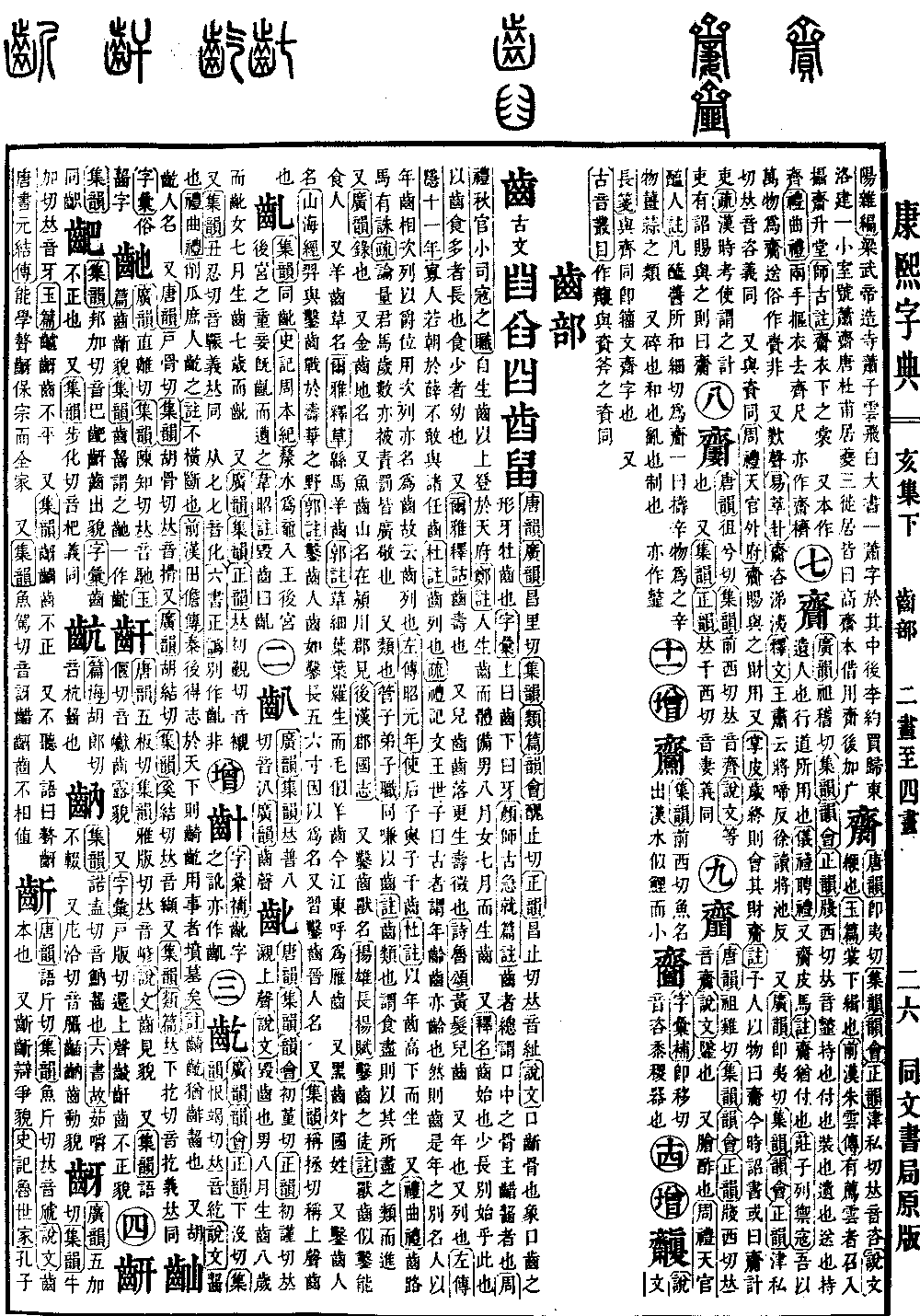
Hai Collection, Lower Volume
Radical: Tooth (chǐ)
Kangxi Strokes: 15
Page 1532, Entry 01
Archaic script
Pronounced chi (rising tone)
According to the Explaining Graphs and Analyzing Characters (Shuowen Jiezi), it refers to the bones in the gums of the mouth. It represents the shape of the teeth in the mouth. Ya refers to male teeth. According to the Dictionary of Characters (Zihui), those in the upper jaw are called chi, while those in the lower jaw are called ya.
Commentary by Yan Shigu on the Urgent Need (Jijiu Pian) states that chi is a general term for the bones in the mouth, used for biting and chewing.
According to the Rites of Zhou (Zhouli), Autumn Office, duties of the Minor Official of the Teeth: From the time teeth emerge, they are recorded in the Celestial Storehouse. Zheng commentary: When a person grows teeth, the body is complete; boys grow them at eight months, girls at seven months.
Also, according to the Explaining Names (Shiming), chi means to begin; seniority is distinguished starting from this. Those who have consumed more food are senior; those who have consumed less are young.
Also, according to the Er Ya (Erya), Explaining Ancient Words, nichi refers to longevity. Commentary: When teeth fall out and are replaced by small ones. Commonly written as the character for child (ér).
Book of Odes (Shijing), Odes of Lu (Lusong): Yellow hair and infantile teeth.
Also, it means age.
Also, it means to arrange in order.
Zuo Tradition (Zuozhuan), Eleventh Year of Duke Yin: If I, the ruler, were to attend court at Xue, I would not dare to be ranked with the various Ren clans. Du commentary: Chi means to arrange. The sub-commentary notes that the Record of Rites (Liji), Hereditary Lineage of King Wen, states that the ancients referred to age as chi; chi is also a term for age. Thus, chi is another name for age. People are arranged sequentially by age; using rank to arrange is also called chi, hence it is said that chi means ranking.
Zuo Tradition (Zuozhuan), First Year of Duke Zhao: Caused Houzi and Zigan to be ranked. Du commentary: Seated according to their relative age.
Also, Rites of Propriety (Quli): Ranking road horses involves penalties. Sub-commentary: Discussing and assessing the age of the ruler's horses is also subject to punishment; all these are to extend respect.
Also, it means category.
Guanzi (Guanzi), Student Duties: Distribute according to category. Commentary: Chi means category. It means that when food is finished, one proceeds according to the category of what was finished.
Also, according to the Guangyun, it means to record.
Also, Jinchi, a place name.
Also, Yuchi, a mountain name. Located in Yingchuan Commandery. Seen in the Record of Commanderies (Junguozhi) of the Later Han.
Also, Zaochi, a type of beast. Yang Xiong, Rhapsody on Longyang (Changyang Fu): Followers of Zaochi. Commentary: The beast's teeth resemble chisels and it can eat humans.
Also, Yangchi, a type of herb. Er Ya, Explaining Plants: Mianma and Yangchi. Guo commentary: The herb has fine leaves, arranged in layers and fuzzy, resembling sheep teeth; currently in the Jiangdong region it is called Yanchi.
Also, Heichi, a foreign surname.
Also, Zaochi, a person's name. Classic of Mountains and Seas (Shanhaijing): Yi fought Zaochi in the wilderness of Shouhua. Guo commentary: Zaochi had teeth like chisels, five or six inches long, and was named accordingly.
Also, Xi Zaochi, a person's name from the Jin dynasty.
Also, according to the Jiyun, pronounced cheng (rising tone). It means teeth.
Editorial note: The Er Ya entry regarding nichi meaning longevity notes: nichi refers to teeth falling out and being replaced by small ones, a sign of longevity. I note that the Er Ya defines nichi as longevity, not chi as longevity. I have corrected this to state nichi means longevity, with the commentary noting that it refers to teeth falling out and being replaced by small ones, commonly written as the character for child.