Hai Collection, Lower Volume
Radical: Tooth (chǐ)
Kangxi Strokes: 15
Page 1532, Entry 08
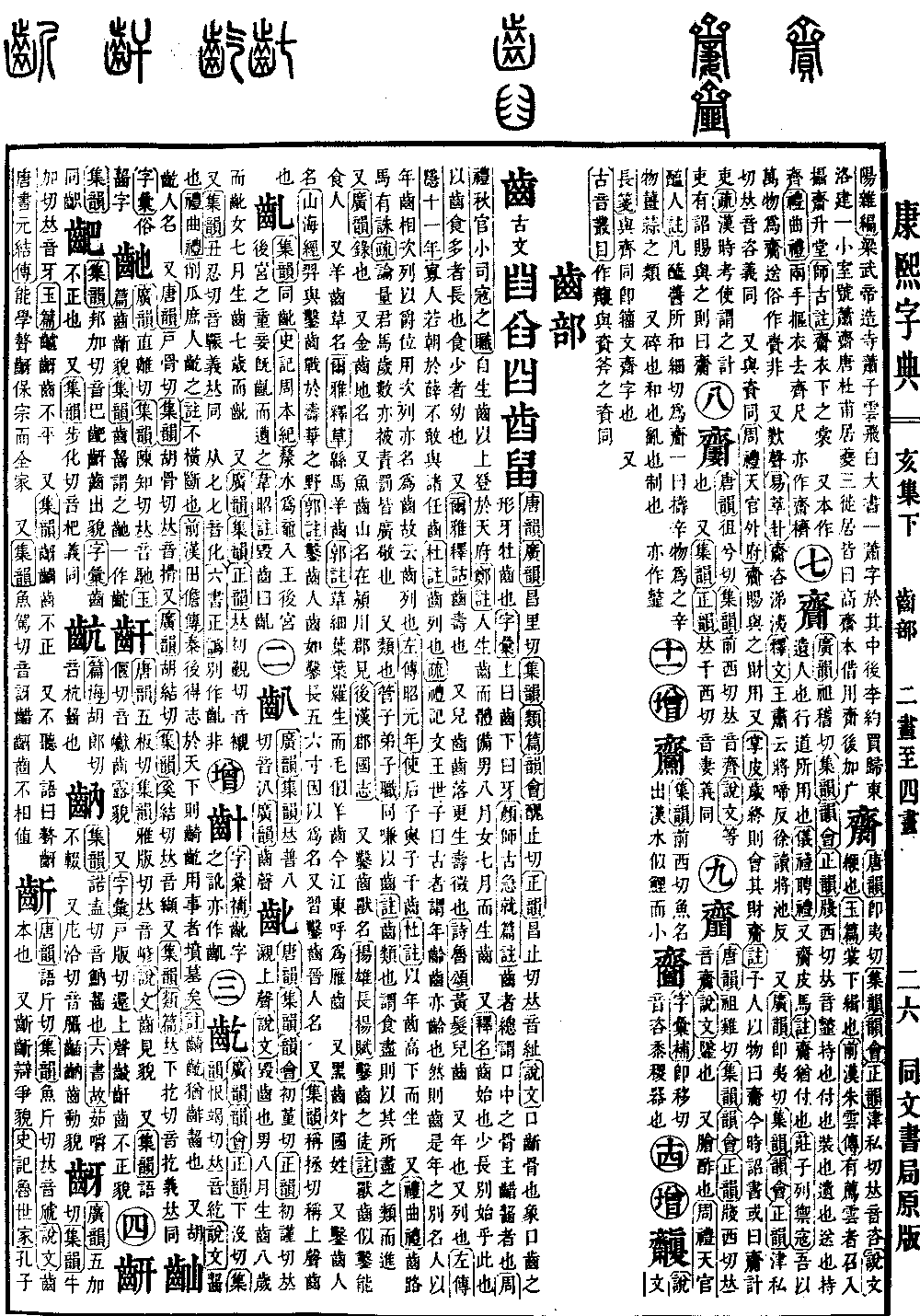
Ancient script. Pronounced chi. Pronounced chi. Pronounced chi. The pronunciation is the same as the character for teeth. According to the Analytical Dictionary of Chinese Characters (Shuowen Jiezi), this refers to the bones in the oral cavity that grow into teeth. The character shape resembles the appearance of teeth in a mouth. Ya refers to the large teeth. According to the Comprehensive Collection of Characters (Zihui), those on the top are called chi, and those on the bottom are called ya. According to Yan Shigu’s Commentary on the Quick to Learn (Jijiupian Zhu), chi is the collective term for the bones in the mouth, primarily responsible for chewing food. In the Rites of Zhou (Zhouli), Autumn Offices, Office of the Lesser Administrator, it is stated that those who have reached the age of developing teeth are recorded in official archives. Zheng’s commentary notes that a person’s physical development is complete once teeth have grown; boys begin to grow teeth at eight months, and girls at seven months. Also, according to the Explanations of Names (Shiming), chi implies the meaning of beginning. From youth to adulthood, the distinction begins here. Because those who use their teeth to eat more are older, and those who use them to eat less are younger. Also, in the Erya, a dictionary of definitions (Erya, Shigu), ni-chi (new growth of teeth) is a symbol of longevity. Note: This refers to fine new teeth growing back after the original teeth have fallen out. It is used as a loan character for the character meaning child or infant. In the Book of Odes (Shijing), Lu Eulogy, it mentions yellow hair and child-like teeth. It also refers to age. It further refers to rank or order. In the Zuo Tradition (Zuozhuan), Eleventh Year of Duke Yin, it is said that if the ruler travels to the state of Xue, he does not dare to rank himself alongside the states of the Ren surname. Du’s commentary states that chi means to be placed in order or side-by-side. The commentary notes that the Record of Rites (Liji), Hereditary Prince Wenwang, states that in ancient times age was called ling; chi is another term for age. Thus, people are ranked by age, and the ranking by status is also called chi, hence the term ranking by teeth. In the Zuo Tradition (Zuozhuan), First Year of Duke Zhao, it is mentioned that he allowed Houzi and Zigan to be seated according to their age. Du’s commentary notes that this refers to arranging seats according to seniority. Also, in the Record of Rites (Liji), Qu Li, it states that discussing the age of the ruler’s horses in private is punishable. The commentary explains that estimating the age of a ruler’s horses is also punishable, all to cultivate a sense of widespread reverence. It also refers to category. In the Guanzi, Student Duties, it is stated that after eating, one should clear the table according to category. The commentary notes that chi means category, implying that after eating, one should clear the offerings according to the type of food consumed. Also, according to the Expanded Rhyme Dictionary (Guangyun), it carries the meaning of being recorded. It also refers to Jinchi, a place name. It also refers to Yuchi, a mountain name located in Yingchuan Commandery, as seen in the Records of Commanderies and States in the Later Han (Houhan Junuozhi). Also, Zaochi is the name of a wild beast. In Yang Xiong’s Rhapsody on the Long Yang (Changyang Fu), it mentions people like Zaochi. The commentary notes that the beast’s teeth are like chisels and can eat humans. Also, Yangchi is the name of a plant. In the Erya, Explanations of Plants (Erya, Shicao), it mentions soft horse-teeth plants. Guo’s commentary notes that the leaves are fine, grow in interlocking clusters, and are hairy, resembling the teeth of a sheep; in the Jiangdong region, they are now called wild goose teeth. Also, Heichi is a foreign surname. Also, Zaochi is a personal name. In the Classic of Mountains and Seas (Shanhaijing), Houyi fought Zaochi in the wild of Shouhua. Guo’s commentary notes that Zaochi refers to a person whose teeth were shaped like chisels and were five or six inches long, hence the name. Also, Xi Zaochi is the name of a person from the Jin dynasty. Also, according to the Collection of Rhymes (Jiyun), it is pronounced cheng (rising tone). It refers to teeth. Editorial note: The Erya, Explanations of Definitions, states that chi signifies longevity. Also, ni-chi refers to teeth regrowing after falling out, a sign of longevity. I have carefully examined the Erya, which uses ni-chi for longevity, not chi itself. It is hereby corrected to: ni-chi signifies longevity. Note: This refers to fine new teeth growing after the originals have fallen out, used as a loan for the character meaning child.