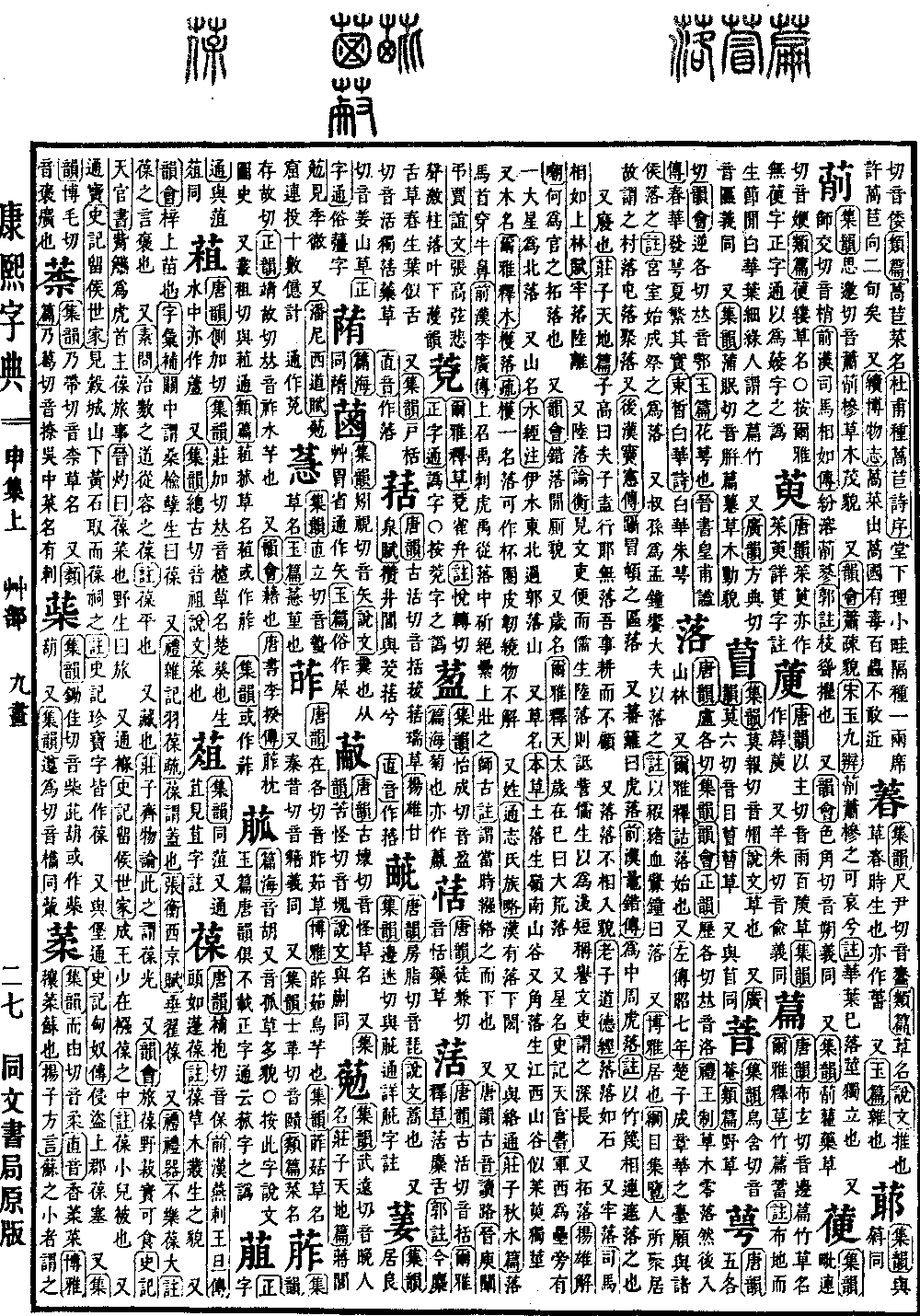
Shen Collection, Upper Volume
Radical: Grass (cǎo)
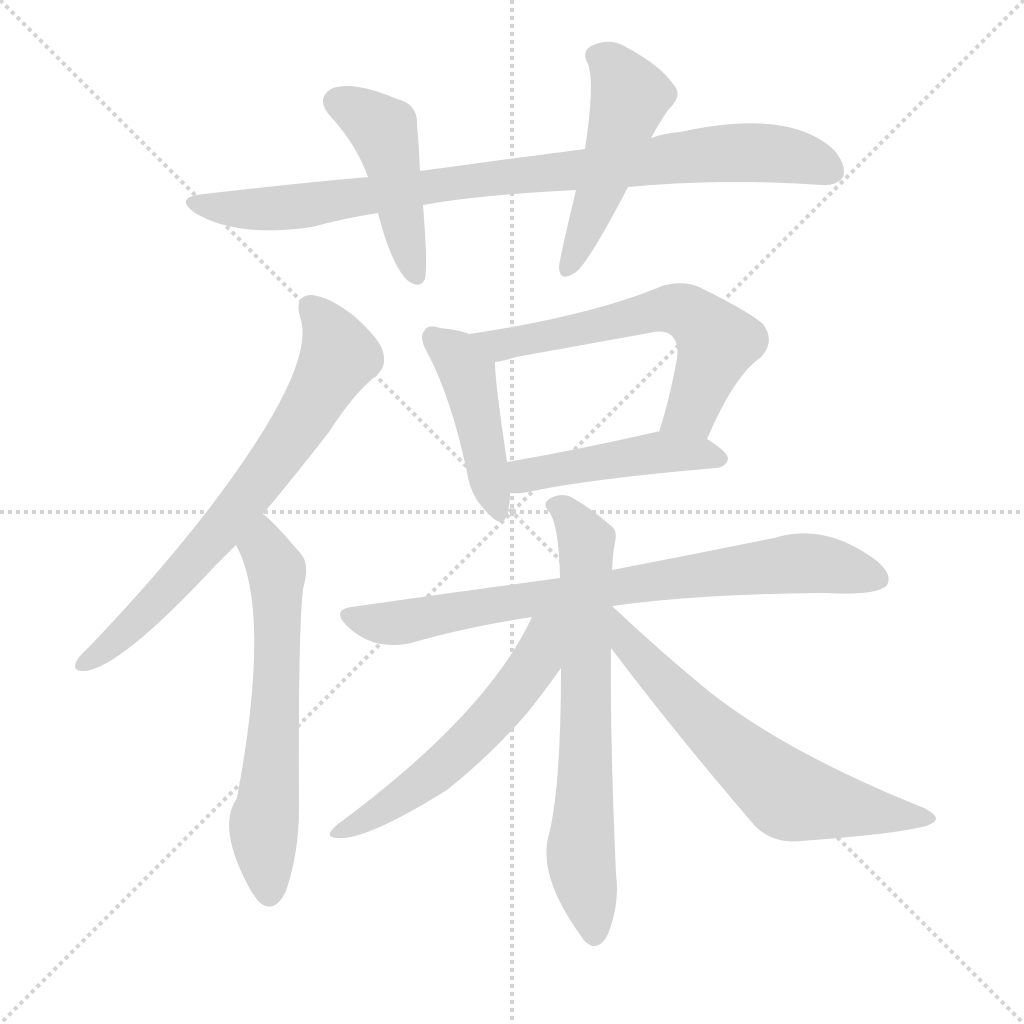
葆
Kangxi strokes: 15
Page 1043, Entry 30
Pronounced bǎo.
From the Biography of Prince Dan of Yan in the History of the Former Han (Qianhan shu): With hair gathered in tufts like horns. Commentary: Bǎo describes the appearance of vegetation growing in thick clusters.
Also, in the Rhyme Collection (Yunhui): The sprouts upon a catalpa tree.
The Supplementary Lexicon (Zihui bu): In the Guanzhong region, the secondary growth of mulberry and elm trees is called bǎo.
Also, in the Book of Rites (Liji), Miscellaneous Records (Zaji), commentary on feather canopies: Bǎo refers to a cover or canopy.
Zhang Heng, Western Capital Rhapsody (Xijing fu): Drooping with pheasant-feather canopies.
Also, in the Book of Rites (Liji), Ritual Vessels (Liqi): Not rejoicing in great abundance. Commentary: Bǎo is synonymous with bāo (praise or abundance).
Also, in the Basic Questions (Suwen): The way of treating numbers is to follow the ease of stability. Commentary: Bǎo means level or stable.
Also means to store or conceal.
Zhuangzi, Discussion on Making All Things Equal (Qiwu lun): This is what is called concealing the light.
Also, in the Rhyme Collection (Yunhui): Lǚbǎo is a type of wild legume with edible fruit.
Records of the Grand Historian (Shiji), Treatise on the Celestial Offices (Tianguan shu): The constellation Zixui acts as the head of the tiger, overseeing the affairs of wild legumes. Jin Zhuo says: Bǎo refers to vegetables. Wild growth is called lǚ.
Also interchangeable with bǎo (swaddling clothes).
Records of the Grand Historian (Shiji), Hereditary House of the Marquis of Liu (Liuhou shijia): When King Cheng was young and in swaddling clothes. Commentary: Bǎo refers to the wrapping for an infant.
Also interchangeable with bǎo (treasure).
Records of the Grand Historian (Shiji), Hereditary House of the Marquis of Liu (Liuhou shijia): He saw the Yellow Stone under Gucheng Mountain and took it to treasure and worship it. Commentary: In the Records of the Grand Historian, the character for precious treasure is always written as bǎo.
Also interchangeable with bǎo (fortress).
Records of the Grand Historian (Shiji), Account of the Xiongnu: Invading and stealing from the fortified passes of Shang Commandery.
Also, in the Collected Rhymes (Jiyun): Pronounced bāo. Means wide or broad.