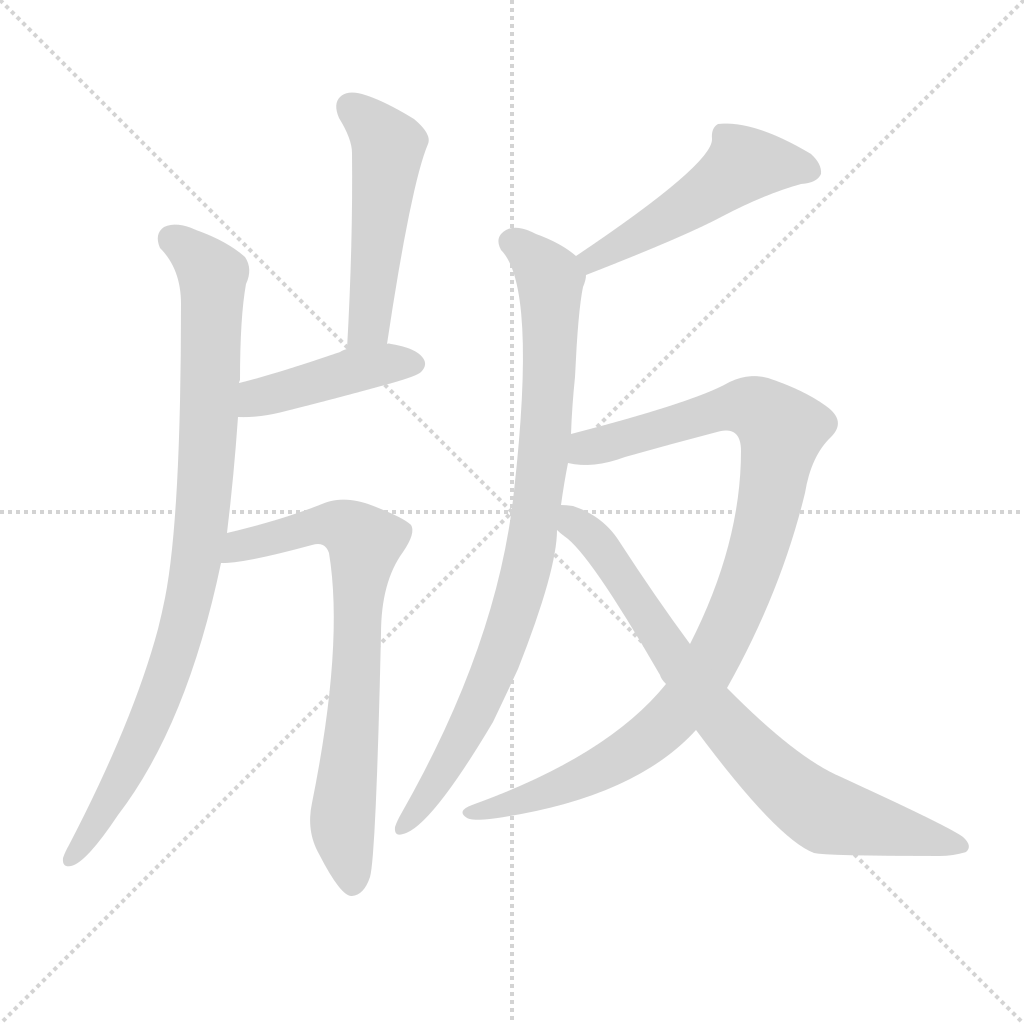
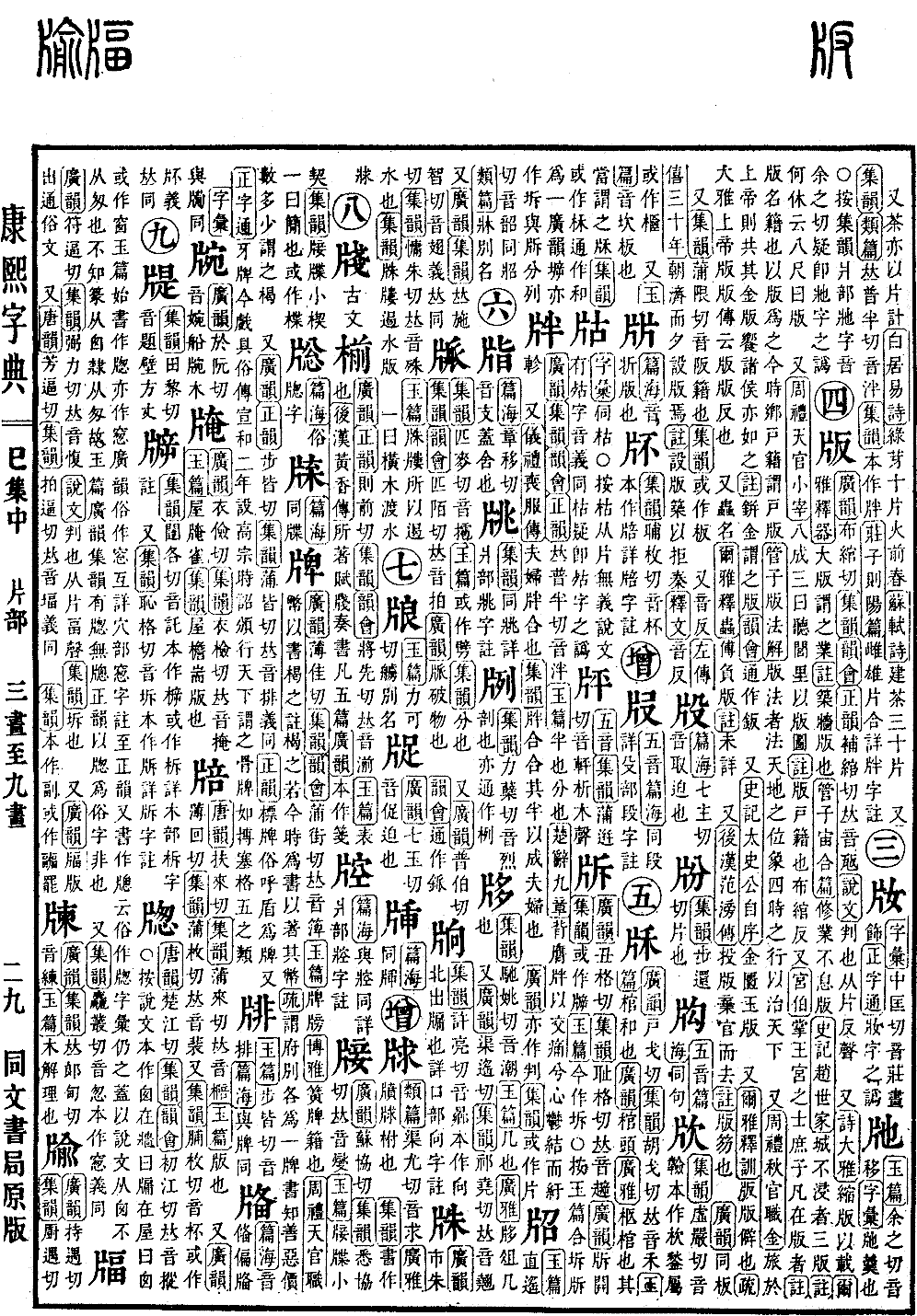
Si Collection, Middle Volume
Radical: Splinter (piàn)
Kangxi Strokes: 8
Page 693, Entry 03
Pronounced ban. According to the Expanded Dictionary of Sounds (Guangyun), the Dictionary of Combined Rhymes (Jiyun), the Collection of Rhymes (Yunhui), and the Correct Rhymes (Zhengyun), the pronunciation is the same as the character ban.
Explaining the Origin of Characters (Shuowen Jiezi) defines it as to split open. The character is formed from the Splinter (piàn) radical, with the component meaning to reverse acting as the phonetic.
The Book of Odes (Shijing), Great Odes (Daya) states: "Use the bound wall-building boards to carry earth."
The Literary Expositor (Erya), Interpretation of Implements (Shiqi) states: A large wooden board is called an ye. The commentary notes that this refers to the wooden boards used in building walls.
Guanzi, Section on Space and Time (Zhouhe) states: "Cultivating and managing affairs continuously is like constructing with boards."
Records of the Grand Historian (Shiji), Hereditary House of Zhao states: "The part of the city wall not yet submerged by water only remained three boards high." The commentary notes that He Xiu states: Eight feet equal one board.
The Rites of Zhou (Zhouli), Offices of Heaven (Tianguan), Lesser Minister (Xiaozai) states: "Of the eight categories of established procedures, the third is to judge civil affairs according to the population registers of the villages and lanes." The commentary notes that this refers to household registration. Pronounced ban.
The Book of Rites, Office of the Palace Administrator (Gongbo) states: "Manage the name registers of the lower-ranking officials and their sons in the royal palace who are recorded in the registers." The commentary notes that this refers to registers written on wooden boards. Nowadays, household registers in the villages are called household boards.
Guanzi, Explanation of the Laws of the Board (Banfa jie) states: "The laws of the board are to emulate the order of heaven and earth, to simulate the movement of the four seasons, and to use them to govern the world."
The Rites of Zhou (Zhouli), Offices of Autumn (Qiuguan), Official of Metals (Zhijin) states: "When offering sacrifices to the Supreme Deity, provide metal boards. The same applies to feasts for the feudal lords." The commentary notes that disk-shaped gold pieces are called boards.
The Collection of Rhymes (Yunhui) states that it is commonly written as the character ban.
Records of the Grand Historian (Shiji), Preface of the Grand Historian states: "Golden coffers and jade boards."
The Literary Expositor (Erya), Interpretation of Instructions (Shixun) states: "Ban ban means perverse and deviant." The commentary to the Book of Odes (Shijing), Great Odes (Daya) states: "The Supreme Deity is ban ban." The Mao commentary explains that ban ban means capricious or changeable.
Also refers to an insect name. The Literary Expositor (Erya), Interpretation of Insects (Shichong) states: "The fu carries a board." The commentary notes that specific details are unknown.
Book of the Later Han (Houhanshu), Biography of Fan Pang states: "Throw down the court tablet and abandon official office to depart." The commentary notes that this refers to a court tablet.
The Expanded Dictionary of Sounds (Guangyun) states it is the same as the character ban.
The Dictionary of Combined Rhymes (Jiyun) notes the pronunciation is the same as the character ban, meaning a register or ledger.
The Dictionary of Combined Rhymes (Jiyun) notes that it is sometimes written as the character ban.
Also pronounced fan.
Zuo Tradition (Zuozhuan), Year 30 of Duke Xi states: "Just having crossed the river in the morning, by evening they set up defensive works (banzhu)." The commentary notes this refers to setting up wall-building works to resist the State of Qin. The Textual Explanation (Shiwen) provides the pronunciation as fan.