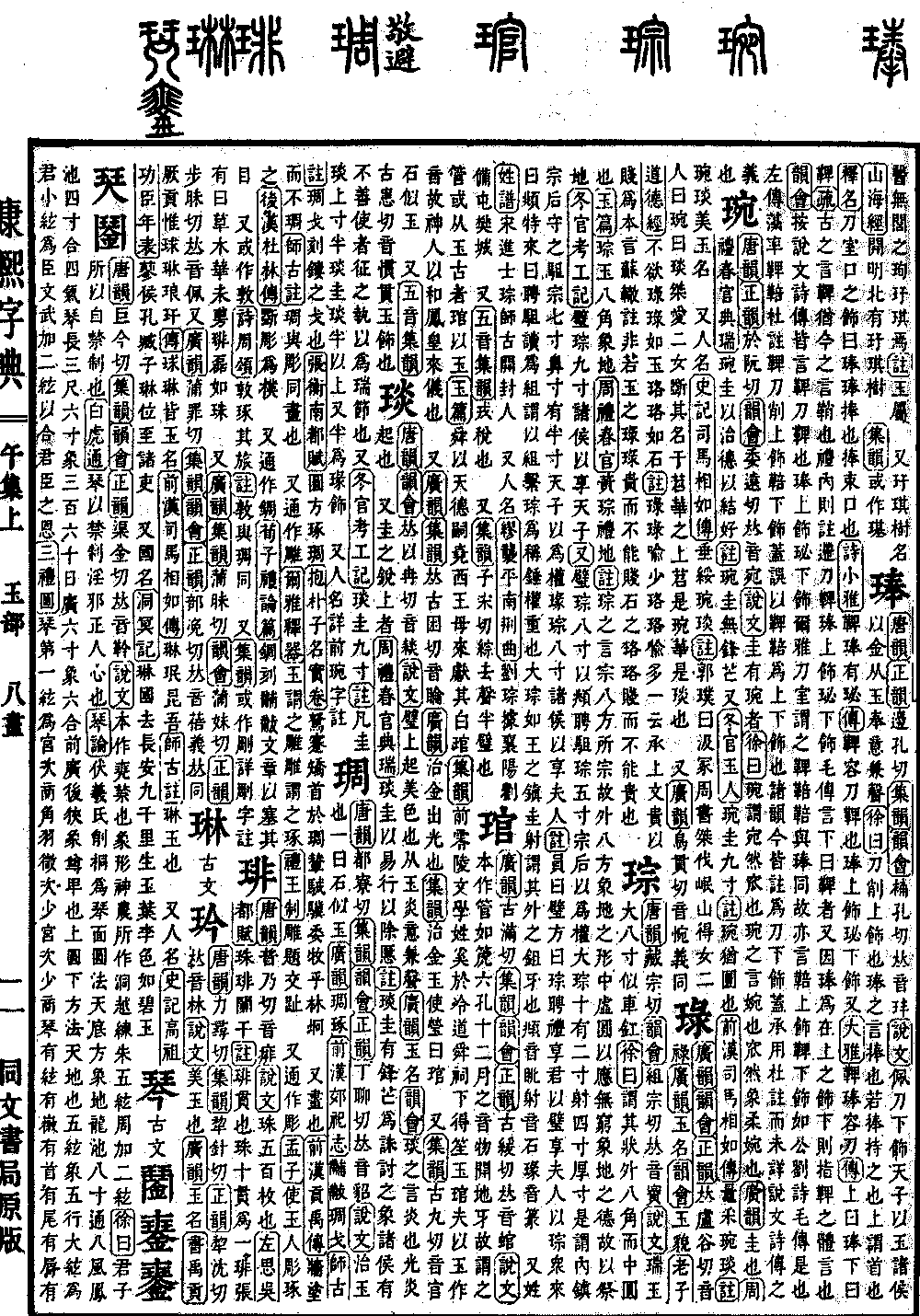
Wu Collection, Upper Volume
Radical: Jade (yù)
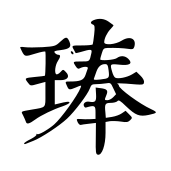
琫
Kangxi brush strokes: 13
Page 735, Entry 01
Pronounced bian.
According to Explanation of Script and Meaning (Shuowen Jiezi), it refers to the decoration on the upper end of a ceremonial sword sheath. The Emperor uses jade for this, while the feudal lords use gold. The structure of the character is derived from jade and holding, conveying both meaning and sound.
Xu Kai says this is the decoration at the top of the scabbard. The term implies holding, as if supported by hands. The mention of top refers to the uppermost part of the sword sheath.
Explanation of Names (Shiming) states that the decoration at the opening of a sword sheath is called the top ornament. It implies holding or binding the opening of the sheath.
Book of Odes (Shijing), Lesser Odes section, contains the line: With sheath top ornament and pommel ornament.
Mao Commentary explains: The sheath is the container for the blade. The top ornament is the decoration at the upper end, and the pommel ornament is the decoration at the lower end.
Also, Book of Odes (Shijing), Greater Odes section, contains the line: The sheath top ornament holds the blade.
Mao Commentary says: The upper end is called the top ornament, and the lower end is called the sheath.
Kong Yingda Commentary explains: The term sheath used in ancient times is like what we now call a scabbard. The commentary on the Book of Rites (Liji), Inner Chapters, mentions a blade and sheath, stating that the top ornament is the upper decoration and the pommel ornament is the lower decoration. The Mao Commentary states the lower end is called the sheath, because since the top ornament is already the upper decoration, the term lower refers to the sheath itself.
Collection of Rhymes (Yunhui) notes: Both the Explanation of Script and Meaning (Shuowen Jiezi) and the commentaries on the Book of Odes (Shijing) define the sheath as the sword container, the top ornament as the upper decoration, and the pommel ornament as the lower decoration. The Erya dictionary states the sword chamber is called a sheath. The characters for top ornament are synonymous. Therefore, it is also said that the top ornament is the upper decoration and the sheath is the lower one. For example, the Mao Commentary on the Book of Odes (Shijing), Gong Liu section, explains it this way. The Zuo Commentary (Zuozhuan) contains a record of algae patterns on sheaths and top ornaments. Du Yu's commentary says: The sheath is the upper decoration, and the top ornament is the lower decoration. This is likely an error in assigning the top and lower decorations respectively. Nowadays, various rhyme dictionaries define it as the lower decoration of a sword sheath, likely following Du Yu's commentary without thoroughly examining the original meaning in the Explanation of Script and Meaning (Shuowen Jiezi) and the Book of Odes (Shijing) commentaries.
Textual research: In the Explanation of Script and Meaning (Shuowen Jiezi), it was originally written as lower decoration. Now, carefully adhering to the original text, the word lower is corrected to upper.