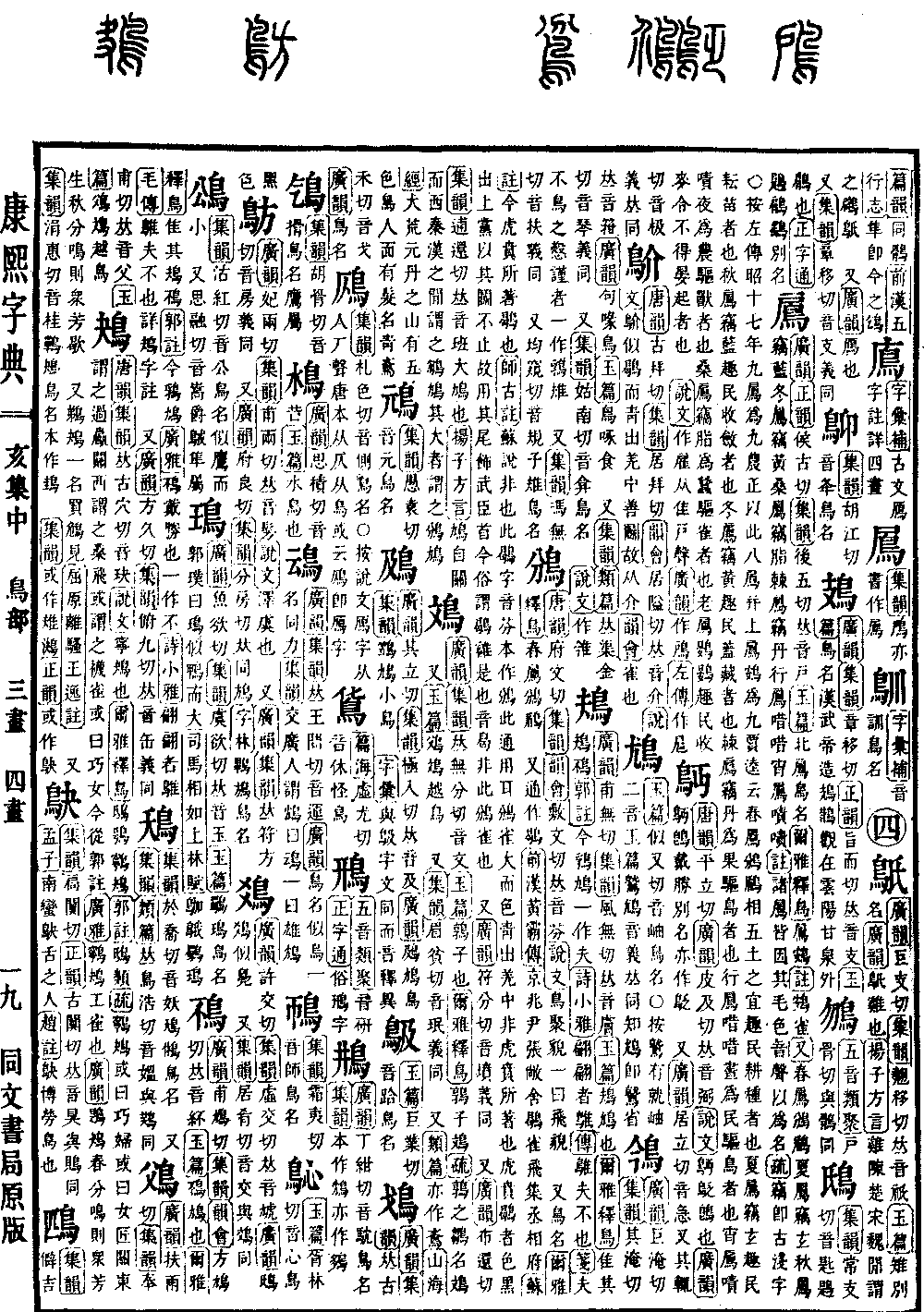
Hai Collection, Middle Volume
Radical: Bird (niǎo)
Kangxi Strokes: 15
Page 1483, Entry 15
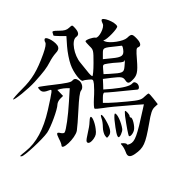
Pronounced fen. According to the Analytical Dictionary of Characters (Shuowen Jiezi), it describes the appearance of birds flocking together. Another interpretation suggests it describes the appearance of birds in flight. It is also the name of a bird. According to the Erya (Erhuo), in spring, there is the bird known as fen.
It is also used interchangeably with the character he. According to the History of the Former Han (Qianhan Shu), in the biography of Huang Ba, a he bird from the household of Zhang Chang, the Metropolitan Magistrate, flew and landed in the丞相府 (Prime Minister's office). Su Lin notes that this is the bird from which the he-crown worn by the tiger-guard (huben) is derived. Yan Shigu notes that Su Lin's interpretation is incorrect. This character he is pronounced he, and was originally written as fen. Here it is merely an interchangeable usage. The fen bird is large in size and blue in color, originating in the Qiang territories, and is not the same bird used for the he-crown of the tiger-guards. The bird used by the tiger-guards is black in color and originates from Shangdang. Because it is fierce and constantly fighting, its tail feathers are used to decorate the hats of military officers. The bird commonly referred to today as the he-chicken is this variety. It is pronounced he, not the fen bird described here.
Also pronounced fen. The meaning is the same.
Also pronounced ban. It refers to a large pigeon. According to the Dialect (Fangyan) by Yang Xiong, in the regions west of the pass, specifically between the Qin and Han territories, pigeons are called qu-pigeons, and the larger ones among them are called fen-pigeons.