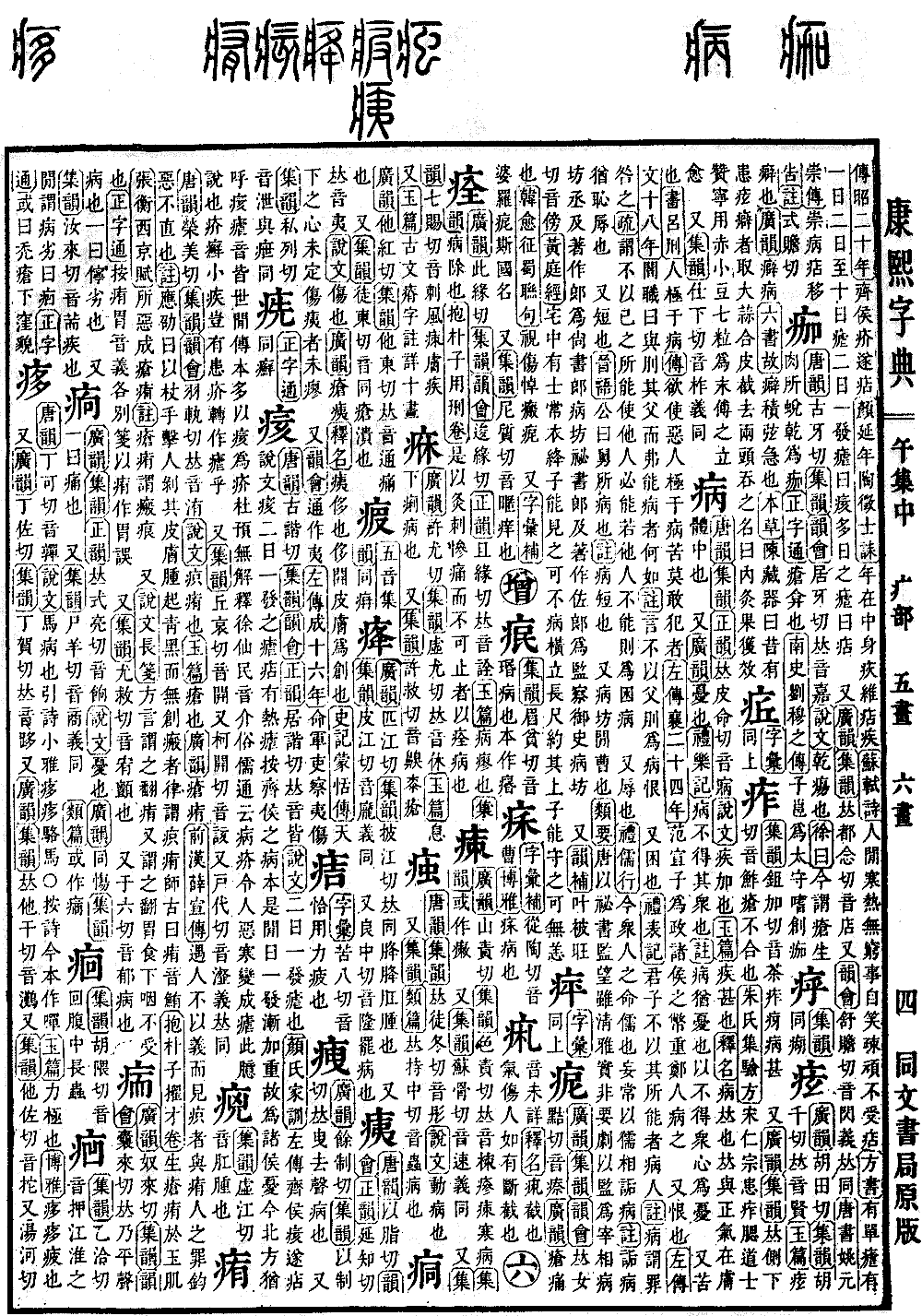
Wu Collection, Middle Volume
Radical: Sickness (bìng)
Kangxi stroke count: 10
Page 772, Entry 06
Pronounced bìng.
Shuowen Jiezi (Shuowen): An aggravation of illness.
Yupian (Yupian): Illness being very severe.
Shiming (Shiming): The term bìng means to combine. It refers to the intersection of pathogenic energy and righteous energy within the body.
Guangyun (Guangyun): Worry.
Book of Rites (Liji), Record of Music (Yueji): Worried about not receiving the support of the masses. Commentary: Bìng refers to anxiety. It is the anxiety of failing to win the hearts of the people.
Also, pain.
Classic of History (Shujing), Counsels of Lu (Lüxing): To cause the wicked to suffer extreme pain. Commentary: To make the wicked suffer to the point that they dare not break the law again.
Zuo Tradition (Zuozhuan), 24th Year of Duke Xiang: When Fan Xuanzi held power, the tribute required from the feudal lords was heavy, and the people of Zheng suffered because of it.
Also, resentment.
Zuo Tradition (Zuozhuan), 18th Year of Duke Wen: Yan Zhi said: How does this compare to the man who does not resent the one who cut off his father's feet? Commentary: Here, it means not regarding the severing of a father's feet as a cause for resentment.
Also, to make things difficult or to blame.
Book of Rites (Liji), Exposition of Propriety (Biaoji): A gentleman does not blame others for things he is capable of doing himself. Commentary: Bìng refers to criticizing or blaming. Sub-commentary: It refers to not demanding that others perform as one does simply because one is capable of it, and then blaming them if they cannot.
Also, humiliation.
Book of Rites (Liji), Conduct of the Scholars (Ruxing): Nowadays, common people refer to scholars casually and often use the term scholar to humiliate one another. Commentary: The phrase goubing refers to shame or disgrace.
Also, a shortcoming or flaw.
Discourses of the States (Guoyu), Narratives of Jin (Jinyu): Duke Hui of Jin said: This is my uncle's shortcoming. Commentary: Bìng means a flaw.
Also, bìng refers to a sinecure or minor official position.
Leiyao (Leiyao): During the Tang Dynasty, the position of Secretariat Director was considered prestigious in name but was not an important position. It was regarded as a sinecure for a chancellor, while the roles of Assistant and Collator were considered sinecures for ministry secretaries, and the roles of Secretary and Assistant Collator were considered sinecures for censorate officials.
Also, following rhyme compensation, pronounced bàng.
Yellow Court Scripture (Huangtingjing): Within the body resides a master, often dressed in deep red robes; if you can see it, you will not fall ill. It spans one foot in width and is restrained in the upper part of the body; if you can maintain this, you will be free from illness.