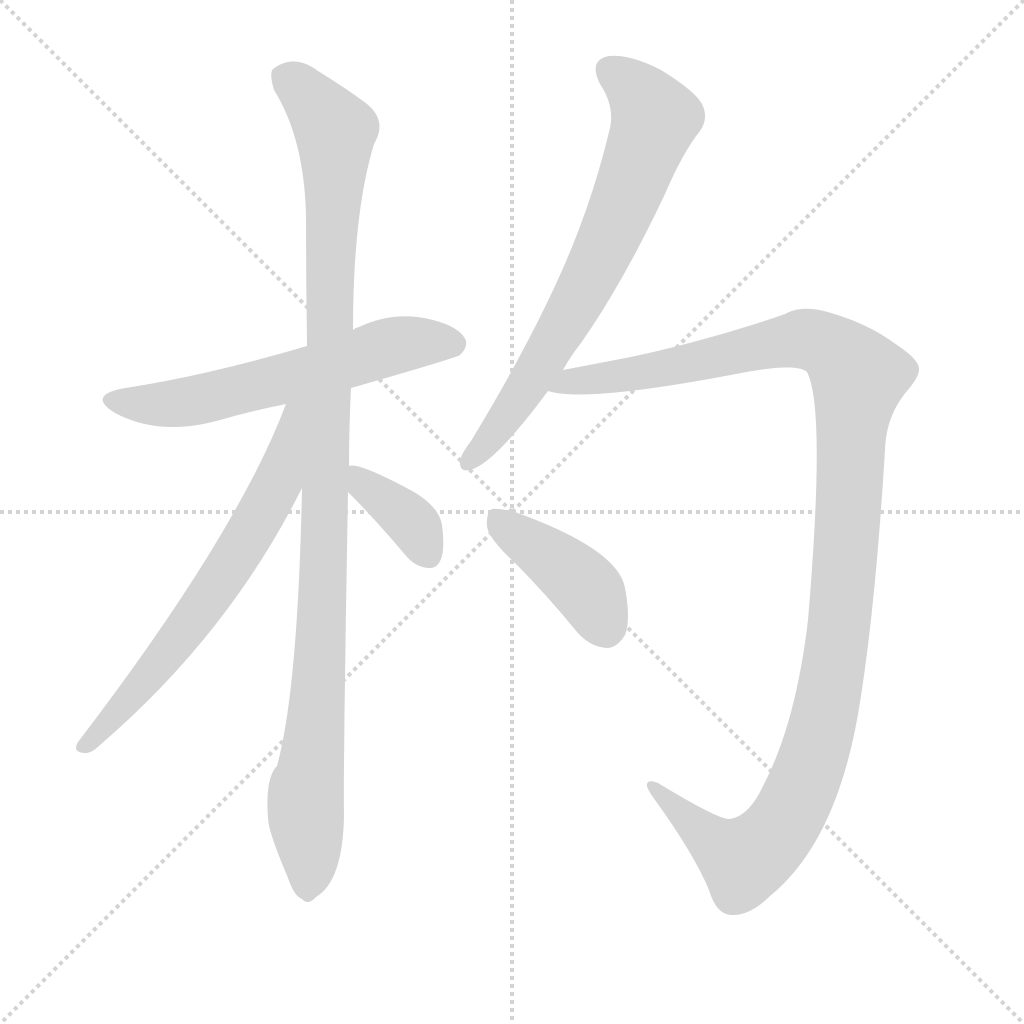
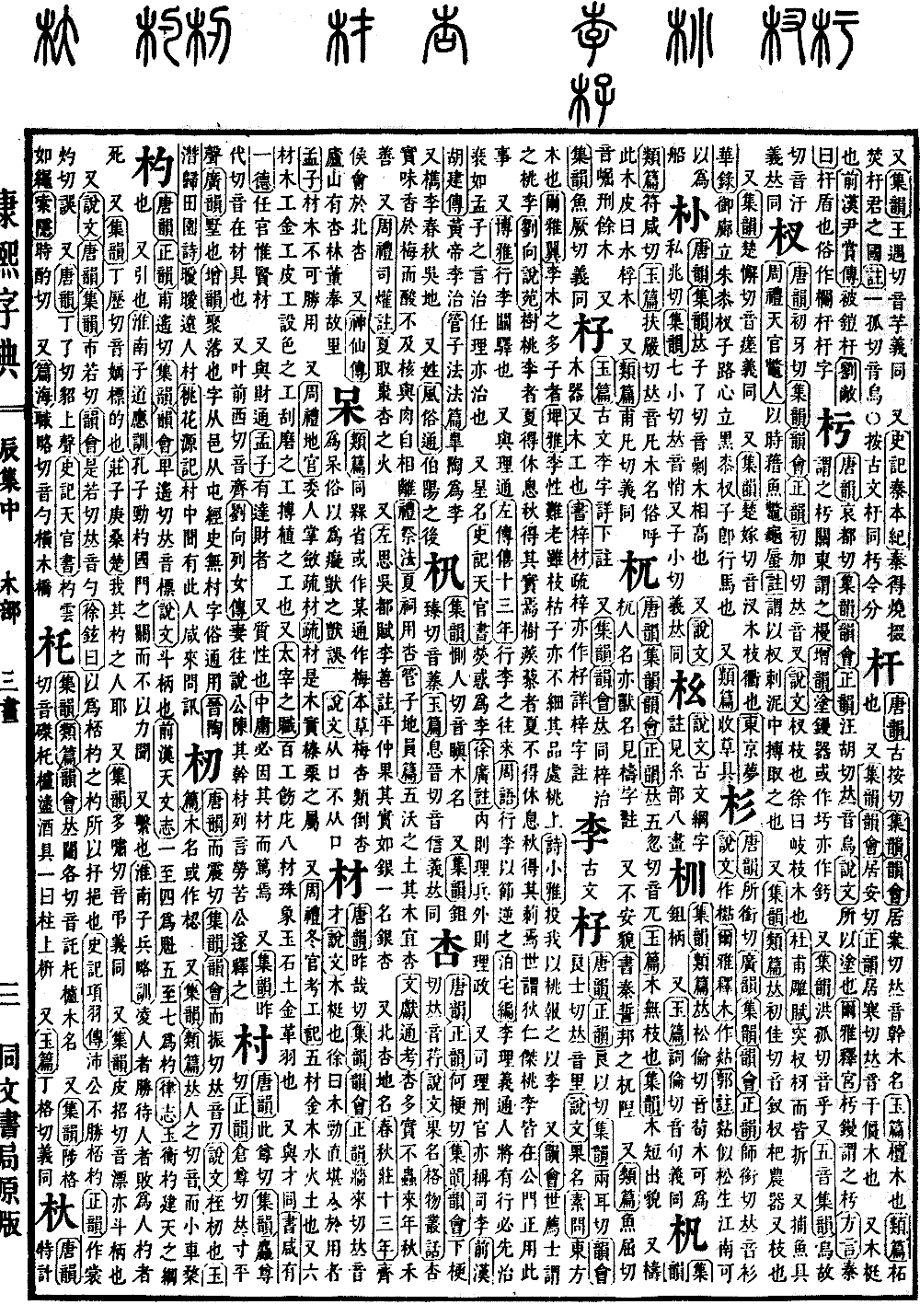
Chen Collection, Middle Volume. Radical: Tree (mù). Kangxi strokes: 7. Page 511, Entry 19.
Pronounced biao. According to the Explaining and Analyzing Characters (Shuowen Jiezi), it refers to the handle of a dipper. In the Astronomy Treatise of the History of the Former Han (Qian Han Shu), it is stated that stars one through four are called the bowl, and five through seven are called the handle. In the Treatise on Harmonics and Calendars, the handle of the jade equilibrium is described as the guiding principle that establishes the way of heaven. It also carries the meaning of to pull or lead. In the Daoist Response Training of the Huainanzi, it is mentioned that Confucius was able to lift the crossbar of the city gate, yet he was not known for his physical strength. It also means to bind or restrain. In the Military Strategy Training of the Huainanzi, it states that one who takes the initiative in an attack will be victorious, one who waits passively will be defeated, and one who is restrained by others will die.
Pronounced di. It means a target. In the Geng Sang Chu chapter of the Zhuangzi, it asks if I am the kind of person who becomes a target for the masses.
Pronounced diao. The meaning is the same as the above.
Pronounced piao. This also refers to the handle of a dipper.
Pronounced shao. Xu Xuan states that this is considered to be the same as the character for a small ladle, a utensil used for scooping or pouring. In the Annals of Xiang Yu from the Records of the Grand Historian (Shiji), it is noted that the Prince of Pei could not withstand the cups and ladles (i.e., could not drink as much as the others). The Zheng Yun dictionary incorrectly records it as being pronounced shang or zhuo.
Pronounced diao (rising tone). In the Treatise on the Celestial Offices from the Records of the Grand Historian, it mentions that the handle-shaped cloud resembles a rope.
Pronounced shao. A horizontal wooden bridge.
Textual research: In the Annals of Xiang Yu from the Records of the Grand Historian, the text originally read Annals of Xiang Yu, which has been corrected to the Records of the Grand Historian in accordance with the original source.