Mao Collection, Lower Volume
Radical: Square (fāng)
Kangxi Strokes: 10
Page 482, Entry 11
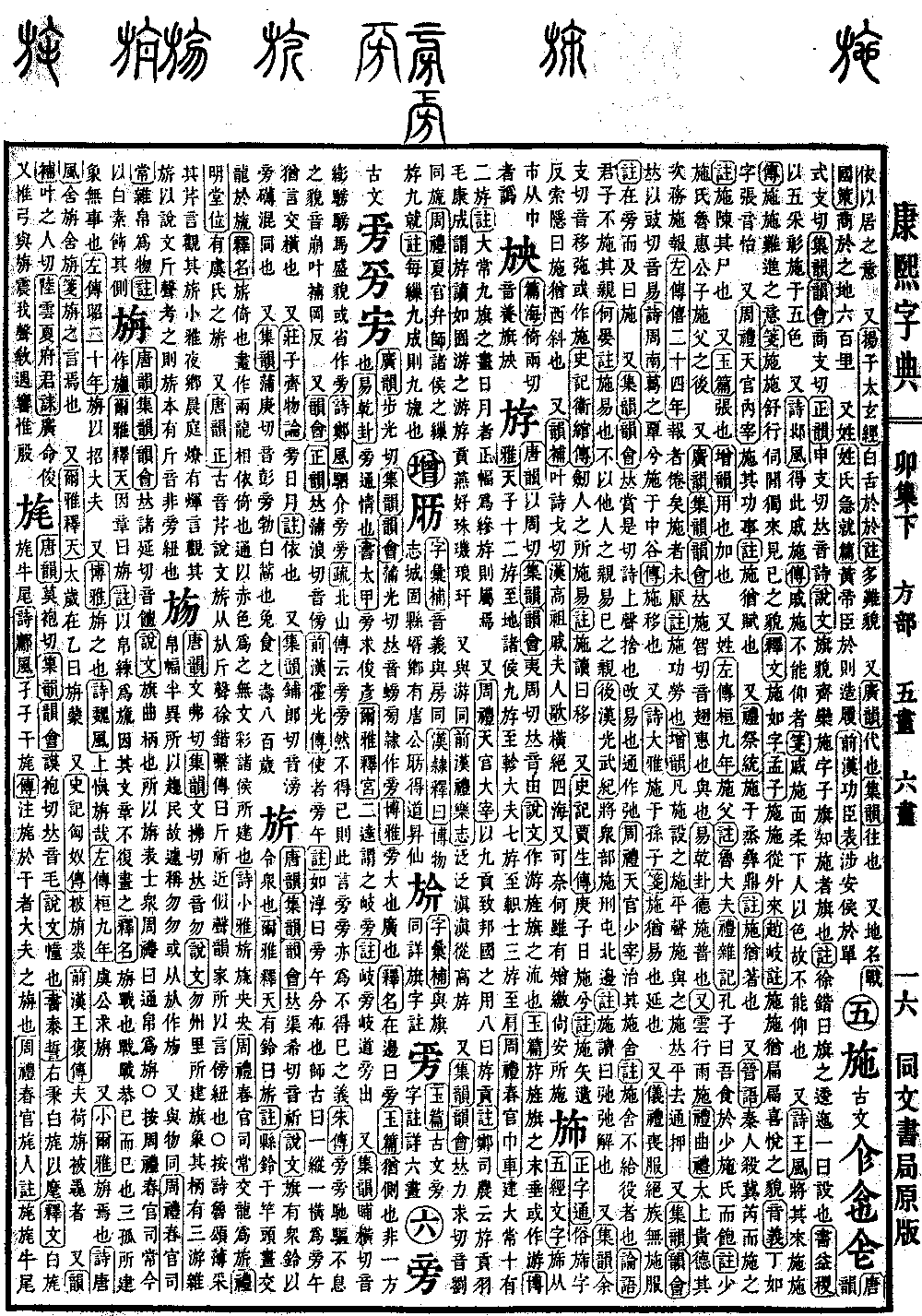
Ancient character. According to Wide Rhymes (Guangyun), pronounced guang. According to Collected Rhymes (Jiyun) and Rhyme Anthology (Yunhui), pronounced guang, read the same as pang. Written as pang in clerical script. According to Extensive Elegance (Boya), pang means large. It also means wide. According to Explanation of Names (Shiming), at the edge is called pang. According to Jade Chapters (Yupian), it is like the side. It is not a single direction. According to Book of Changes (Yijing), Qian hexagram, widely reaching principles. According to Book of Documents (Shujing), Taijia chapter, widely seeking talented and virtuous people. According to Erya, Explaining Palaces, two roads connecting is called qipang. Commentary: Qipang refers to a fork in the road branching off to the side. Also, according to Collected Rhymes (Jiyun), pronounced heng. Pengpeng describes horses that are strong. Sometimes simplified as pang. According to Book of Odes (Shijing), Zheng Winds, four armored horses that are strong and powerful. Commentary: The Zuo Zhuan commentary on the North Mountain poem states that pangpang means an appearance of being unable to stop, so the usage here also implies an inability to stop. Zhu Xi's commentary says: pangpang is the appearance of racing without ceasing. Pronounced beng. Rhyming with gang. Also, according to Rhyme Anthology (Yunhui) and Correct Rhymes (Zhengyun), pronounced pang. According to Book of Han (Qian Hanshu), Biography of Huo Guang, envoys crossing and mingling. Commentary: Ru Chun says: pangwu means distributed. Yan Shigu says: one vertical and one horizontal is called pangwu. It is like saying crisscrossing. According to Zhuangzi, Discourse on Making All Things Equal, relying on the sun and moon. Commentary: This means to depend on. According to Collected Rhymes (Jiyun), pronounced pang. Pangbo means to merge and unite. According to Collected Rhymes (Jiyun), pronounced peng. Pangbo is a type of white artemisia. If a rabbit eats it, it can live for eight hundred years.