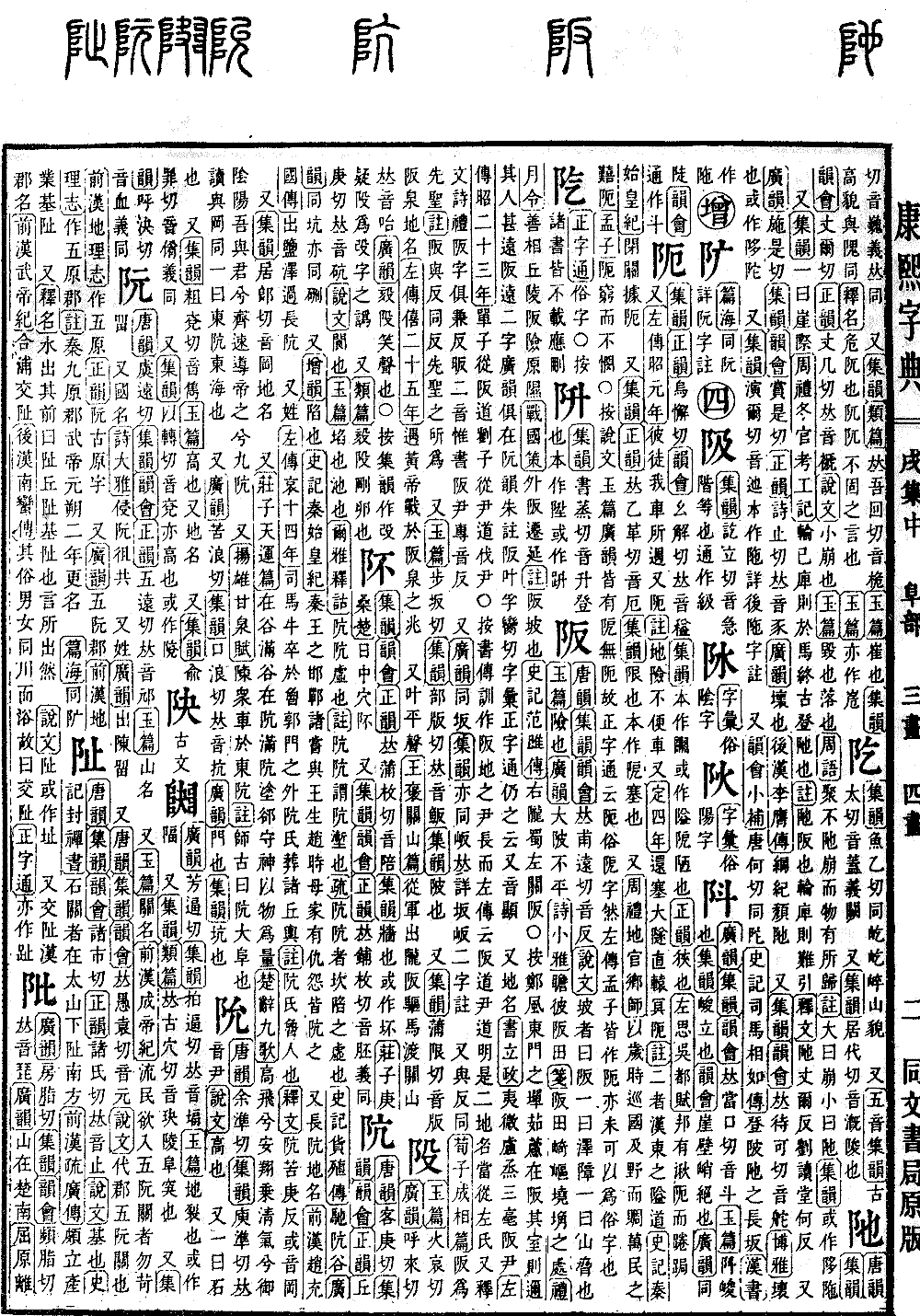
Xu Collection, Middle Volume, Radical: Mound (fù)
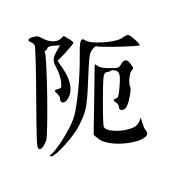
Entry: 阨
Kangxi Stroke Count: 12
Page: Page 1346, Entry 08
Pronounced yè (falling tone) — Jiyun, Zhengyun
Pronounced yǎi (falling tone) — Yunhui
Also written as 隘, meaning narrow or base. — Jiyun
Narrow. — Zhengyun
"The state had narrow passes and was cramped." — Zuo Si, Wu Du Fu
"Our chariots were blocked by their men; where we encountered them was a narrow pass." — Zuo Zhuan, Zhao Yuan Nian
Note: A difficult terrain unsuitable for chariots.
"Returned and blocked the Great Tunnel, the straight carriage, and the narrow pass." — Zuo Zhuan, Ding Yuan Nian
Note: These are narrow passes in the Han Dong region.
"Closed the passes and occupied the narrow passes." — Shiji, Annals of the First Emperor of Qin
Pronounced è (entering tone) — Jiyun, Zhengyun
Limit. Also written as 阸, meaning to block. — Jiyun
"To inspect the country and the wilds at different seasons, and to relieve the distress of the myriad people." — Zhou Li, Official of the Earth, Township Master
"Suffering from hardship and poverty, yet not feeling pity." — Mengzi
According to Shuowen, Yupian, and Guangyun, only 阸 exists, not 阨. Therefore, Zhengzi Tong states that 阨 is a common variant of 阸. However, since Zuo Zhuan and Mengzi both use 阨, it cannot be considered a vulgar character.
Correction: "Returned and blocked the Great Tunnel, the straight carriage, and the narrow pass." — Zuo Zhuan, Ding Yuan Nian
Note: These two are narrow passes in the Han Dong region. Corrected from "these two" to "these three" according to the original text.