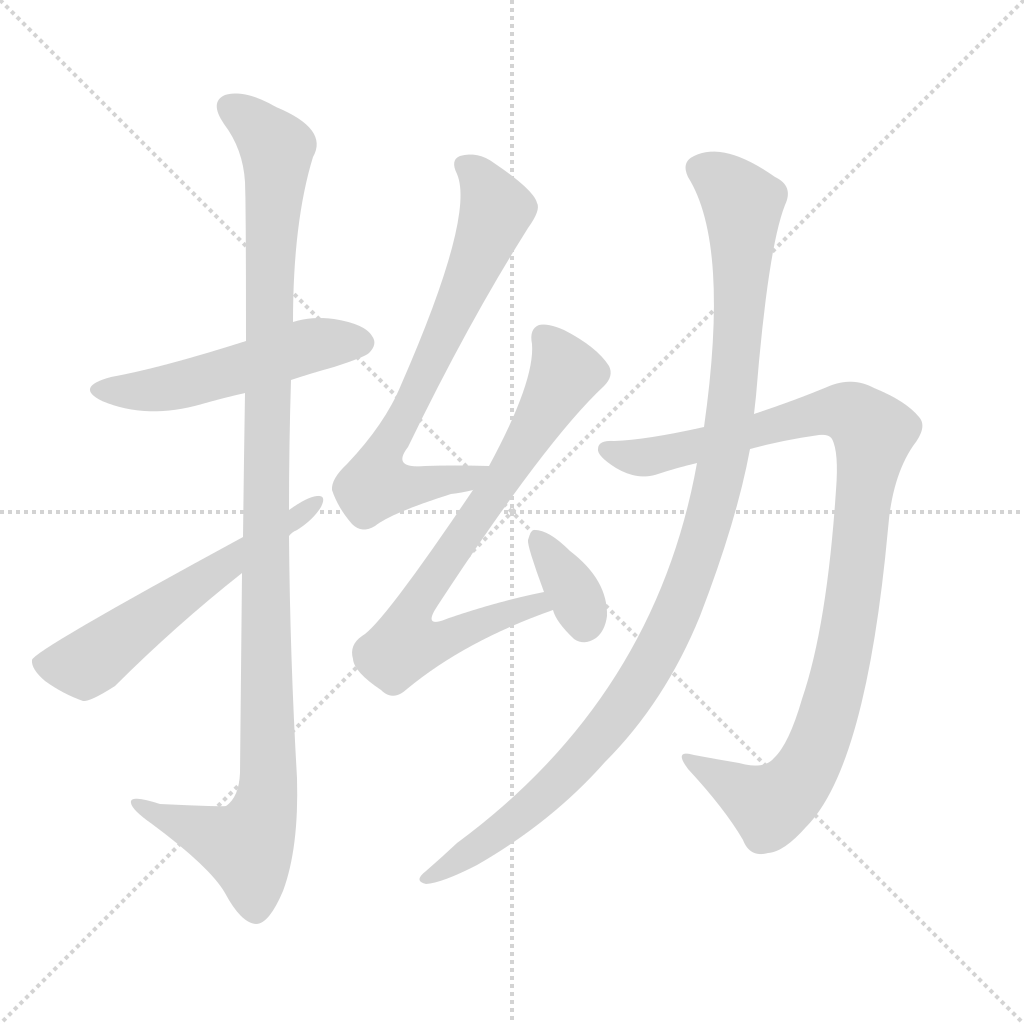
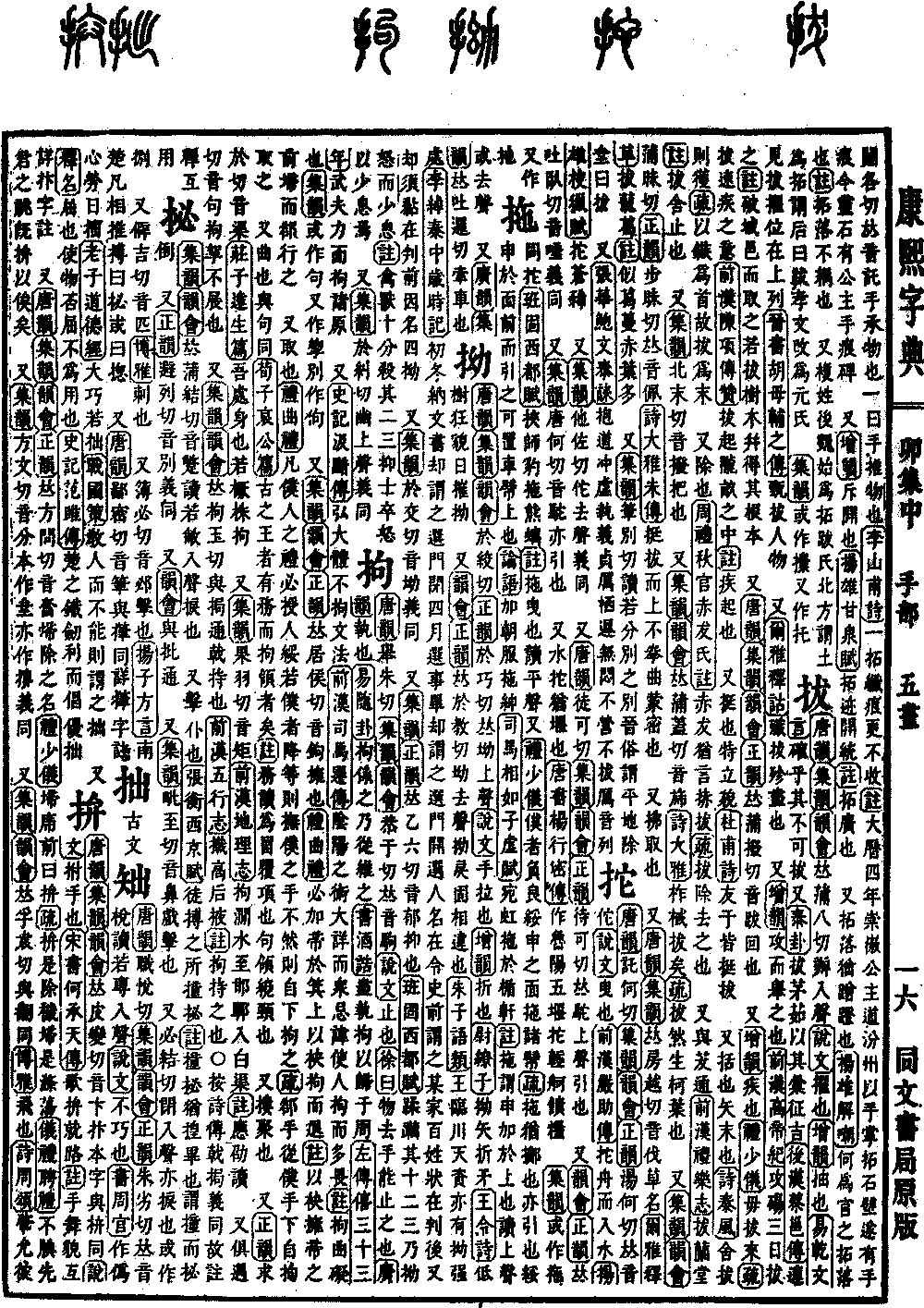
Mao Collection, Middle Volume
Radical: Hand (shǒu)
Kangxi Strokes: 9
Page 426, Entry 04
According to Tang Rhyme (Tangyun), Collection Rhyme (Jiyun), and Rhyme Meeting (Yunhui), it is pronounced ao (rising tone). According to Correct Rhymes (Zhengyun), it is pronounced ao (rising tone). It is read as the rising tone of ao. Explaining Characters and Writing (Shuowen Jiezi) interprets it as pulling or dragging with the hand. Expanded Rhymes (Zengyun) interprets it as to break. The Master of Weiliao (Weiliaotian) contains the record: breaking arrows and snapping spears. The poet Wang Ling wrote: The low trees and wild appearance are destroyed and snapped daily.
Furthermore, Rhyme Meeting (Yunhui) and Correct Rhymes (Zhengyun) also note the pronunciation as ao (departing tone), read as the departing tone of ao. The meaning is stubborn or contrary, obstinately opposing. Zhu Xi mentioned in Classified Conversations (Yulei): Wang Linchuan also had a stubborn and headstrong side to his innate character. Li Chuo records in Record of Annual Festivals in the Capital (Qinzhong Suishi Ji): At the beginning of winter, when submitting documents, it is called closing the selection gate. When the selection affairs conclude in the fourth month, it is called opening the selection gate. When the candidates' names are written before the clerks, it is called a commoner of such-and-such family. When the petition is placed after the judgment but must be pasted before the judgment, it is therefore called the fourfold stubbornness.
Also, according to Collection Rhyme (Jiyun), it is pronounced ao. It has the same reading as ao, and the meaning is the same.
Additionally, according to Collection Rhyme (Jiyun) and Correct Rhymes (Zhengyun), it is pronounced yu. The meaning is to suppress. Ban Gu wrote in Rhapsody on the Western Capital (Xidu Fu): Trampling upon two or three tenths of them, then suppressing their anger to rest a while. The commentary explains: When two or three tenths of the beasts were killed, the soldiers' anger was then suppressed, allowing them to rest briefly.
Also, according to Collection Rhyme (Jiyun), it is pronounced you (rising tone). The meaning is the same.