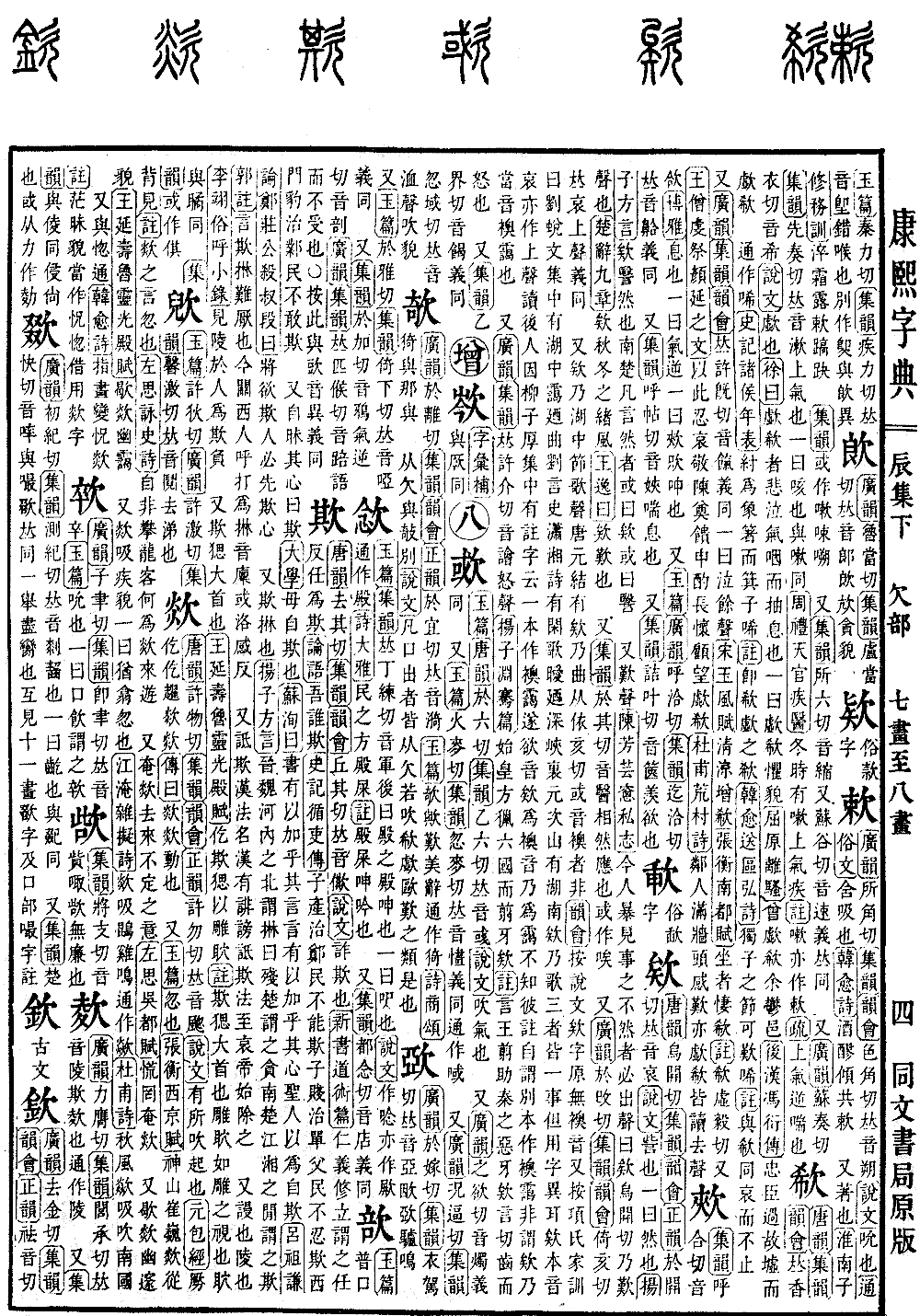
Chen Collection, Lower Volume
Radical: Lacking (qiàn)
Kangxi strokes: 11
Page 568, Entry 07
Pronounced ai.
In the Shuowen Jiezi (Shuowen), it means to criticize. Another meaning is to agree. In the Dialects (Fangyan) by Yang Xiong, it states that ai means to agree. In the southern Chu region, when people say something is so, they sometimes say ai. It is also an exclamation. According to the Private Records of the Yun Window (Yunchuang Sizhi) by Chen Fang, people today, upon seeing something that is not right, will inevitably make the sound ai; this is an exclamation. In the Nine Chapters (Jiuzhang) of the Songs of Chu (Chuci), it says: Sighing at the enduring winds of autumn and winter. Wang Yi comments that ai is a sigh.
Also pronounced yi. It is a sound of agreement or response. Sometimes written in a variant form (ai).
Pronounced ai (rising tone). The meaning is the same as above.
Also refers to the sound of rowing songs on a lake. The Tang dynasty poet Yuan Jie wrote the Ai Nai Qu. It is pronounced according to the reading for ai (rising tone). Those who pronounce it as ao are incorrect. The Rhyme Compilation (Yunhui) notes that the Shuowen does not contain the pronunciation ao. According to the Family Instructions of Xiang (Xiangshi Jiaxun), Liu Tui’s literary collection contains the Ai Nai Qu, Liu Yanshi’s Xiaoxiang poems contain a line about singing ai nai in the deep gorges, and Yuan Cishan wrote the Hunan Ai Nai Ge. These three all refer to the same thing, merely using different characters. Ai is originally pronounced ai, and is also read in the rising tone. Later people, because of a note in the collected works of Liu Zongyuan saying that another version of the text used the characters for ao and ai, mistakenly attempted to pronounce ai as ao and nai as ai, not realizing that the note referred to the variant edition, not the pronunciation of the term ai nai itself.
Pronounced hui. A sound of anger. In the Yuanqian Pian by Yang Xiong, it describes the First Emperor hunting the six states and the fangs of Wang Jian. The commentary explains that this refers to Wang Jian assisting the evil of the Qin state, where fangs hui describes the gnashing of teeth in anger.
Pronounced ai. Meaning is the same as the above.