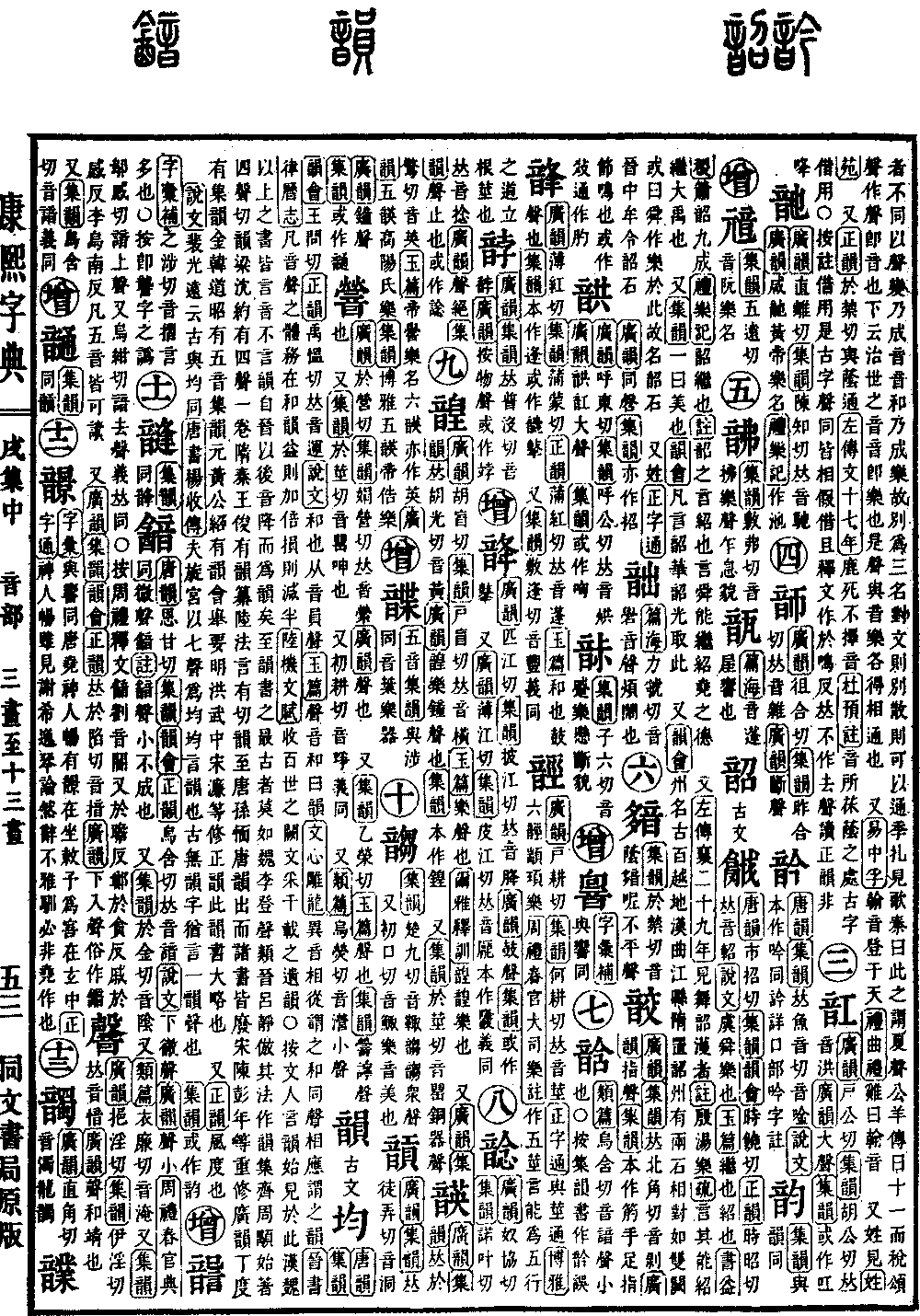
Xu Collection, Middle Volume
Radical: Sound (yīn)
20 strokes
Page 1397, Entry 33
Pronounced an.
According to the Explanation of Words and Phrases (Shuowen Jiezi), a low, deep, and penetrating sound.
According to the Broad Rhymes (Guangyun), a faint or small sound.
According to the Rites of Zhou (Zhouli), Spring Office, Official of Music, a faint sound described as an.
Note: An refers to a sound that is weak and incomplete.
Also pronounced yin according to the Collected Rhymes (Jiyun).
Also pronounced yan according to the Classified Chapters (Leipian).
Also pronounced an (rising tone) according to the Collected Rhymes (Jiyun).
Also pronounced an (falling tone) according to the Collected Rhymes (Jiyun).
The meaning is the same.
Note: According to the Commentary on the Rites of Zhou (Zhouli Shiwen), Liu Changzong reads it as an. It is also read as zhan. Zheng Xuan reads it as tan. Qi Gun reads it as gan. Li Gui reads it as nan. There are five ways to read this, all of which are acceptable.
Also pronounced an (falling-rising tone) according to the Broad Rhymes (Guangyun), Collected Rhymes (Jiyun), Rhyme Compilation (Yunhui), and Orthodox Rhymes (Zhengyun).
According to the Broad Rhymes (Guangyun), a low and deep, penetrating sound.
Commonly written in a variant form.