Xu Collection, Lower Volume
Radical: Leaf (yè)
Page 1403, Entry 06
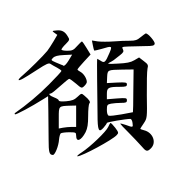
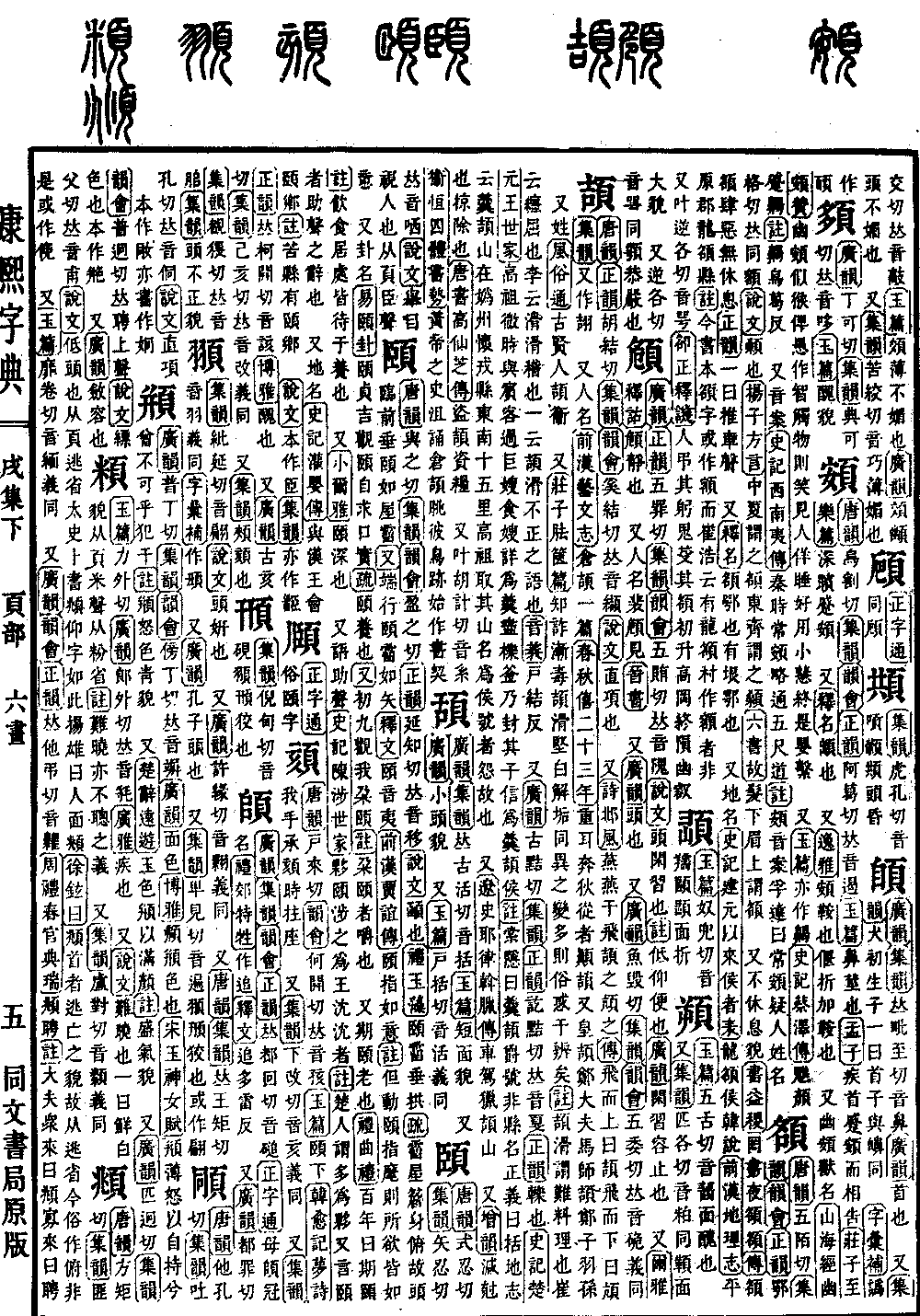
Pronounced e. Same as forehead. According to the Discussion of Writing (Shuowen Jiezi), it refers to the forehead. According to the Regional Speech (Fangyan) by Yang Xiong, it is called e in the Central Plains and sang in the eastern Qi region. According to the Origins of the Six Writings (Liushugu), the area below the hair and above the eyebrows is called e. It also denotes the appearance of not resting. In the Book of Documents (Shujing), under the section The Beneficent Grain (Yiji), it says, Without day or night, toiling incessantly. The commentary states that the repeated term refers to excessive evil without rest. According to the Correct Rhymes (Zhengyun), it also denotes the sound of pushing a cart. According to the Explanation of Names (Shiming), it means an edge or a boundary. Also a place name. In the Records of the Grand Historian (Shiji), in the Table of Marquises Established Since the Jianyuan Period, it mentions the Marquis of Long'e, Han Yue. In the History of the Former Han (Qianhan Shu), under the Treatise on Geography, it mentions Long'e County in Pingyuan Commandery. The commentary notes that while modern editions write it as e, Cui Hao stated there is a Long'e village and using the character for forehead is incorrect. It also rhymes with e and has the sound e. In the Explanation of Ridicule (Shiji) by Que Zheng, it says, People mourn his body, spirits mow down his brow. Initially ascending a high ridge, finally falling into a dark abyss.