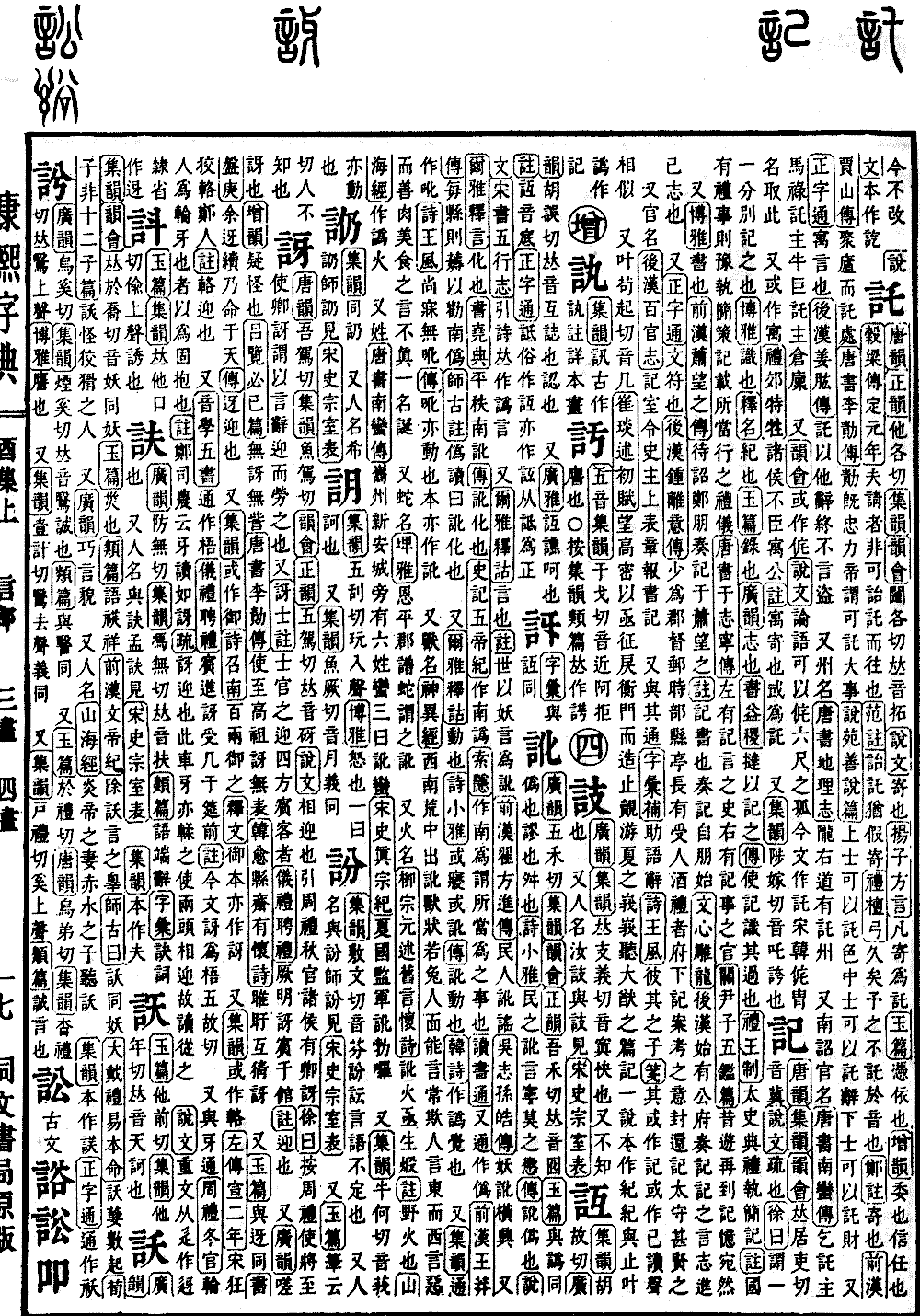
You Collection, Upper Volume
Radical: Speech (yán)
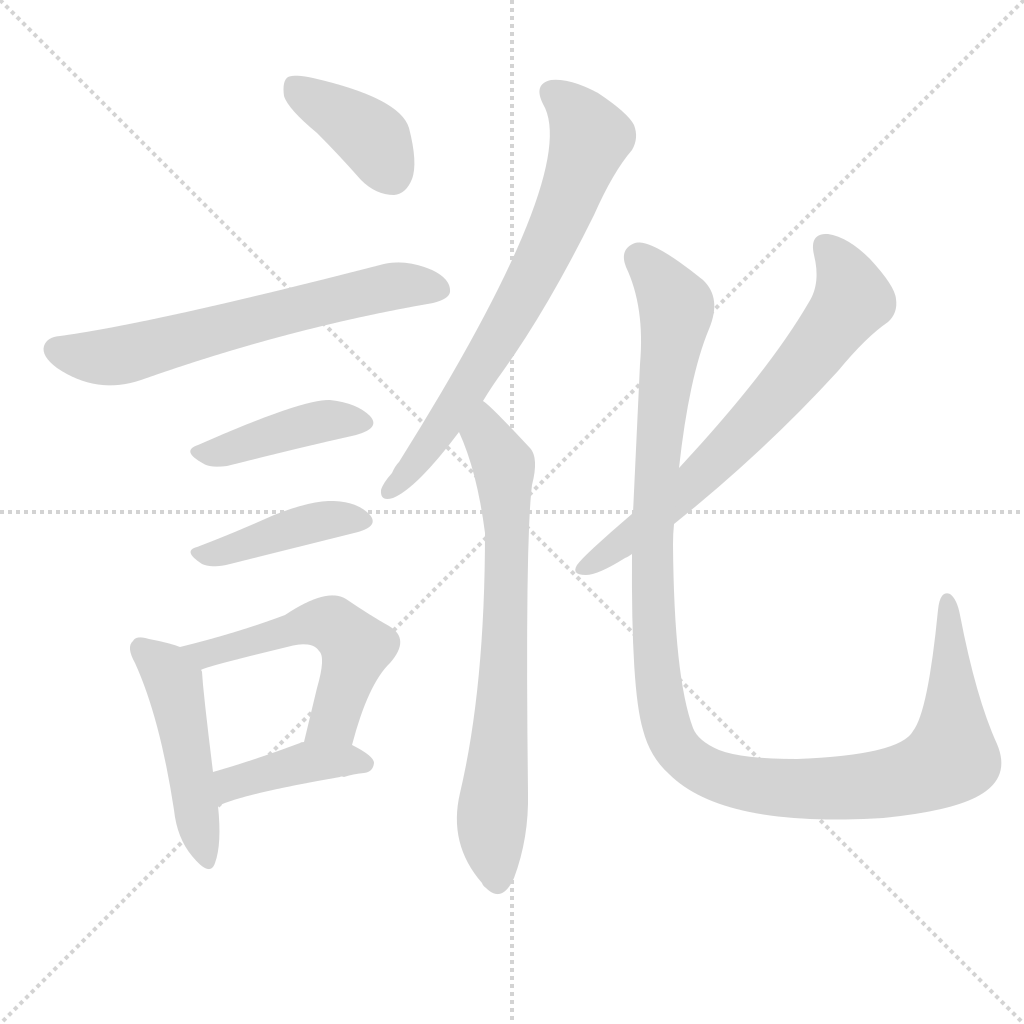
訛
Kangxi Stroke Count: 11
Page 1149, Entry 08
Pronounced e (rising tone).
Jade Chapters (Yupian): Same as the variant form (e). It means false, erroneous, or deviating.
Book of Odes (Shijing), Lesser Odes of the Kingdom (Xiaoya): People speak false words; would no one punish them?
Commentary: E means false.
Analytical Dictionary of Chinese Characters (Shuowen Jiezi) and Book of Song (Songshu), Treatise on the Five Elements (Wuxing Zhi): Quote the Book of Odes (Shijing) as using the variant form (e) for false words.
Also from Literary Expositor (Erya), Interpretation of Ancient Words (Shigu): Means to speak.
Note: The world considers supernatural words to be e.
Book of Han (Qianhan Shu), Biography of Zhai Fangjin: The people spread false rumors.
Records of the Three Kingdoms (Wuzhi), Biography of Sun Hao: Supernatural rumors and falsehoods arise everywhere.
Also from Literary Expositor (Erya), Interpretation of Words (Shiyan): Means to change.
Book of Documents (Shujing), Canon of Yao (Yaodian): Regulate the southern change.
Commentary: E means change.
Records of the Grand Historian (Shiji), Annals of the Five Emperors (Wudi Ji): Written as southern (e).
Detailed Explanation (Suoyin): Written as southern (wei), meaning the work that should be performed.
General Survey of Reading (Dushu Tong): Also used interchangeably with the variant form (wei).
Book of Han (Qianhan Shu), Biography of Wang Mang: In every district they weed, to encourage southern change.
Commentary by Yan Shigu: Wei is pronounced e. It means to change.
Also from Literary Expositor (Erya), Interpretation of Ancient Words (Shigu): Means to move.
Book of Odes (Shijing), Lesser Odes of the Kingdom (Xiaoya): Some sleep, some move.
Commentary: E means move.
Han School of Odes (Hanshi): Written as the variant form (e). Means to awaken.
Also from Collected Rhymes (Jiyun): Used interchangeably with the variant form (e).
Book of Odes (Shijing), Odes of Wang (Wangfeng): I would sleep and not move.
Commentary: E also means to move. The original text also uses the character (e).
Also the name of a beast: Classic of Divine Anomalies (Shenyi Jing) states that in the southwest wilderness there is an e-beast, shaped like a rabbit with a human face, capable of speech, often deceiving people; it says east when it means west, and says evil when it means good. Its flesh is delicious, but eating it makes one unable to speak the truth. Also known as the dan.
Also the name of a snake: Piya (Encyclopedia of Plants and Animals) states that in the Enping Prefecture records, a snake is called an e.
Also a name for fire: Liu Zongyuan, Poem Expressing Thoughts on the Past: The wild fire quickly burns.
Note: Refers to wild fire.
Classic of Mountains and Seas (Shanhai Jing): Written as the variant form (e).
Also a surname: Book of Tang (Tangshu), Record of the Southern Barbarians (Nanman Zhuan): Beside the new city of Xinan in Suizhou there are six barbarian surnames, the third is called the E barbarian.
History of Song (Songshi), Annals of Emperor Zhenzong: The Xia State supervisor Eboluo.
Also from Collected Rhymes (Jiyun): Pronounced e (level tone). Also means to move.