You Collection, Middle Volume
Radical: Shell (bèi)
Kangxi Strokes: 12
Page 1206, Entry 14
Pronounced er (falling tone). Homophone with the character for jujube (er).
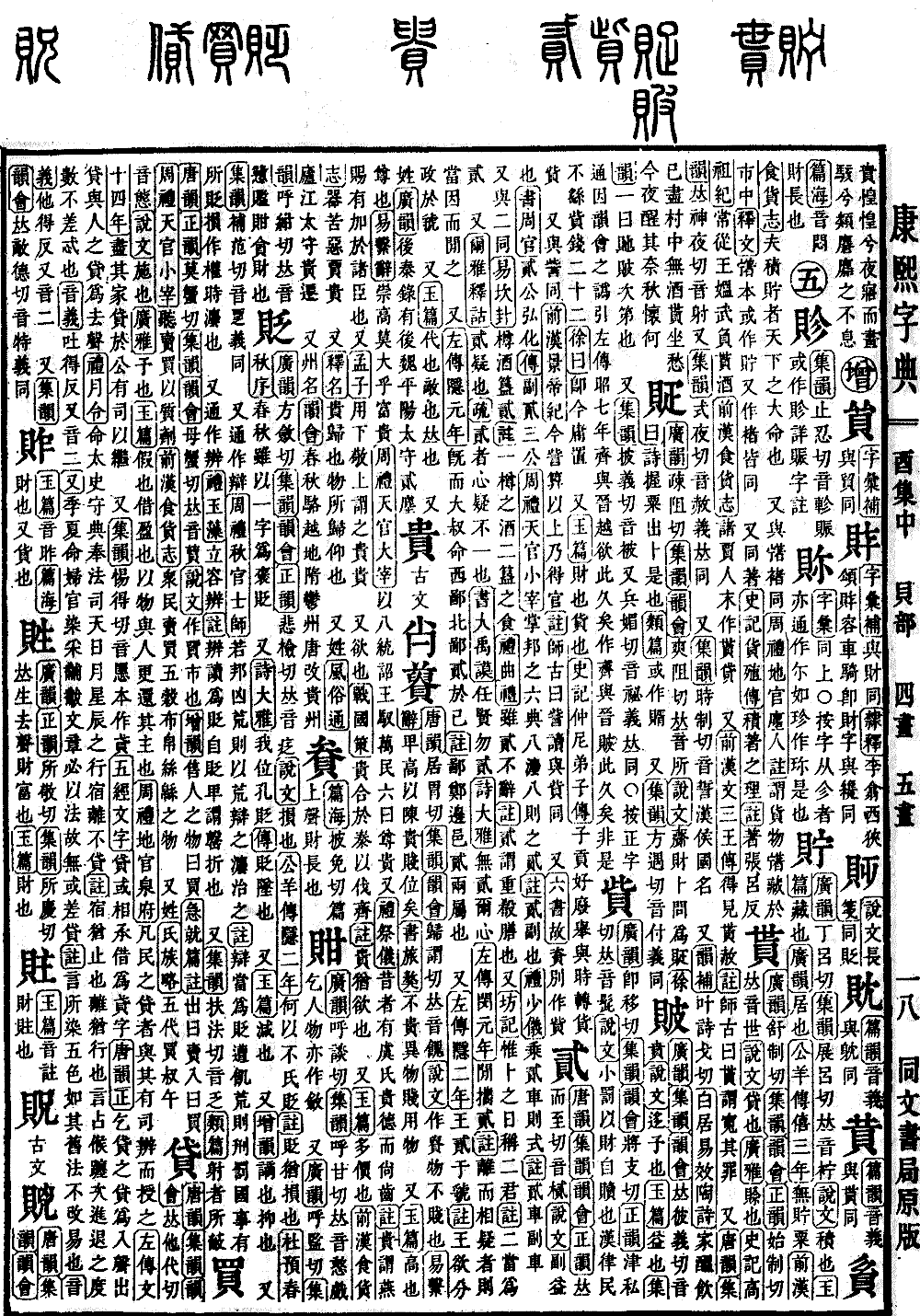
In the Shuo Wen (Dictionary of Chinese Characters), defined as a deputy, assistant, or an increase in utility. In the Book of Documents (Shujing), under the chapter Zhou Guan, it states: "The assistants to the Three Excellencies broaden the transformation." The commentary explains this as assisting the Three Excellencies. In the Rites of Zhou (Zhouli), under the Heaven Official and the Minor Prefect, it records: "Overseeing the two copies of the state's six codes, eight laws, and eight principles." The commentary explains this as a duplicate or secondary position. In the Book of Rites (Liji), under the Shao Yi, it states: "When riding in a secondary carriage, one should bow forward." The commentary explains this as a support carriage.
Also carries the same meaning as the number two. In the Book of Changes (Yijing), in the Kan hexagram, it states: "A vessel of wine and two bamboo baskets of food." The commentary explains this as one vessel of wine and two baskets of grain. In the Book of Rites (Liji), under the Qu Li, it states: "Even if the food is served twice, do not decline." The commentary explains this as a repetition or abundance of dishes and food. Also, in the Fang Ji, it states: "Only on the day of divination should one mention the two rulers." The commentary notes that here, the character for two should be written as this character.
In the Erya (Approaching Elegance), it is defined as suspicion. The sub-commentary explains that this refers to a heart that is suspicious and not single-minded. In the Book of Documents (Shujing), under the Counsels of Great Yu, it states: "When employing the virtuous, do not be suspicious." In the Book of Odes (Shijing), under the Greater Odes, it states: "Do not let your heart be divided." In the Zuo Tradition (Zuo Zhuan), first year of Duke Min, it states: "Sowing discord and suspicion." The commentary explains this as referring to people who have become alienated and mutually suspicious, whom one should take the opportunity to drive apart.
In the Zuo Tradition (Zuo Zhuan), first year of Duke Yin, it states: "Soon after, Lord Dashu ordered the western and northern border territories to owe allegiance to him as well." The commentary notes that the border territories were towns on the frontier of the Zheng state, and this character denotes being subject to two parties simultaneously. In the Zuo Tradition (Zuo Zhuan), second year of Duke Yin, it states: "The King intended to divide his power with the state of Guo." The commentary explains this as the King of Zhou wanting to transfer a portion of his political power to the state of Guo.
According to the Yu Pian (Jade Chapters), it also carries meanings of substitution, being a match, or deviation.
It is also used as a surname. In the Guang Yun (Broad Rhymes), the Records of Later Qin (Hou Qin Lu) mentions a Later Wei dynasty prefect of Pingyang named Er Chen.