You Collection, Upper Volume
Radical: Speech (yán)
18 strokes
Page 1178, Entry 19
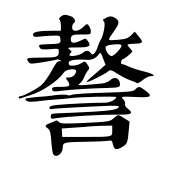
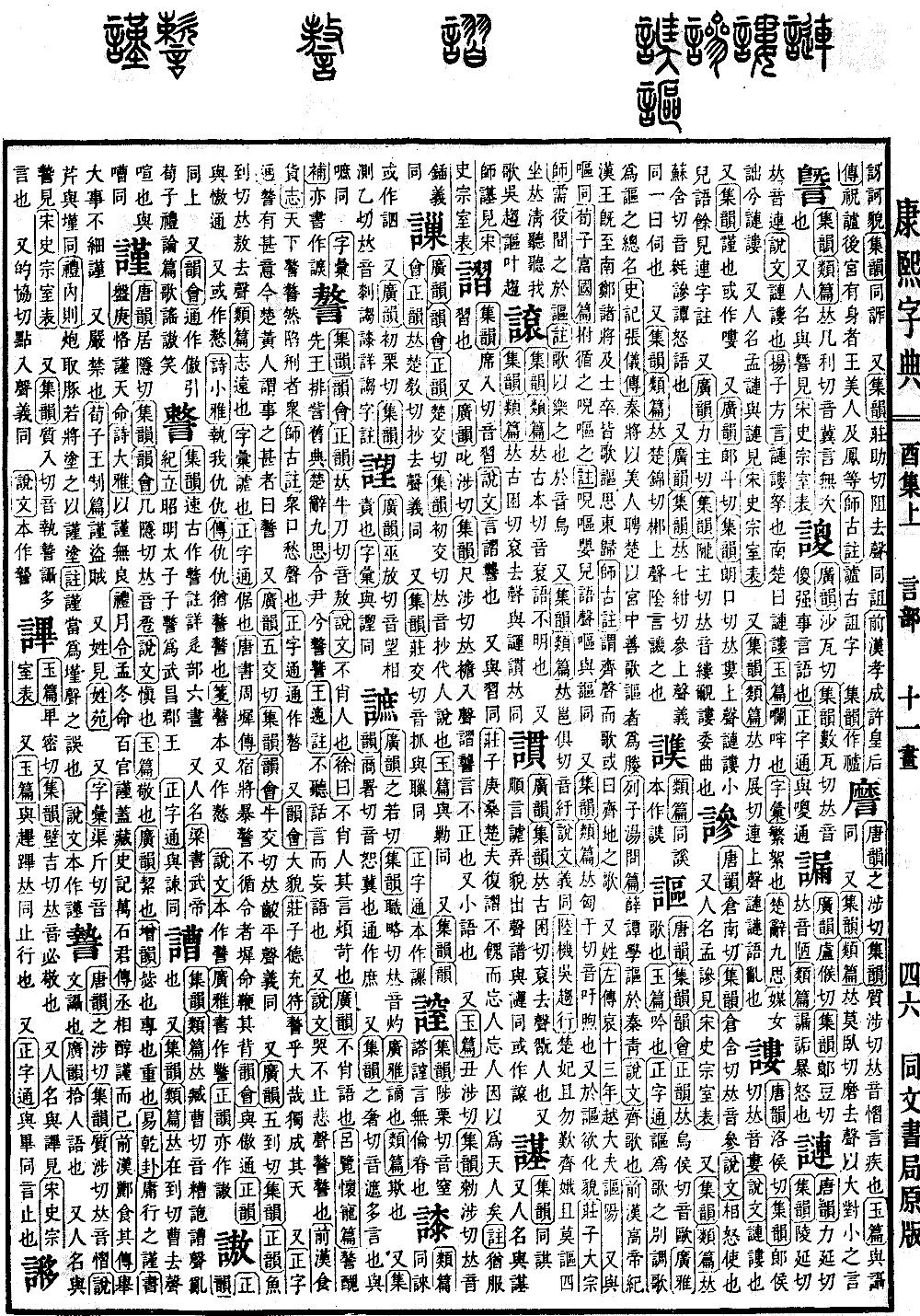
According to the Rhyme Collections (Jiyun), the Rhyme Assembly (Yunhui), and the Correct Rhymes (Zhengyun), it is pronounced ao. According to the Explaining Graphs (Shuowen), it refers to a degenerate person. Xu states that for a degenerate person, their speech is troublesome and harsh. According to the Extensive Rhymes (Guangyun), it refers to degenerate language. In the Lu Annals (Lüshi Chunqiu), Chapter on Cherishing Favors, it says: Slandering the former kings and attacking the ancient standards. In the Songs of Chu (Chuci), Nine Thoughts, it says: The prime minister is ao-ao. Wang Yi comments that this refers to not listening to correct words and speaking recklessly. Also, according to the Explaining Graphs, it refers to weeping without stopping, a sound of sorrow being ao-ao. In the History of the Former Han (Qian Hanshu), Treatise on Food and Money, it says: The people of the world were ao-ao, and many fell into ruin. Shigulu comments that this refers to the sound of sorrow from the mouths of the masses. The Correct Meaning Compendium (Zhengzitong) notes that it is commonly written as ao. Also, according to the Rhyme Assembly, it means appearing grand. In the Zhuangzi, Evidence of Virtue, it says: Grand indeed, he alone completes his nature. Also, according to the Correct Meaning Compendium, ao carries the meaning of extreme; today, the people of Chu and Huang refer to matters of an extreme nature as ao.
Also, according to the Extensive Rhymes, it is pronounced ao (level tone). The meaning is the same.
Also, according to the Extensive Rhymes, it is pronounced ao (departing tone). According to the Classified Chapters (Leipian), it refers to an ambitious will. The Word Collection (Zihui) states it means to tease. The Correct Meaning Compendium states it means to be arrogant. In the History of the Tang (Tangshu), Biography of Zhou Chi, it says: For veteran generals who were violent and arrogant and did not follow orders, Chi ordered their backs to be whipped. The Rhyme Assembly states it is interchangeable with ao. The Correct Rhymes states it is interchangeable with ao.
It is also sometimes written as the variant form (ao). In the Book of Odes (Shijing), Lesser Odes, it says: Holding us in hatred. The Commentary says: Hatred is the same as ao-ao. The Explication of Text states that for ao, the original text also uses the variant form. The Explaining Graphs states the original text is ao. The Expanded Erya (Guangya) writes it as ao. The Correct Rhymes also writes it as ao. The character ao is written with the radical for strike (pu) on the upper right.
Verification: In the Book of Odes, Lesser Odes, it says: Holding us in hatred. The Commentary says: Hatred is the same as ao-ao. The Jian note states that for ao, the original text also uses the variant form. We have carefully corrected the Explication of Text based on the original book.