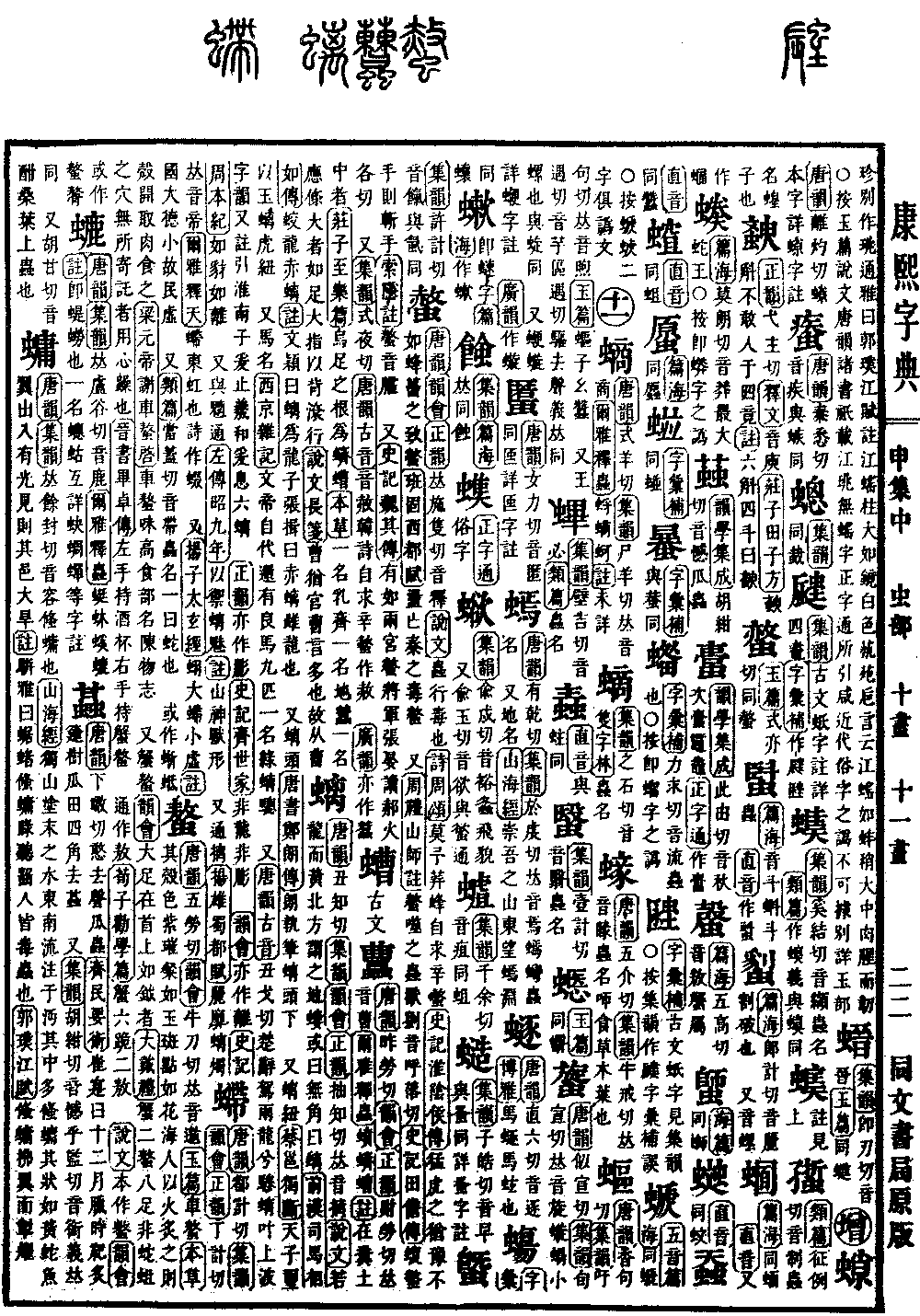
Shen Collection, Middle Volume. Radical: Insect (chóng). Kangxi stroke count: 17. Page 1094, Entry 53.
Pronounced ao. According to the Jade Chapter (Yupian), it refers to a type of clam. According to the Materia Medica (Bencao), its shell is purple and shines like jade, with spotted patterns. People living by the sea roast it over a fire to make the shell open, then eat the meat inside. In the Memorial Thanking for the Gift of Clams by Emperor Yuan of Liang (Liang Yuandi Xie Che'ao Qi), it is noted that this clam is a high-grade delicacy, and its name is recorded in books documenting local products.
It also refers to crab claws. According to the Rhyme Collection (Yunhui), it refers to the large pincers located at the top of the head, shaped like a battle-axe. In the Book of Rites by Dai the Elder (Da Dai Liji), it is written that a crab has two claws and eight legs, and if it does not occupy the hole of a snake or an eel, it has no place to dwell because its nature is restless. In the Biography of Bi Zhuo from the Book of Jin (Jinshu), it is mentioned that he held a wine cup in his left hand and a crab claw in his right.
It is also commonly written with the character pronounced ao. In the Exhortation to Learning (Quanxue Pian) by Xunzi, it states that a crab has six legs and two claws. In the Analytical Dictionary of Characters (Shuowen), it was originally written as a different form. According to the Rhyme Collection (Yunhui), it is sometimes also written in a variant form.