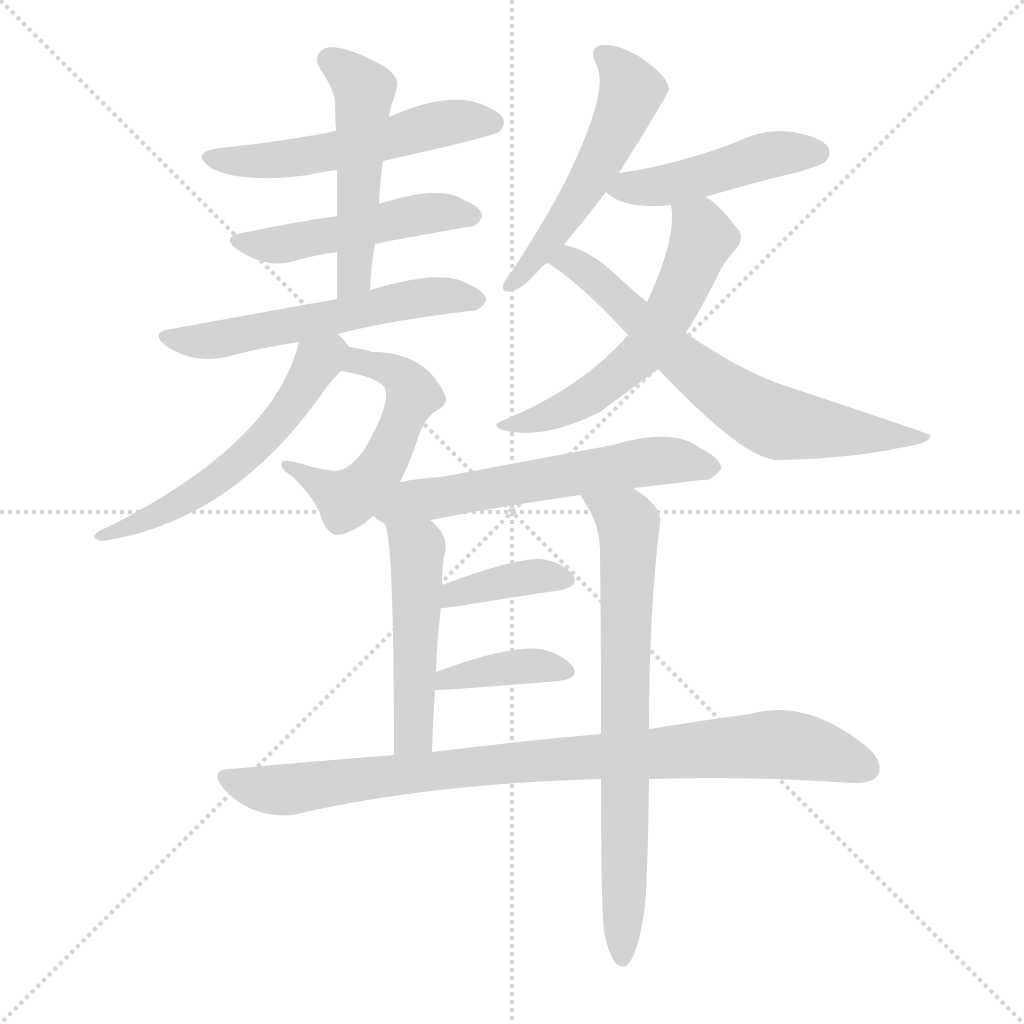
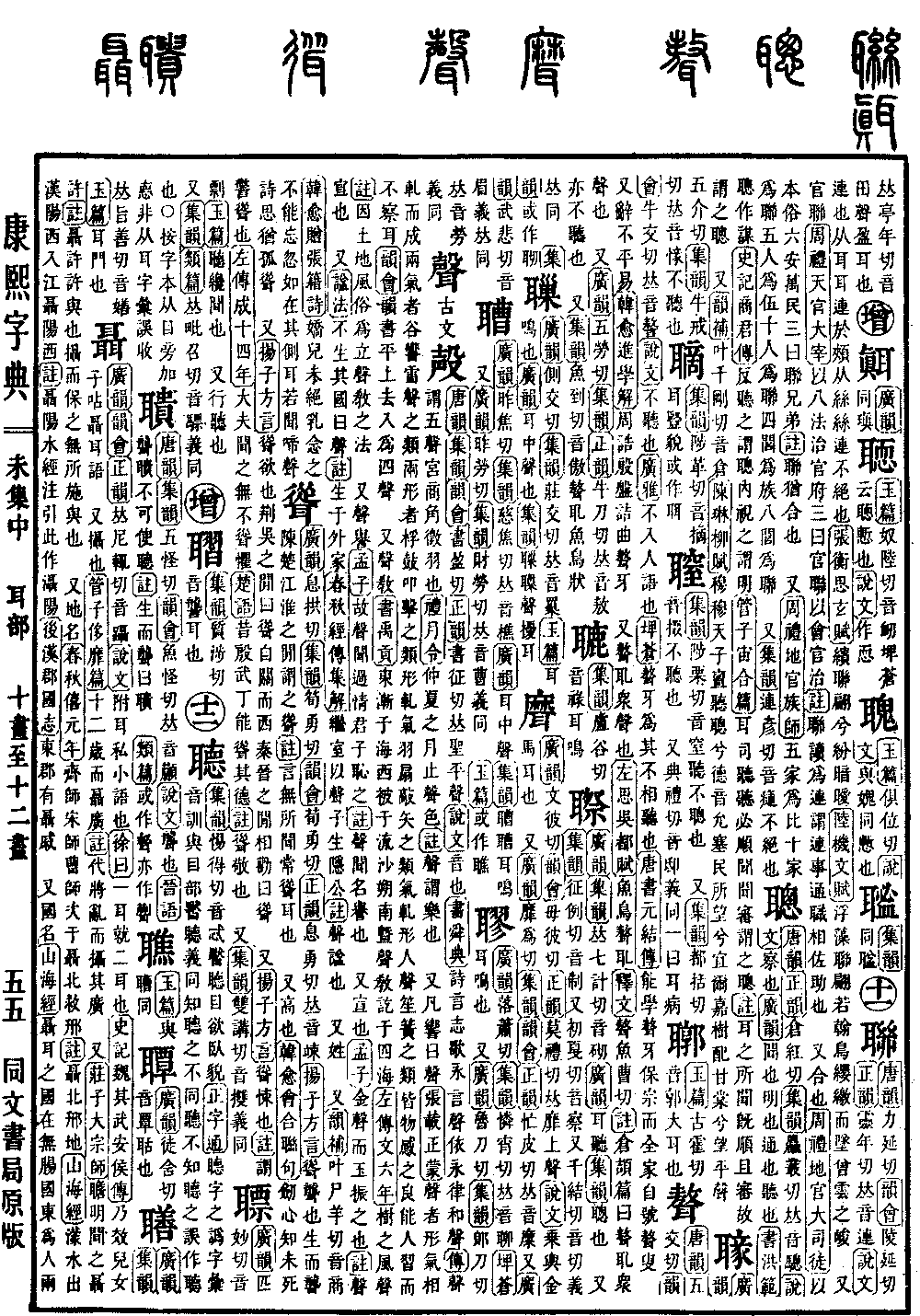
Wei Collection, Middle Volume. Radical: Ear (ěr). Kangxi stroke count: 17. Page 969, Entry 11.
Pronounced ao. According to the Tang Rhyme (Tangyun) and the Rhyme Collection (Yunhui), it is not listening. The Analytical Dictionary of Characters (Shuowen) defines it as refusing to listen. The Broad Collection of Refinements (Guangya) defines it as words that do not enter the mind. The Pi Cang dictionary notes that the phrase ao ya describes words that do not accord with one another. The History of Tang (Tangshu), Biography of Yuan Jie, records: He was able to study the difficult and jagged (ao ya) texts, protected his lineage and whole family, and referred to himself as the Old Man of Ao. It also refers to language that is not smooth or easy. Han Yu, in Exhortation to Learning (Jinxue jie), writes: The Zhou Proclamations and the Yin Basin inscriptions are tangled and jagged (ao ya). It also appears in the term ao ran, referring to a multitude of sounds. Zuo Si, in Rhapsody on the Capital of Wu (Wu du fu), writes: Fish and birds make a cacophonous noise (ao ran). The Explanatory Text (Shiwen) states that the character is pronounced ao. The note in the Cangjie Collection states: Ao ran refers to a multitude of sounds. It is also pronounced ao according to the Broad Rhymes (Guangyun), Collection of Rhymes (Jiyun), and Correct Rhymes (Zhengyun); it also means not listening. According to the Collection of Rhymes (Jiyun), it is also pronounced ao, referring to the appearance of fish and birds.