Hai Collection, Upper Volume
Radical: Carriage (chē)
Kangxi Strokes: 15
Page 1436, Entry 07
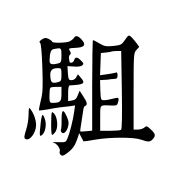
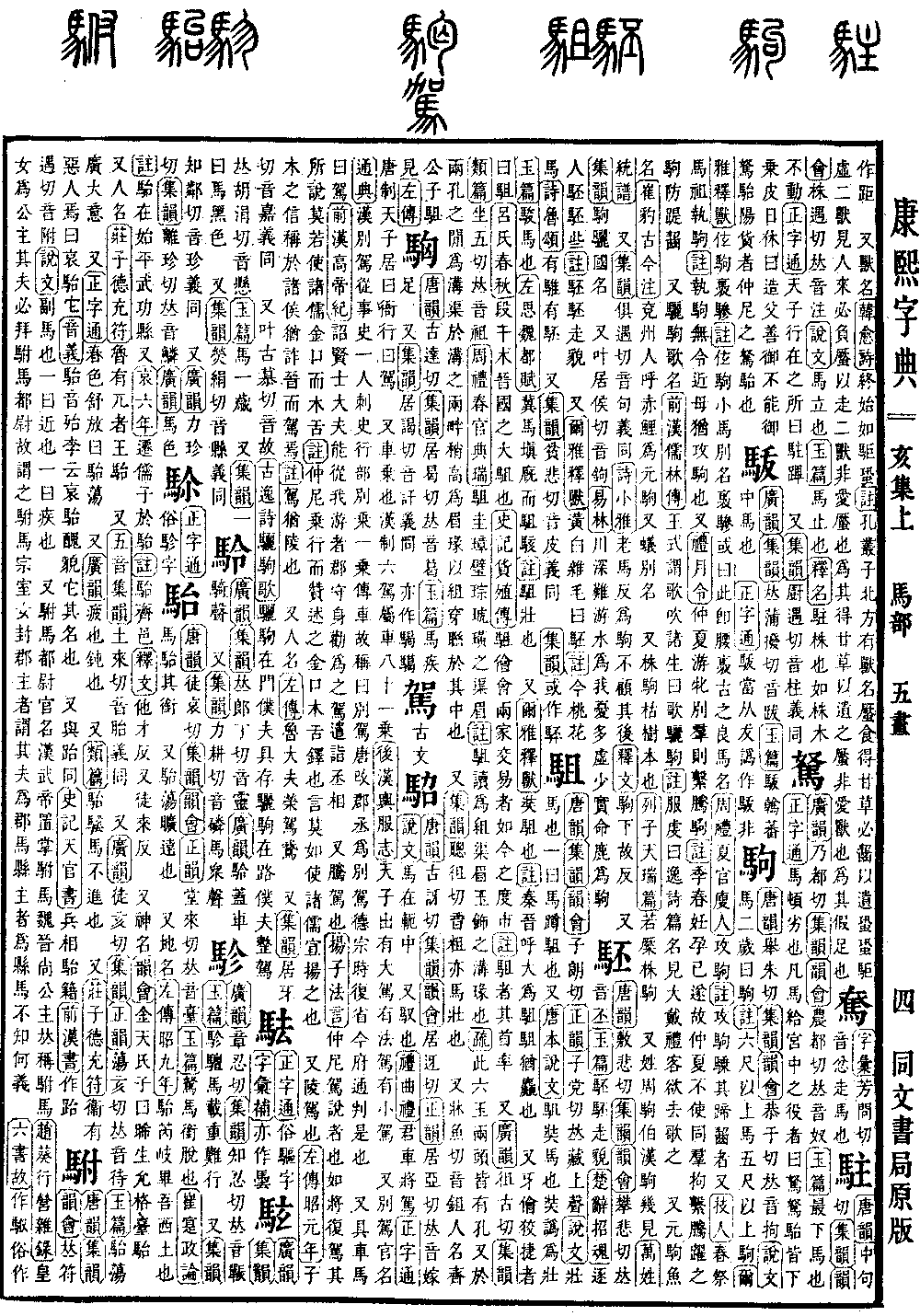
Tang Rhymes (Tangyun), Collection Rhymes (Jiyun), and Rhyme Compendium (Yunhui): Pronounced zang (rising tone). Correct Rhymes (Zhengyun): Pronounced zang (rising tone). Explanatory Note: A strong horse. Another interpretation suggests it describes the posture of a horse crouching. According to the Tang Edition of the Explanation of Scripts and Analysis of Characters (Shuowen): Zang refers to a sturdy horse. The character for sturdy was mistakenly written as the character for strong. According to the Jade Chapters (Yupian): A fine horse. In the Rhapsody on the Wei Capital (Weidu Fu) by Zuo Si: The horses of the Ji region fill the stables, all of them being strong and fine. Commentary: Zang means strong and vigorous. According to the Approach to Elegance (Erya), in the chapter on language: Zang is the same as zang. Commentary: In the region east of the Yangtze River, large is referred to as zang; zang is similar to the meaning of coarse. It also refers to a cunning and agile middleman in the market. In the Master Lu's Spring and Autumn Annals (Lüshi Chunqiu): Duangan Mu was a great middleman of the Jin state. In the Records of the Grand Historian (Shiji), Biography of Money Makers (Huozhi Zhuan): Zangkuai are those who facilitate trade between two parties, similar to modern market brokers. Commentary: Zang refers to their leader. According to the Broad Rhymes (Guangyun): Pronounced cu. According to the Collection Rhymes (Jiyun) and Classified Chapters (Leipian): Pronounced zu. Pronounced zu. In the Rites of Zhou (Zhouli), Spring Office, Statutes of the Auspices (Dianrui): Used for silk ribbons to string through the grooves on jade objects such as the gui, zhang, bi, cong, hu, and huang. Commentary: Zang is pronounced as zu; qumei refers to the grooved patterns decorating jade. Sub-commentary: These six types of jade objects all have holes at both ends, and a groove is made between the two holes, with the edges of the groove slightly raised like eyebrows, and silk ribbons are used to connect them in the middle. According to the Collection Rhymes (Jiyun): Pronounced cu. Also refers to a horse being strong and vigorous. Also pronounced chu. A personal name, Prince Zang of the Qi state, as seen in the Zuo Tradition (Zuo Zhuan).
Textual Research: In the Rhapsody on the Wei Capital (Weidu Fu) by Zuo Si, the original text stated the horses were strong and startling. Following the original text, startling has been corrected to fine. In the Approach to Elegance (Erya), chapter on the explanation of beasts, the text stated that zang is the same as zang. Following the original text, the chapter title explanation of beasts has been corrected to language, and the region Qin and Jin has been corrected to east of the Yangtze River.