Shen Collection, Upper Volume
Radical: Grass (cǎo)
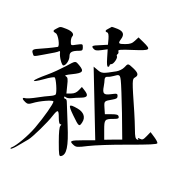
蒩
Kangxi stroke count: 16
Page 1049, Entry 19
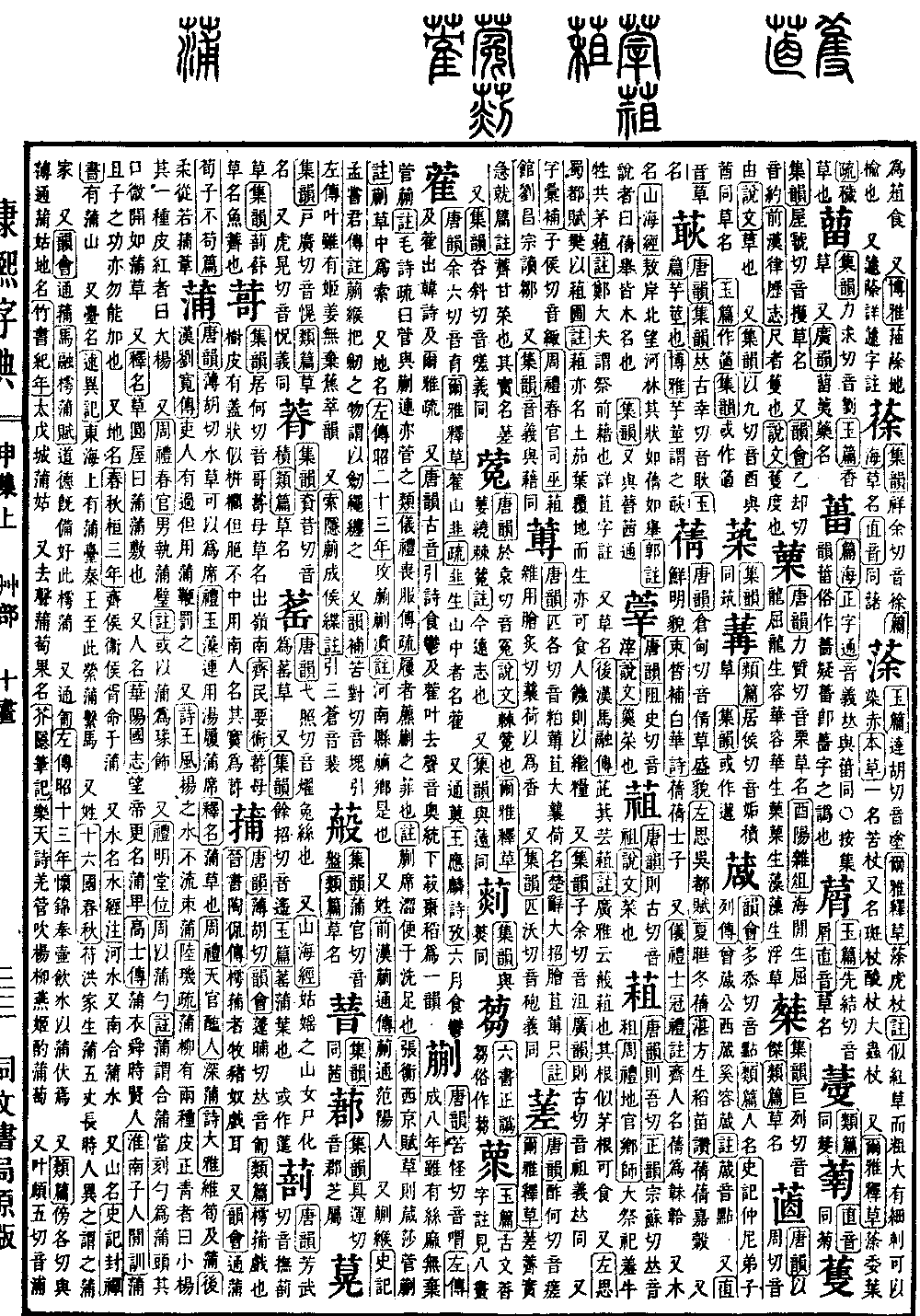
According to the Tang Rhymes (Tangyun), pronounced zu (level tone); according to the Corrected Rhymes (Zhengyun), pronounced zu (level tone). In the Rites of Zhou (Zhouli), section on the Office of Earth and the Local Officials: At major sacrificial rites, one presents the bovine sacrificial animal and provides straw mats for the rituals. The commentary by Zheng Xuan states that this refers to the mats used before the sacrifice. See the detailed entry under the character for hemp fiber (ju).
Also, the name of a plant. In the History of the Later Han (Hou Hanshu), biography of Ma Rong: The purple cogon grass and the yu-ju plant. The commentary citing the Erya states: The ji plant is also known as ju; its roots resemble those of the cogon grass and are edible.
Also, in the Rhapsody on the Capital of Shu (Shudu Fu) by Zuo Si: Fenced with gardens of ju. The commentary states: The ju plant is also called earth eggplant; its leaves grow covering the ground and are also edible, used as a food substitute during times of famine.
Also, according to the Collected Rhymes (Jiyun), pronounced ju (rising tone). According to the Broad Rhymes (Guangyun), pronounced zu (rising tone). The meaning is the same.
Also, according to the Supplement to the Collection of Characters (Zihui Bu), pronounced zou. In the Rites of Zhou (Zhouli), section on the Spring Officials and the Master of Shamans: The ju-shrine. Liu Changzong reads it as zou.
Also, according to the Collected Rhymes (Jiyun), the pronunciation and meaning are the same as the character for mat (jie).