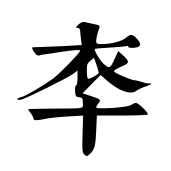
"Tang Yun" and "Ji Yun" state that this character is pronounced "zàng mò qiè," with the same sound as "cuò." "Shuowen Jiezi" explains it as a subordinate official performing labor service. "Yun Hui" states that in ancient times, dyed clothes were used as markers, thus the character is composed of "yi" (clothing) and "shi" (ten). "Yangzi Fangyan" records that in the regions of Southern Chu and Eastern Sea, "biǎo" was called "chǔ." "Guo Pu's commentary" states this is because their clothes were red. "Yupian" explains it as a person carrying out a flogging punishment. "Zhou Li, Di Guan, Xiao Situ" records military organization: five "wu" form one "liang," four "liang" form one "biǎo," and five "biǎo" form one "lü." "Qi Yu" records: four "li" form one "lian," thus two hundred people are called one "biǎo," led by a company commander. "Zuo Si Wu Du Fu" describes: warriors with tattooed patterns on their foreheads, soldiers with engraved designs on their bodies.
It also refers to "Jibiǎo," which is the name of a constellation. "Jin Shu, Tian Wen Zhi" records: the Jibiǎo stars number twelve, located south of the Fang constellation, and their main duty is guarding.
Furthermore, "Guang Yun" reads it as "zi yu qiè," with the same sound as "jué." It means "to exhaust" or "to complete." "Jin Yu" records: Shi Su drank the wine in his cup to the last drop, then knelt and kowtowed again.
It also indicates finality and completion. "Shi Jing, Bei Feng" sings: "Father, oh mother, you raised me but did not treat me well until the end." "Shi Ji, Huaiyin Hou Zhuan" states: "You are a petty person, who starts good deeds but never finishes them."
It also signifies death. "Li Ji, Qu Li" records: the death of a Grand Master is called "biǎo," the death of a scholar-official is called "bulu," and the death of a commoner is called "si."
Additionally, "Tang Yun" reads it as "cāng mò qiè," with the same sound as "cù." It means "hasty" or "urgent." "Shi Ji, Qin Ben Ji" states: unable to cope with sudden changes. "Jin Shu, Li Zhi" records: at that time, both inside and outside the court, upon hearing Du Yu's dissenting opinion, most were surprised.
Furthermore, "Ji Yun" reads it as "zuó lǜ qiè," with the same sound as "lüè." The annotations of "Shi Jing" state that it is interchangeable with the character "lǜ," meaning "high and precipitous." "Shi, Xiao Ya" writes: "Steep rocks, so high and precipitous."
It is also read as "qǔ nèi qiè" in "Lei Pian." It is the same as the character "cuì," meaning "deputy" or "assisting official." "Li Ji, Yan Yi" mentions: the deputies appointed from the illegitimate sons of feudal lords, ministers, grand masters, and scholars.
Furthermore, in "Yun Bu," its rhyme can be read as "chāng shuō qiè," with the same sound as "chuò." "Su Zhe's Poetry" writes: "The deeds are passed down to future generations, becoming material for people's discussions. Right and wrong have passed, how hasty were prosperity and decline." "Liu Shu Zheng'e" believes: the character's form represents (a person) carrying clothes on their shoulder, making it a suggestive-indicative character. Separately, writing it as "zú" or "" is incorrect. Verification: [ "Yangzi Fangyan" states that between Southern Chu and Eastern Sea, "biǎo" was called "chēng." ] Following the original text, "chēng" has been changed to "chǔ."