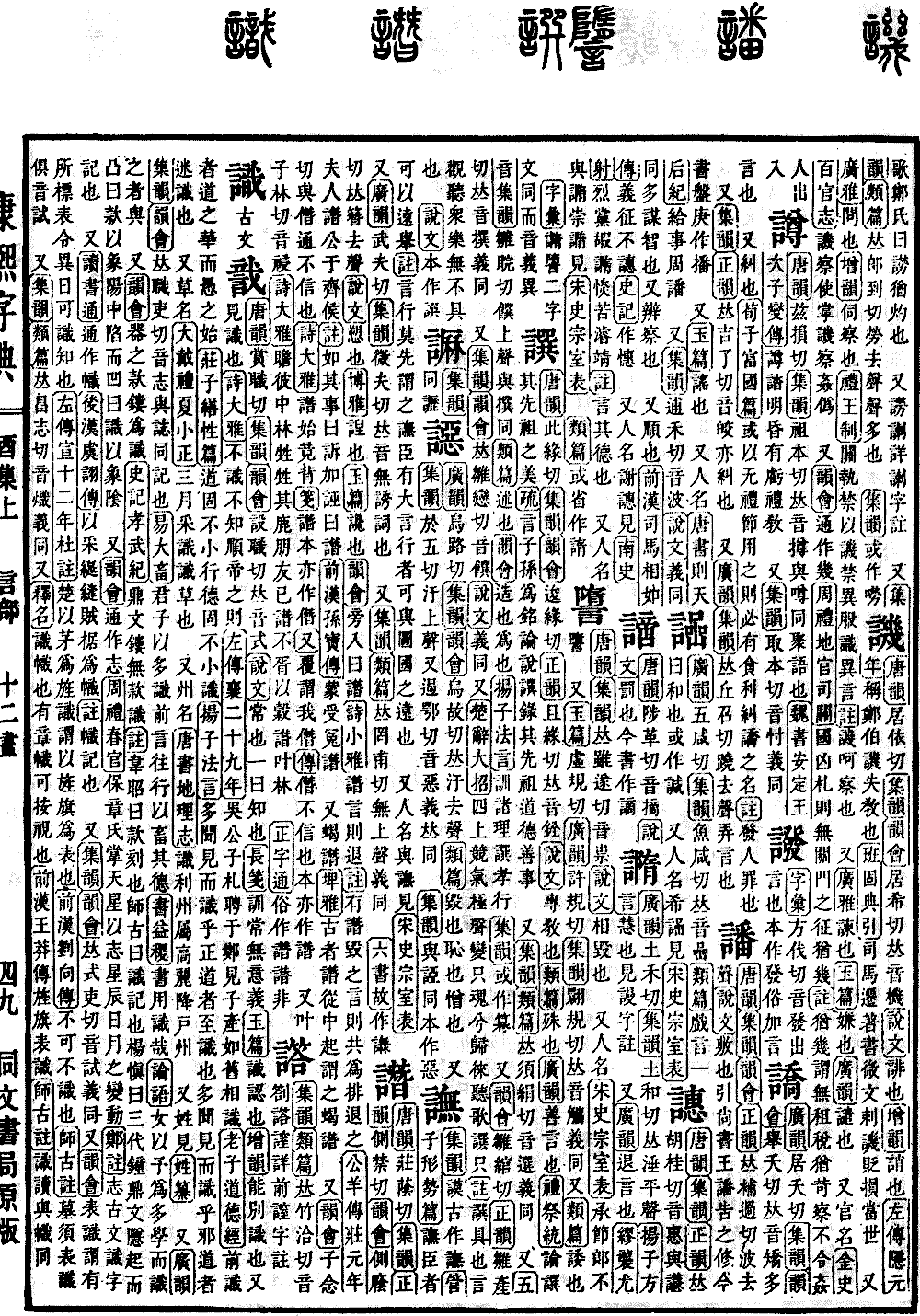
You Collection, Upper Volume
Radical: Speech (yán)
Kangxi Strokes: 19
Page 1181, Entry 01
Pronounced zèn (falling tone).
Shuowen Jiezi (Explanation of Graphs and Analysis of Characters): To slander.
Guangya (Expanded Dictionary): To slander.
Yupian (Jade Chapters): To slander.
Yunhui (Collection of Rhymes): To enter slander from the side.
Book of Odes (Shijing): When slanderous words arise, one retreats.
Commentary: When slanderous and destructive words exist, one jointly repels and withdraws.
Gongyang Commentary (Gongyang Zhuan): The wife slandered the Duke to the Marquis of Qi.
Commentary: Telling of a factual matter is called accusing (su); adding falsehoods is called slandering (zèn).
History of the Former Han (Qian Han Shu): To suffer unjust slander.
Also, scorpion-like slander.
Piya (Amplified Expositions): In ancient times, when slander arose from within, it was called scorpion-like slander.
Also, pronounced jiàn (falling tone). Interchangeable with jian (to exceed, to be dishonest).
Lack of trust.
Book of Odes (Shijing): Slander begins and finally goes against.
Shiwen (Explanation of Text): The original text of zèn also written as jiàn.
Also: Covertly calling me dishonest.
Jian (Sub-commentary): Jian means lack of trust. The original text also written as zèn.
Also, rhyming with lín, pronounced jìn (falling tone).
Book of Odes (Shijing): Looking at that middle forest, the deer are numerous. Friends have already slandered; they do not look at each other with goodness. Zèn rhymes with lín.
Zhengzitong (Correction of Characters): Commonly written as zèn (with the radical replaced), which is incorrect.
Textual Research:
Book of Odes (Shijing): Slander begins and finally goes against.
Jian (Sub-commentary): Jian means lack of trust. The original text also written as zèn.
Note: According to the original text, changed sub-commentary to Explanation of Text, and changed the commentary to sub-commentary.