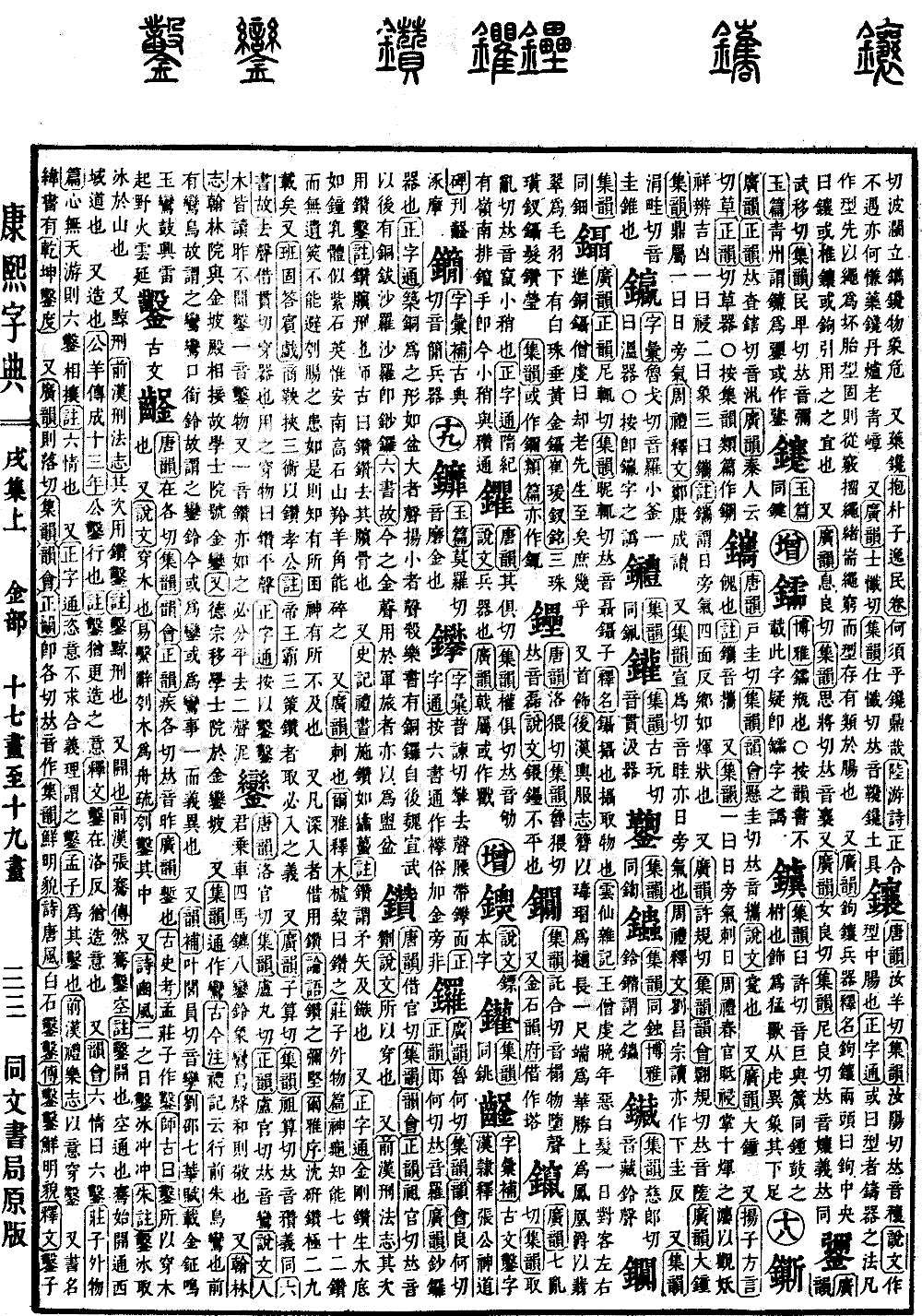
Xu Collection, Upper Volume
Radical: Metal (jīn)
Page 1327, Entry 29
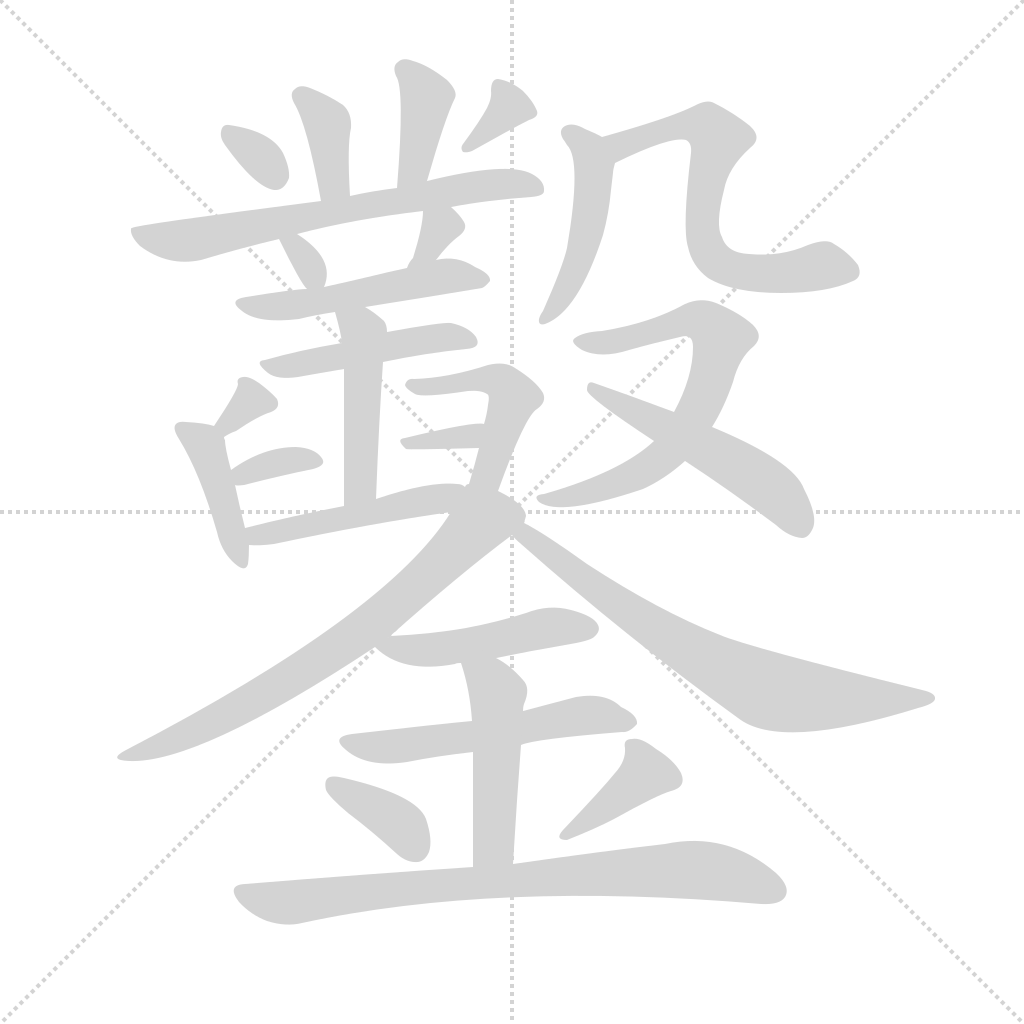
Ancient script. According to Tang Rhymes (Tangyun), pronounced zuo. According to Collection of Rhymes (Jiyun), Rhyme Compendium (Yunhui), and Orthodox Rhymes (Zhengyun), pronounced zuo. According to Broad Rhymes (Guangyun), it means to chisel. According to Records of Ancient History (Gushikao), Meng Zhuangzi created the character for chisel. Master Yan Shigu says: The chisel is a tool used for boring wood.
Also, according to Discussion of Writing (Shuowen), it means to bore into wood. In the Book of Changes (Yijing), Commentary on the Appended Phrases (Xici), it refers to splitting and hollowing out wood to make a boat.
Also, in the Book of Odes (Shijing), Binfeng, it states, "In the second month, they chisel ice with a resounding clang." Zhu Xi's commentary notes: Chiseling ice refers to going into the mountains to extract ice blocks.
Also refers to the punishment of tattooing the face. In the History of the Former Han (Qianhan), Treatise on Law, it says, "Next is the use of the drill and chisel." The commentary notes: Chisel refers to the punishment of tattooing.
Also refers to opening or clearing. In the History of the Former Han (Qianhan), Biography of Zhang Qian, it says, "However, Qian opened the path." The commentary notes: Chisel means to open or clear, and empty means to penetrate. This refers to Zhang Qian being the first to open the route to the Western Regions.
Also refers to manufacturing or creating. In the Gongyang Commentary (Gongyangzhuan), 13th Year of Duke Cheng, it says, "The Duke practiced his own way." The commentary notes: Chisel has the meaning of manufacturing anew. The Explanation of Texts (Shiwen) says: Chisel is pronounced luo. It means to manufacture deliberately.
Also, according to the Rhyme Compendium (Yunhui), the six emotions are called the six chisels. In the Book of Zhuangzi (Zhuangzi), External Things chapter, it says, "If the mind does not wander in the realm of nature, the six chisels will conflict with one another." The commentary notes: This refers to the six emotions.
Also, according to the Comprehensive Dictionary of Characters (Zhengzitong), acting according to one's own desires without seeking to conform to reason is called chiseling. Mencius mentions this as being far-fetched and forced. In the History of the Former Han (Qianhan), Treatise on Rites and Music, it refers to acting based on subjective conjecture and forced interpretation.
Also, it is the name of a book. Among the apocryphal texts, there is the Qiankun Chiseling Method (Qiankun zaodu).
Also, according to Broad Rhymes (Guangyun), pronounced zuo. According to Collection of Rhymes (Jiyun), Rhyme Compendium (Yunhui), and Orthodox Rhymes (Zhengyun), pronounced zuo. According to Collection of Rhymes (Jiyun), it refers to a bright and clear appearance. In the Book of Odes (Shijing), Tangfeng, it says, "The white stones are bright." The commentary says: Bright, the appearance of being clear. The Explanation of Texts (Shiwen) says: Chisel is pronounced luo.
Also, in the Nine Chapters on the Mathematical Art (Jiuzhang suanshu), it says, "For every fifty parts of grain, there are twenty-four parts of chisel." This means five dou of grain can yield two dou and four sheng of rice. In the Zuo Commentary (Zuozhuan), 2nd Year of Duke Huan, it says, "The grain offered was not chiseled." The commentary notes: Not finely milled. The Explanation of Texts (Shiwen) says: Chisel is pronounced luo. In Du Fu's poetry: The autumn wild rice becomes black grain, refined chiseling produces white rice.
Also, according to Broad Rhymes (Guangyun) and Collection of Rhymes (Jiyun), pronounced zu. According to Broad Rhymes (Guangyun), it means to chisel or carve flowers and leaves.
Also, according to Collection of Rhymes (Jiyun), Rhyme Compendium (Yunhui), and Orthodox Rhymes (Zhengyun), pronounced zao in the departing tone. According to Collection of Rhymes (Jiyun), it means to bore a hole. According to Extended Rhymes (Zengyun), a hole or cave. In the Book of Rites (Zhouli), Winter Officials, Artisans' Record, Wheel Maker, it says, "Regarding the spokes, measure the depth of the hole to determine the width of the spoke." The Explanation of Texts (Shiwen) says: Chisel is pronounced cao in the departing tone. There are also readings that follow the original pronunciation. In the History of the Former Han (Qianhan), Biography of King Yuan of Chu, it says, "The sheep entered its hole." The commentary by Yan Shigu notes: Chisel is pronounced zao in the departing tone. This refers to an excavated tomb. In the Songs of Chu (Chuci), Nine Arguments (Jiubian), it says, "When will the customs of the world be skillful, erasing the compass and square to alter the chisel? Standing alone and upright without following the crowd, I yearn for the legacy of the former sages."
Also, according to Collection of Rhymes (Jiyun), pronounced cao. It means complicated or messy.
Also, according to Tang Rhymes Corrected (Tangyunzheng), read in the level tone, pronounced cao. In the Commentary on the Water Classic (Shuijingzhu), it says, "Huan had the ambition of inquiring about the tripods, so he channeled an island to reach the number of one hundred." Channeled (cao) is the character for chisel.
Also, according to Supplement to Rhymes (Yunbu), rhyming with zu, read as the rising tone of zu. In the Forest of Changes (Yilin), it says, "A lead knife attacking jade, nothing is left un-drilled or chiseled. The dragon body is fully displayed, Lu Ban acts as an assistant."