Chou Collection, Upper Volume
Radical: Mouth (kǒu)
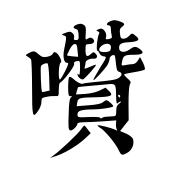
Character: Zan
Kangxi strokes: 22
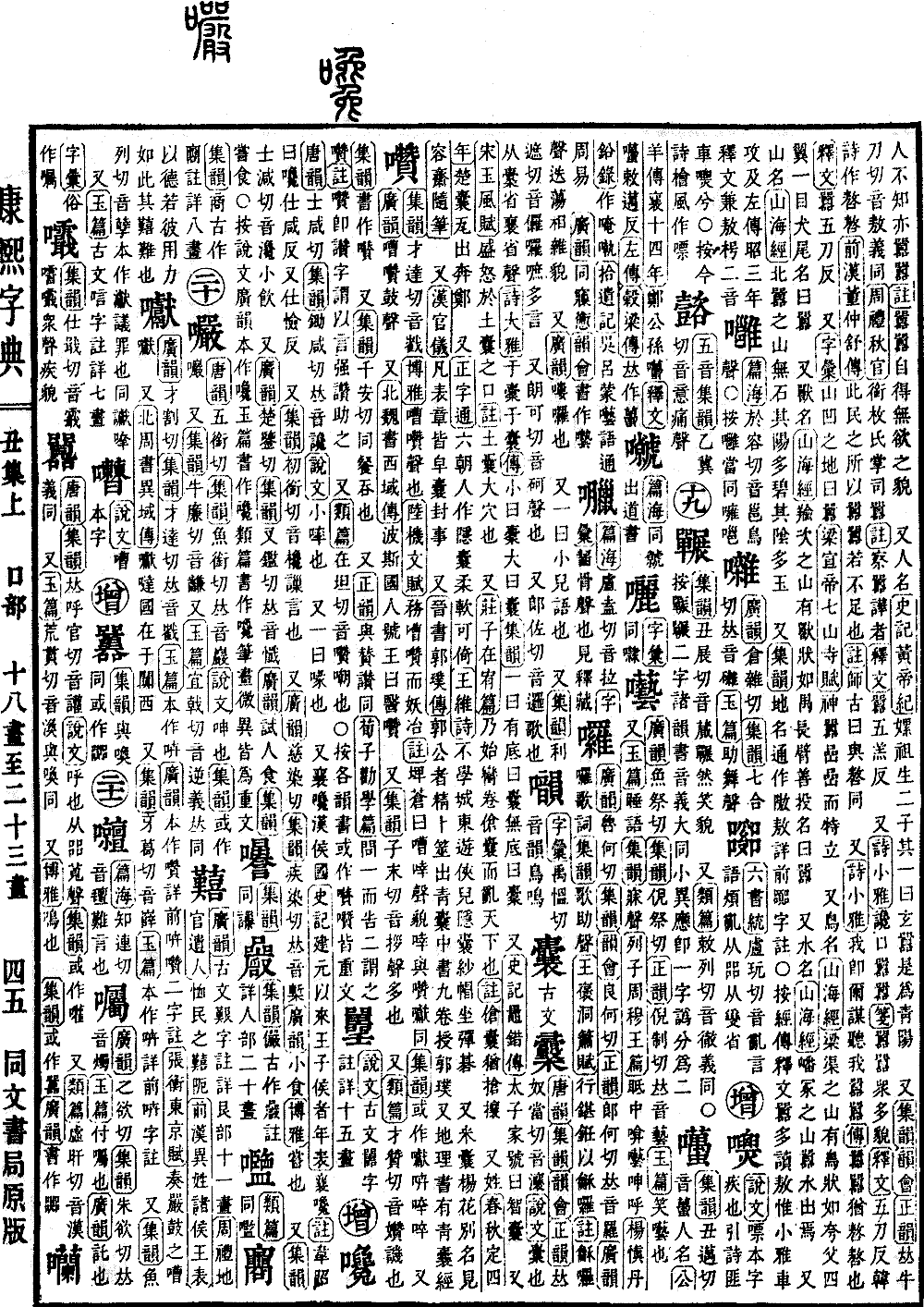
Page 215, Entry 16
Collected Rimes (Jiyun): Pronounced jie.
Broadly Refined (Boya): Cao-zan, refers to sound.
Lu Ji, Poetic Exposition on Literature (Wenfù): Engaging in clamorous and seductive styles.
Commentary: Cang says, cao-zan is the appearance of sound. Zan is synonymous with cuo.
Collected Rimes (Jiyun): Sometimes written as cuo or cui.
Wide Rimes (Guangyun): Cao-zan, the sound of drums.
History of the Northern Wei (Beiwei Shu), Account of the Western Regions: The people of Persia call their king Yizan.
Collected Rimes (Jiyun): Pronounced za. Refers to abundant sound.
Categorized Chapters (Leipian): Pronounced zan. To ridicule.
Collected Rimes (Jiyun): Written as zan.
Collected Rimes (Jiyun): Pronounced can. The same as can. To swallow.
Corrected Rimes (Zhengyun): The same as zan (to assist or praise).
Xunzi, Exhortation to Learning (Quanxue Pian): To ask one question but receive two answers is called zan.
Commentary: Zan is the character for praise, meaning to use words to forcefully assist or support.
Categorized Chapters (Leipian): Pronounced zan. To mock.
Note: Various rime books sometimes write this as zan; all are variant forms. The character is formed with the component jin (jian); it does not follow the component indicating an alternative structure.