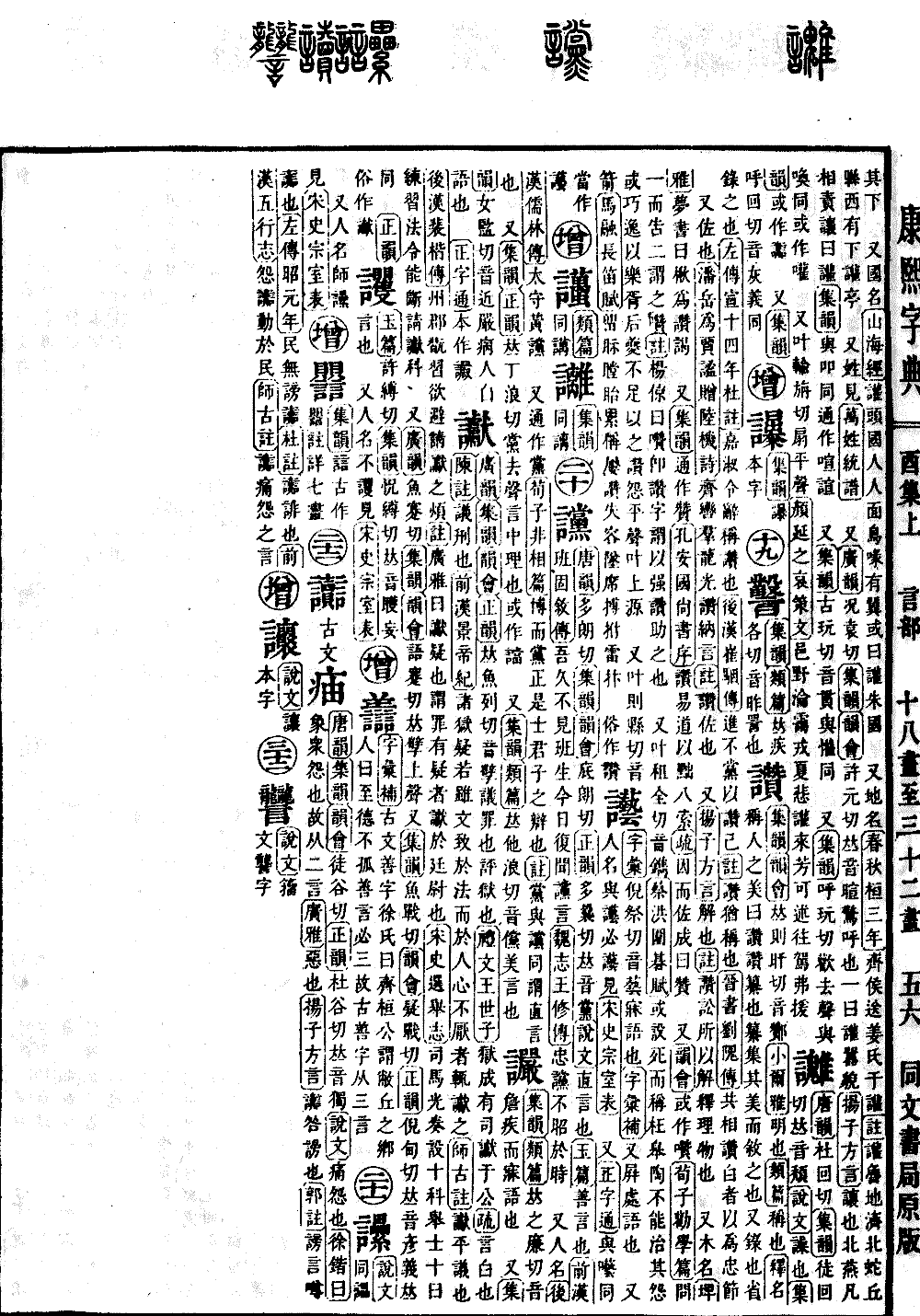
You Collection, Upper Volume
Radical: Speech (yán)
讚
Kangxi Strokes: 26
Page 1188, Entry 04
According to Collection of Rhymes (Jiyun) and Rhyme Anthology (Yunhui), the pronunciation is zan (falling tone). According to Small Erya (Xiao Erya), it means to clarify. According to Categorized Chapters (Leipian), it means to praise. According to Explanations of Names (Shiming), praising the beauty of a person is called zan. Zan means to collect; it means to gather together their merits and narrate them. It also means to record, or to summarize and record. According to the commentary by Du Yu on the Zuo Commentary (Zuo Zhuan), fourteenth year of Duke Xuan, it means to praise virtuous and refined language. In the Biography of Cui Yin in the Book of the Later Han (Hou Hanshu), it states: To advance without forming factions to promote (zan) oneself. The commentary notes that zan is similar to praise. In the Biography of Liu Wei in the Book of Jin (Jinshu), it mentions those who promote and introduce others are considered loyal. It also means to assist. In the poem by Pan Yue composed for Jia Mi to gift to Lu Ji, it says: Holding the reins of many dragons, brilliantly assisting the one who offers words. The commentary notes that zan means to assist. According to Master Yang’s Regional Dialects (Fangyan), it means to explain. The commentary notes that zan-song refers to explaining or clarifying matters. It is also the name of a tree. According to Essential Glosses (Piya), the Dream Book states that the catalpa tree is called the zan-ye. According to Collection of Rhymes (Jiyun), it is also written in a variant form (zan). In the Preface to the Book of Documents (Shangshu) by Kong Anguo, it states: Promoting (zan) the way of the Book of Changes (Yi) to eliminate the eight lost documents. The commentary says: To follow along and assist in the completion of something is called zan. According to Rhyme Anthology (Yunhui), it is sometimes written as a variant (zan). In the Exhortation to Learning chapter of the Xunzi, it says: To ask one question and be told of two is called zan. The commentary by Yang Liang says: Zan is the same as the character zan, referring to forcefully assisting someone. It also rhymes with quan (level tone), with the pronunciation juan (level tone). In the Rhapsody on Weiqi by Cai Hong, it states: Some feign death and claim injustice, even Gao Yao could not resolve their grievances; others skillfully retreat to enjoy leisure, even Hou Kui is not enough to assist (zan) them. Grievance is a level tone, rhyming with the preceding word. It also rhymes with xian (falling tone), with the pronunciation jian (falling tone). In the Rhapsody on the Long Flute by Ma Rong, it states: Staring and gaping, repeatedly praising and reciting (zan); losing composure and falling from the mat, beating the drum and clapping like thunder. Commonly written as the variant (zan).