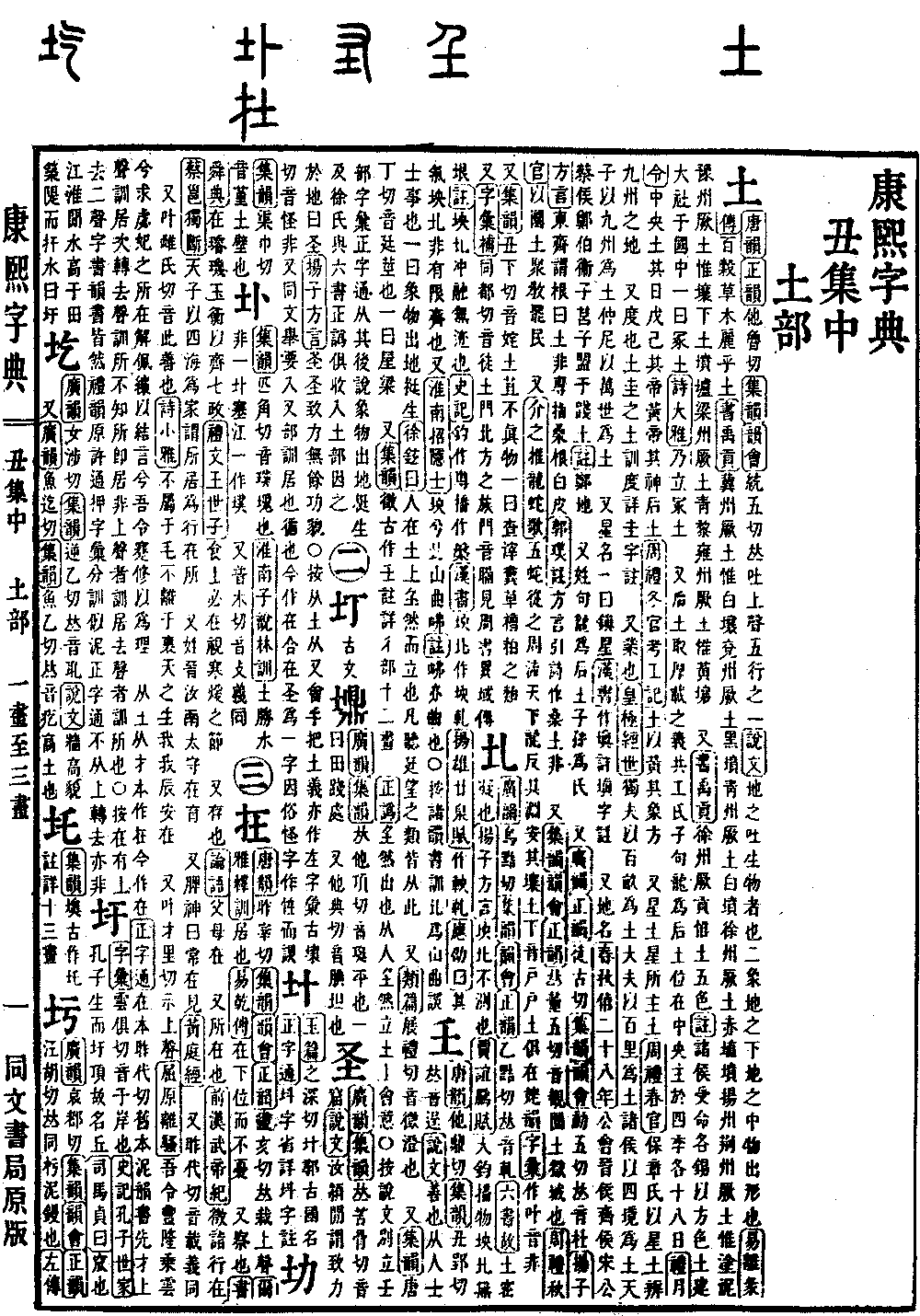
Chou Collection, Middle Volume. Radical: Earth (tǔ). Kangxi strokes: 6. Page 223, Entry 10.
Pronounced zài (rising tone).
According to the Erya, Explanation of Teachings (Erya): To reside.
In the Book of Changes, Commentary on the Qian Hexagram (Yi Jing): To remain in a lower position without sorrow.
Also, to examine.
In the Book of Documents, Canon of Shun (Shujing): Positioned at the jade armillary sphere to regulate the seven governors.
In the Book of Rites, Royal Son of King Wen (Liji): When eating, one must observe the cycles of cold and warmth.
Also, to exist or to be alive.
In the Analects (Lunyu): When parents are alive.
Also, the place where one is located.
In the History of the Former Han Dynasty, Annals of Emperor Wu (Qian Hanshu): Summoned to attend at the imperial temporary residence.
Cai Yong, Unique Decisions (Duduan): The Son of Heaven considers the four seas his home; the place where he resides is called the temporary residence.
Also, a surname. The Jin dynasty administrator of Runan was named Zai Yu.
Also, the spleen deity is called Chang Zai, as seen in the Yellow Court Classic (Huangting Jing).
Also pronounced zài. The meaning is the same.
Also pronounced cǐ (rising tone). Good.
In the Book of Odes, Minor Odes (Shijing): Neither attached to the fur nor separated from the lining. Since Heaven gave me birth, in what cycle shall I be at peace?
Also pronounced lǐ (rising tone).
In Qu Yuan, Encountering Sorrow (Lisao): I ordered Fenglong to ride the clouds to seek where the Fu River concubine resides. I unfastened my girdle to pledge our words, and ordered Jianxiu to act as my matchmaker.
Formed by the characters for earth and talent. Originally written as a variant form, now written as in this entry.
Correct Character Guide (Zhengzitong): The character was originally pronounced zài. Older dictionaries insisted on defining it in the rising tone as to reside, and then shifted to the departing tone to define it as a place, not realizing that a place is simply where one resides. It is not the case that the rising tone defines residence while the departing tone defines place. Note that the character has both rising and departing tones, as recognized by all character and rhyme dictionaries. The Rites Rhymes (Liyun) originally allowed for them to be rhymed together, while the Character Collection (Zihui) separated the definitions, which seems overly rigid. The Correct Character Guide (Zhengzitong) does not support the shift from rising to departing tone, which is also incorrect.