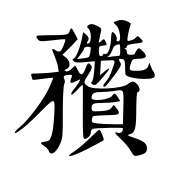
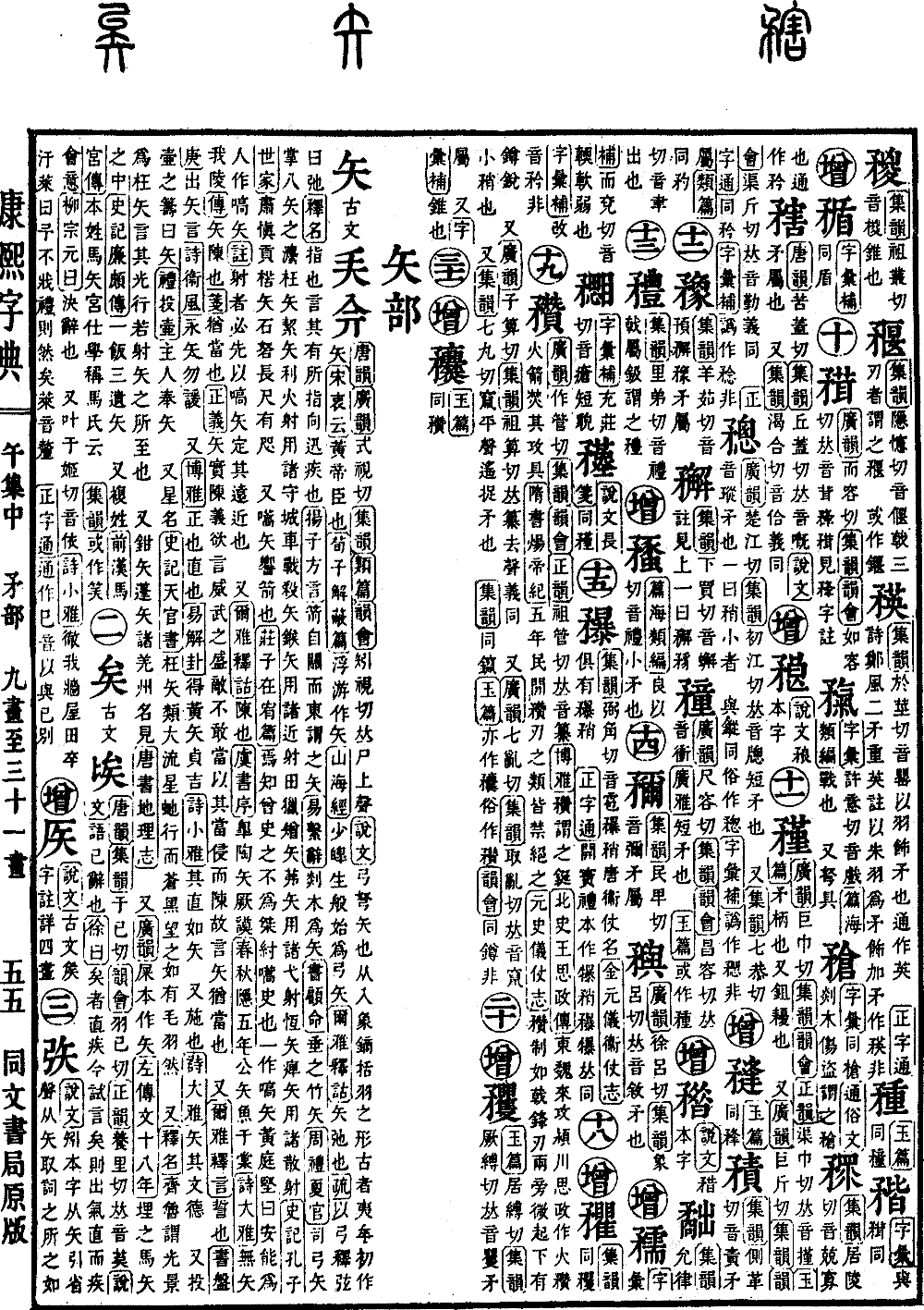
"Guangyun" renders this as *guǎn* cut, and "Jiyun," "Yunhui," and "Zhengyun" render it as *zǔ guǎn* cut, pronounced *zuǎn*. "Boyao" states that *lǐn* is called *chán*. In the "History of the Northern Dynasties - Biography of Wang Sizheng," it is stated that when the Eastern Wei attacked Yingchuan, Wang Sizheng manufactured fire *lín* and fire arrows, burning their siege equipment. In the "History of the Sui - Annals of Emperor Yang," it is stated that in the fifth year, weapons such as *lín* blades were prohibited. The "History of Yuan - Treatise on Ceremonial Equipments" states that the *lín* has a form similar to a *ji*, with slightly raised edges on both sides of the blade and a sharp tip at the bottom.
Also, "Guangyun" renders this as *zǐ suàn* cut, and "Jiyun" renders it as *zǔ suàn* cut, pronounced *zuǎn* in the departing tone. The meaning is the same.
Also, "Guangyun" renders this as *qī luàn* cut, and "Jiyun" renders it as *qǔ luàn* cut, pronounced *cuàn*. This refers to a small spear.
Also, "Jiyun" renders this as *qī wán* cut, pronounced *cuàn* in the level tone. This refers to a spear for long-distance throwing. "Jiyun" is the same as *làng*. "Yupian" also writes it as . The common form is written as . "Yunhui" states it is the same as *zūn*, which is incorrect.