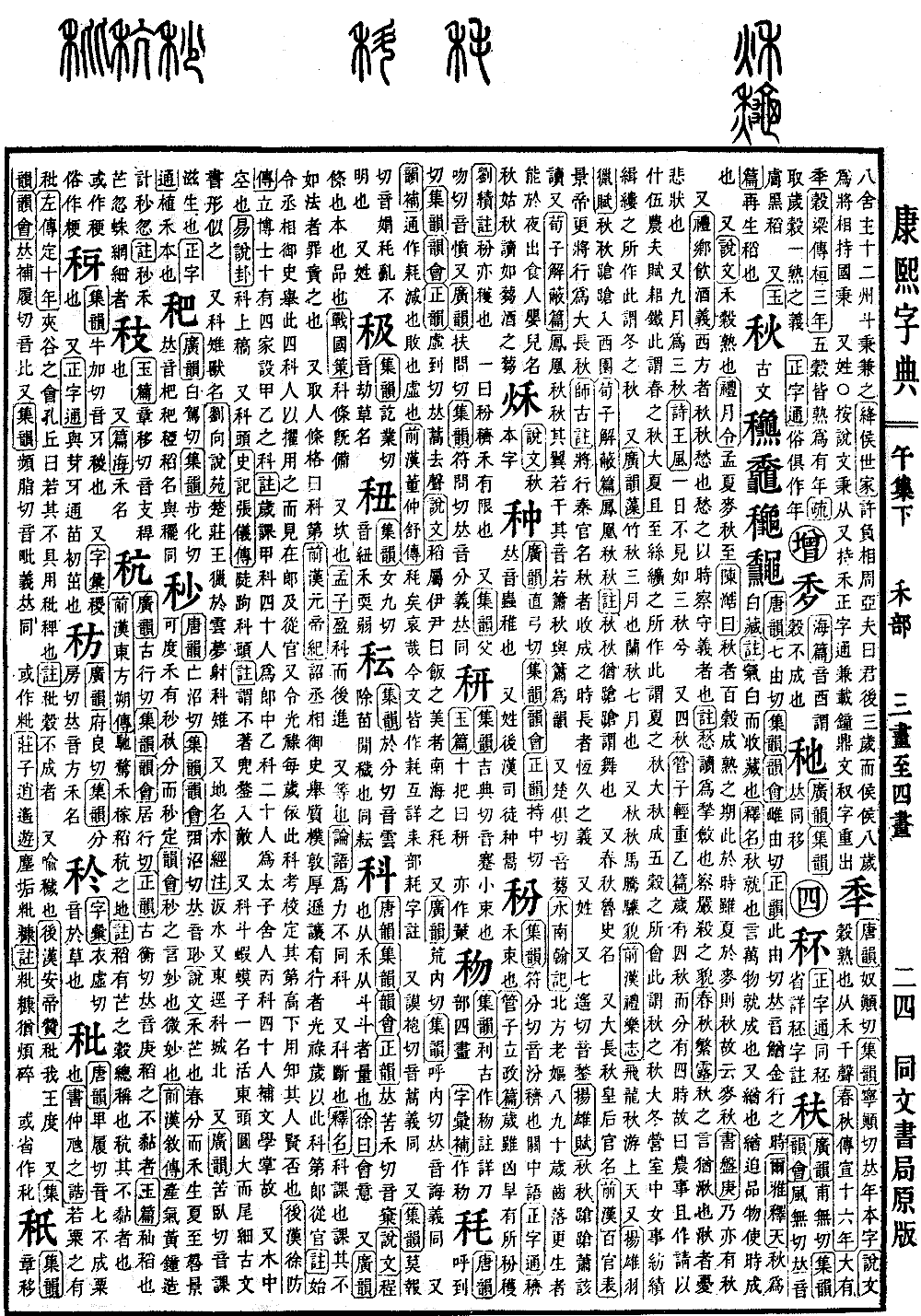
Wu Collection, Lower Volume
Radical: Grain (hé)
Kangxi Strokes: 14
Page 850, Entry 02
In Classical Chinese, Pronounced zhong (rising tone). Seeds of grain.
Book of Odes (Shijing): Heaven sends down good seeds.
Rites of Zhou (Zhouli): According to the properties of the land, select suitable crops to sow.
Also, Rites of Zhou (Zhouli): In Yu Province, it is suitable to plant five kinds of grain. Commentary: Millet, broomcorn millet, soybeans, wheat, and rice.
Also refers to types or kinds.
Book of Documents (Shangshu): Do not let the bad kinds spread in this new capital.
Records of the Grand Historian (Shiji): Worried that if the matter did not succeed, the Qin dynasty would exterminate his family.
Book of the Later Han (Houhanshu): This is the place where the remaining ethnic tribes reside.
Also refers to a place name.
Records of the Grand Historian (Shiji): Merchants in the Yang and Pingyang regions traded west with Qin and Di, and north with Zhong and Dai. Commentary: Zhong is located in Shiyi County, Heng Prefecture; the north is likely Wei Prefecture.
Also refers to the name of a foreign state.
Book of the Later Han (Houhanshu): Wuwei Commandery faces the Xiongnu to the north and connects to the Qiang tribes to the south; the people feared raids by bandits and mostly abandoned their fields and property.
Also, Zhuangzi: Abandon those hearts of the common people that are full of cunning. Commentary: Zhongzhong, meaning a cautious and sincere appearance.
Also, Expanded Rhymes (Zengyun): Zhongzhong, similar to saying wuwu (every single thing).
Also refers to the appearance of short hair.
Zuo Tradition (Zuozhuan): My hair has become short like this.
Also, Pronounced zhong (falling tone). To plant, to scatter.
Book of Documents (Shangshu): Gaoyao widely spread virtuous conduct. Commentary: Zhong, to scatter. Sowing must involve scattering seeds upon the ground, hence it carries the meaning of spreading.
Records of the Grand Historian (Shiji): Those that are not discarded are books on medicine, divination, and the planting of trees.
Book of the Former Han (Hanshu): The lunar mansion Chunshou begins at the sixteenth degree of the Jing constellation, corresponding to the Mangzhong solar term.
Zhengzitong: In the Analytical Dictionary of Characters (Shuowen Jiezi), zhong refers to grain that is planted first and ripens later. Composed of the radical for grain and the phonetic component for heavy, pronounced zhirong. Zhong, meaning to plant, composed of the radical for grain and the phonetic component for child, pronounced zhiyong; this separates zhong and zhong into two characters. Note: In the Book of Odes (Shijing), the character for heavy was borrowed for the term for early and late ripening grains, and the explanation in the Analytical Dictionary of Characters (Shuowen Jiezi) appears to differ from the Book of Odes (Shijing). Furthermore, the phonetic component child is the opposite of the pronunciation zhiyong. The character for art (yi) is synonymous with the character for planting (zhong). In the Rites of Zhou (Zhouli), the character for planting (zhong) is the same as the one used in the classics and commentaries, and one should follow the usage of the classics and commentaries. The old readings of tong and chong are both incorrect.