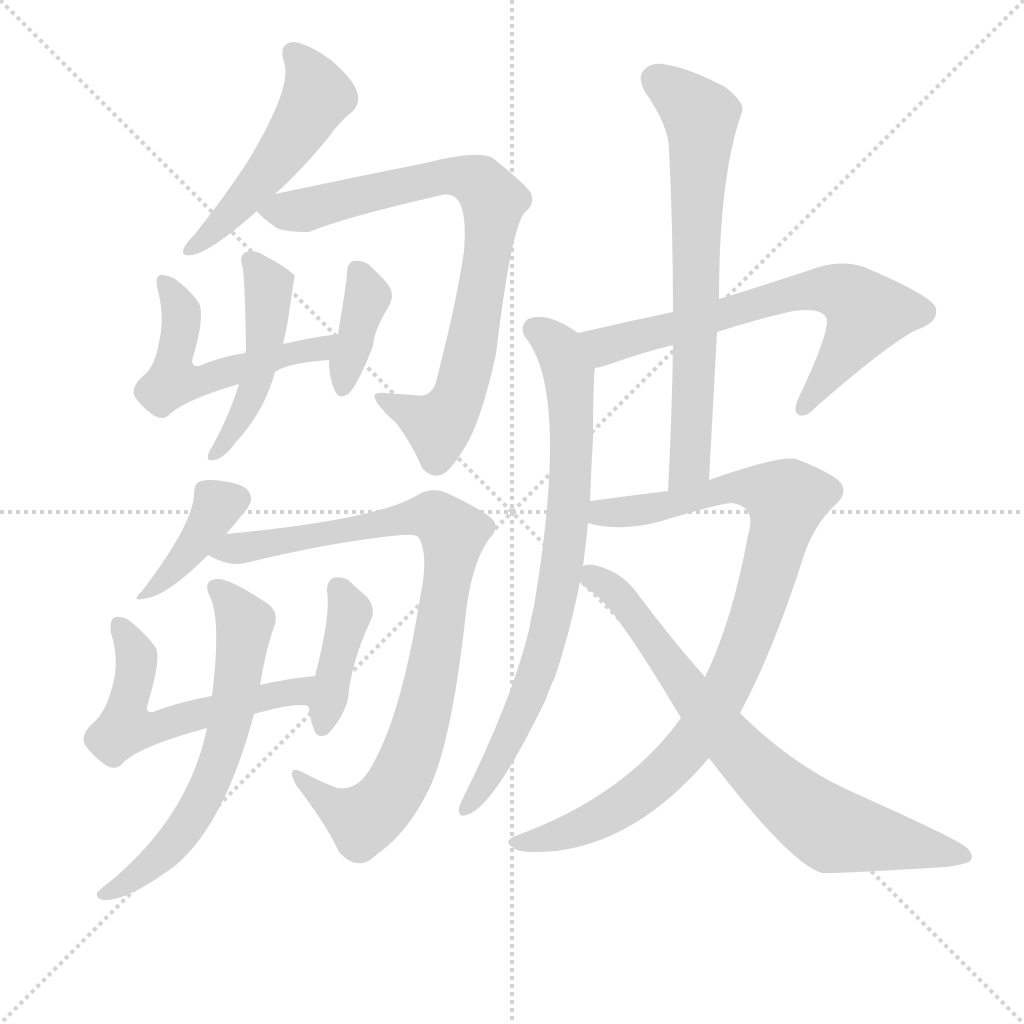
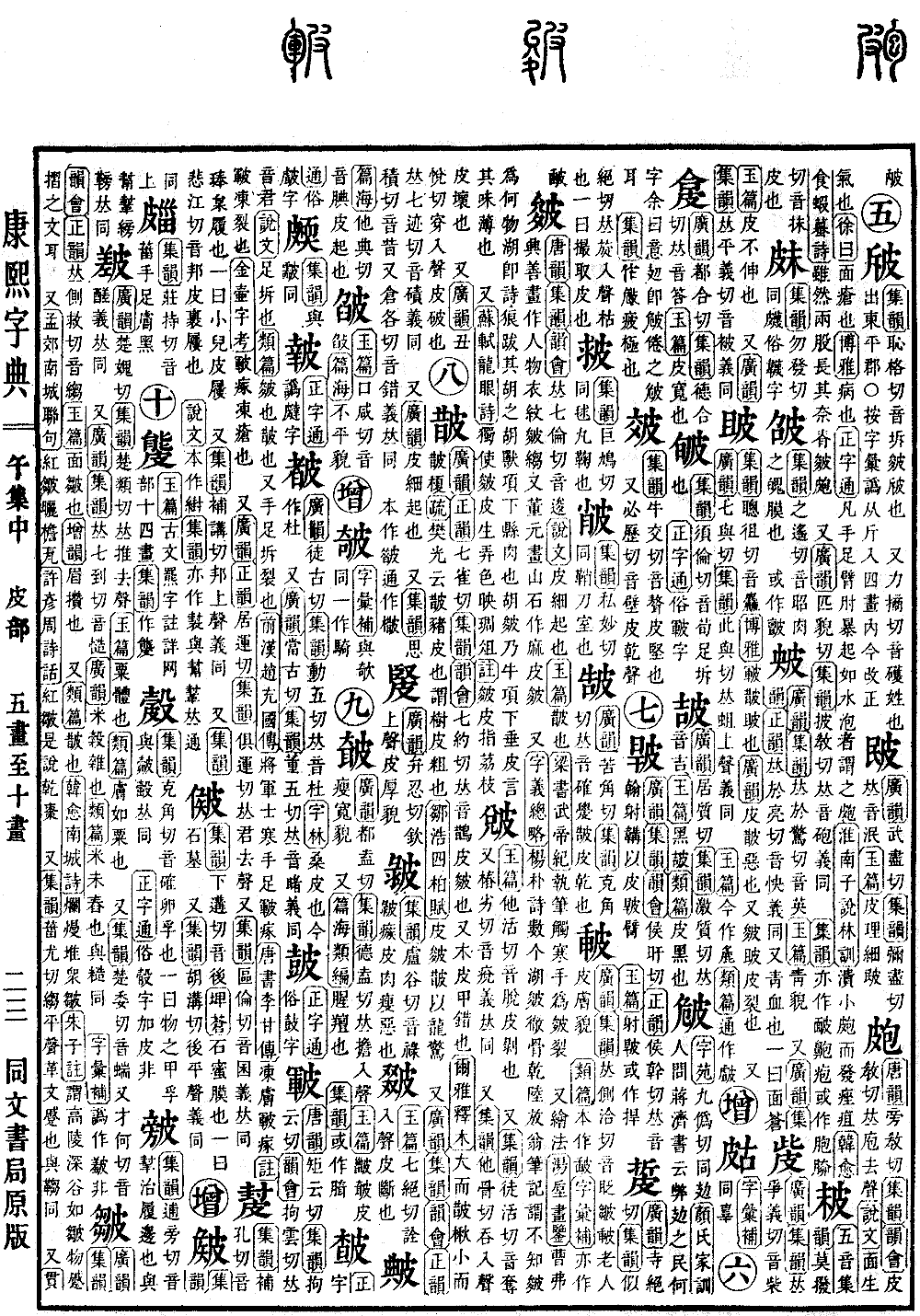
Wu Collection, Middle Volume. Radical: Skin (pí). Kangxi stroke count: 15. Page 791, Entry 46.
Broad Rhymes (Guangyun), Collected Rhymes (Jiyun), Rhyme Meetings (Yunhui), and Correct Rhymes (Zhengyun) state it is pronounced zhou (falling tone). Jade Chapters (Yupian) defines it as folds appearing on the skin of the face. Extended Rhymes (Zengyun) defines it as a knitted brow. The Categorized Chapters (Leipian) defines it as dry, cracked, or rough skin.
Han Yu’s Nancheng Poems: Cluttered piles of gathered wrinkles. Zhu Xi's commentary notes this refers to the towering mountain ridges and deep valleys resembling the creases on the surface of a shriveled object.
Meng Jiao’s Nancheng Linked Verses: Red wrinkles drying on the roof tiles. Xu Yanzhou’s Remarks on Poetry states that red wrinkles refers to dried dates.
Collected Rhymes (Jiyun) also provides the pronunciation zhou (level tone). It refers to the tightly compressed texture on the surface of leather. It is identical to the variant form (zhou).
Guanxiu’s Villa by the Lake Poems: A hungry mouse lifts the water caltrop shell, a new cicada avoids the chestnut wrinkle. The note explains that chestnut wrinkle refers to a chestnut burr. The rhyme for the upper character is tou, and the lower character is xiu.
Jade Chapters (Yupian) notes it is also written in the variant form (zhou). The Supplement to the Dictionary (Zihuibu) also notes it is written in the variant form (zhou). It is commonly written in the variant form (zhou).