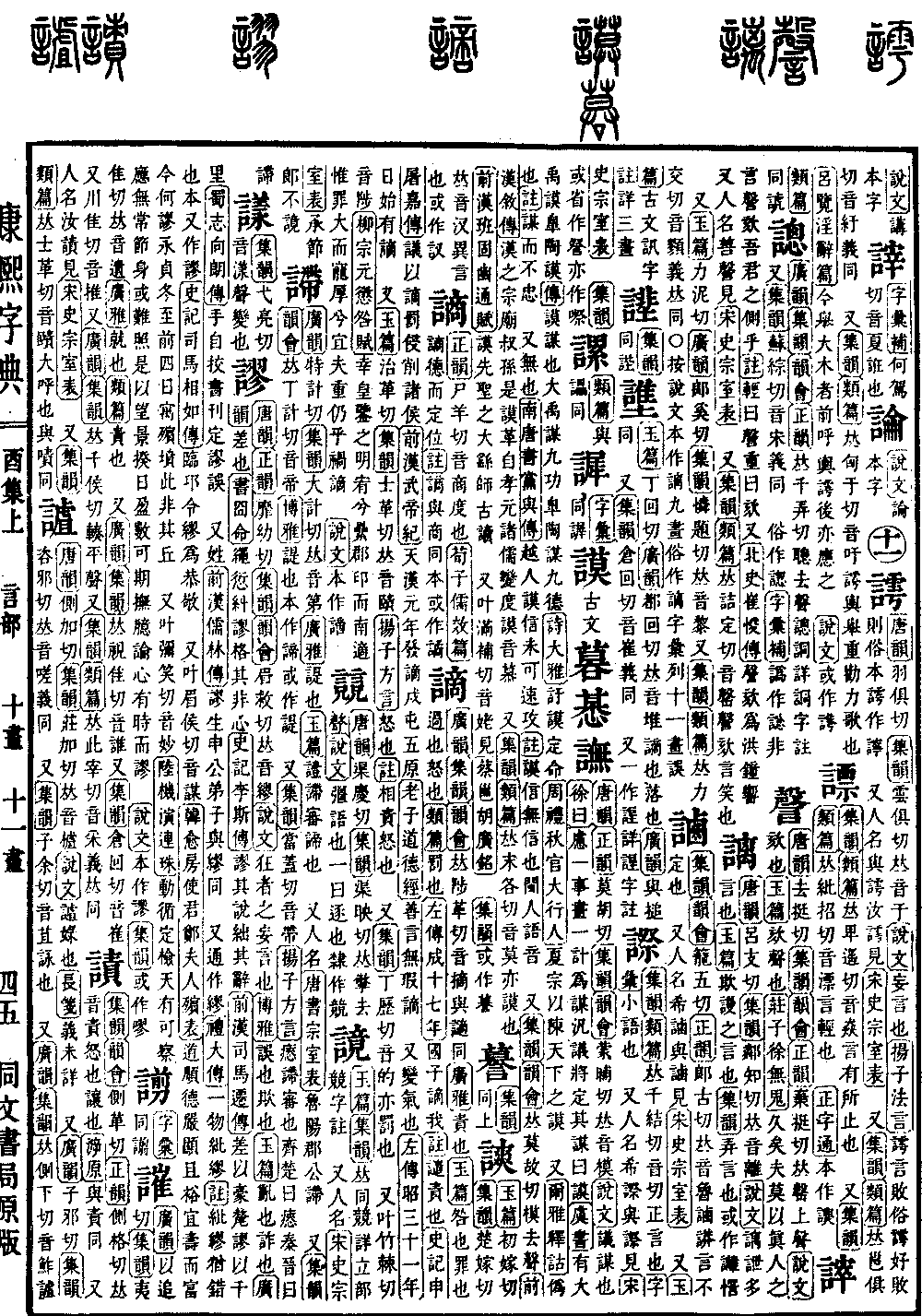
You Collection, Upper Volume
Radical: Speech (yán)
Kangxi Strokes: 18
Page 1177, Entry 22
Pronounced zhāi. Same as the character variant (zhé).
According to the Expanded Glosses (Guangya), it means to rebuke.
According to the Jade Chapters (Yupian), it means blame, crime, error, or anger.
According to the Classified Chapters (Leipian), it means to punish.
As recorded in the Zuo Commentary (Zuozhuan), Year 17 of Duke Cheng: The State Master rebuked me. The commentary states: This means to reprimand.
As recorded in the Records of the Grand Historian (Shiji), Biography of Shentu Jia: Discussing punishment by exile, encroaching upon and diminishing the feudal lords.
As recorded in the History of the Former Han (Qianhan), Annals of Emperor Wu: In the first year of the Tianhan era, they sent those punished by exile to guard the frontiers at Wuyuan.
As recorded in the Laozi (Daodejing): Those skilled in speech have no flaws or faults.
It also refers to atmospheric irregularities. As recorded in the Zuo Commentary (Zuozhuan), Year 31 of Duke Zhao: The sun began to show irregularities.
Also, according to the Jade Chapters (Yupian), pronounced zé. According to the Classified Chapters (Leipian), pronounced zé.
According to the Master Yang's Regional Dialects (Fangyan), it means anger. The commentary states: To mutually reproach in anger.
Also, according to the Classified Chapters (Leipian), pronounced dí. It also means to punish.
Also, rhyming with the syllable zhí. In the Prose-poem on Repenting Faults (Chenggiu Fu) by Liu Zongyuan: Fortunately, the Imperial mirror clearly grants leniency, yet I am burdened with the prefectural seal and move to the south. Because my crimes are great and the favors are abundant, it is fitting that I endure repeated disasters and rebukes.
The Original Script (Shuowen) states: This was originally written as the variant form.